AI Ethics News — 2026-10-15 (Thu) Morning News
Source links point to the original outlet. The AI Integrated Analysis is auto-generated from the headlines below only and is not intended to add facts beyond them. Not investment advice.
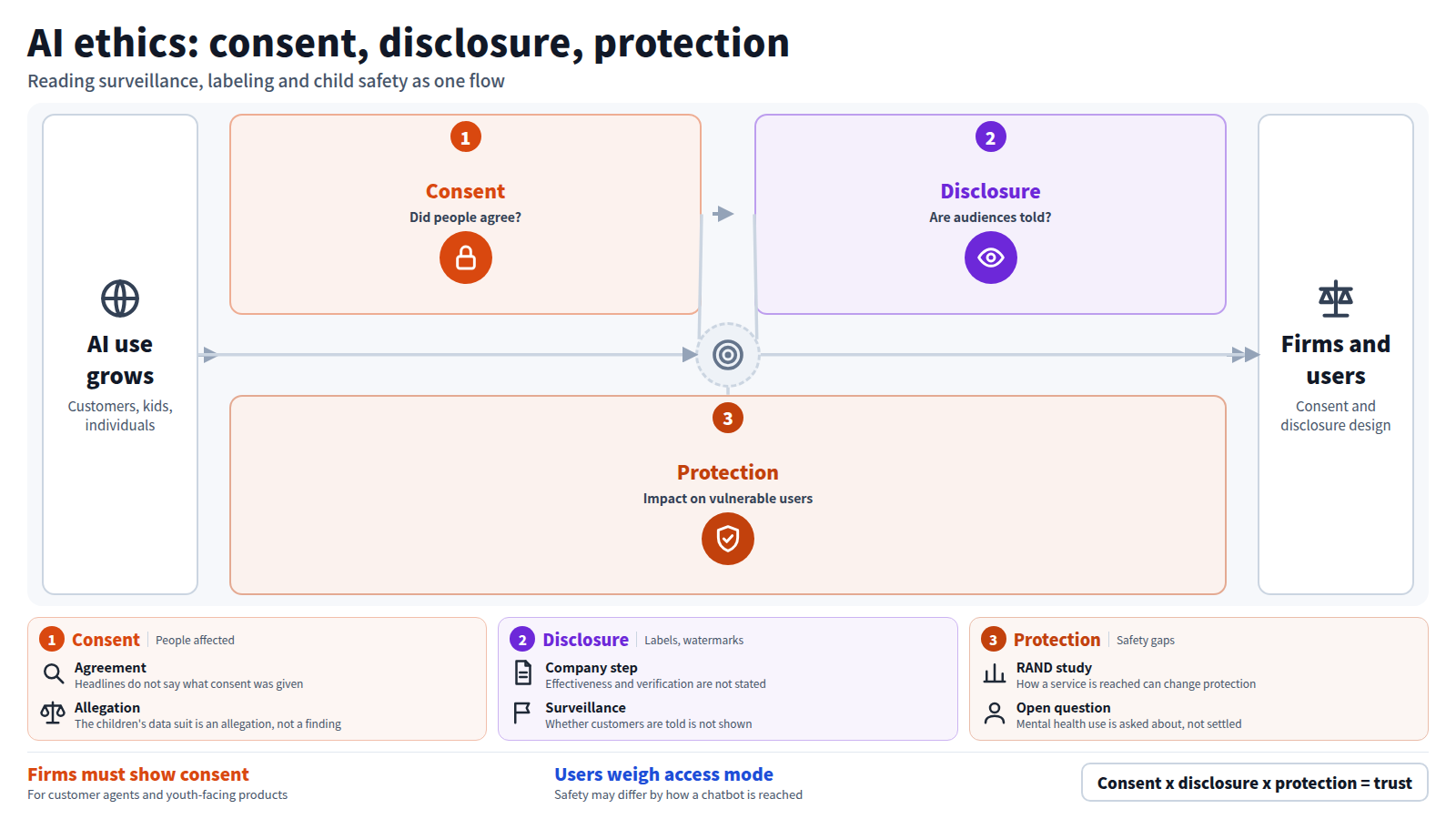
Overview
The questions that surfaced were how data from children and consumers is collected and used, and who is protected when chatbots enter mental health and companionship (Futurism, Telehealth.org, Newswise). Surveillance by AI agents and disclosure of AI-generated content were also in the news (Futurism, The Decoder, Mashable, media-marketing.com). 【Bias, discrimination and fairness】 - The Conversation asks whether AI can feel safer than human advice for consumers who face discrimination (The Conversation). - Amina Bouayach warned of AI risks to human rights at a conference in Athens (Morocco World News). - The headlines give no measurement method or scale for either item.
Privacy and surveillance
- A Y Combinator startup is reported to say "Every Company Will Soon Assign an AI Agent to Every Customer to Watch Their Every Move" (Futurism). - An alleged OpenAI spy is reported to have vibe-coded a surveillance device using his wife's chatbot account (The Decoder). - An opinion piece by Henry Mack and Grazie Pozo Christie argues that Florida will not outsource childhood to a chatbot (Florida Politics). - Personal AI agents are raising concerns about financial privacy (Tri-State Alert). - The headlines do not say what consent was given for the data involved. 【Transparency and accountability】 - Unric frames the future of AI as everyone's responsibility (Unric). - IAB Discovery is discussing whether to label AI-generated content for the audience (media-marketing.com). - The headlines do not say what is disclosed or what remains undisclosed. 【Creators, copyright and consent】 No notable developments.
Disinformation and deepfakes
- OpenAI is adding an invisible watermark to AI-generated text (Mashable). The headline does not state how effective it is or how it can be verified. 【Protection of children and vulnerable people】 - OpenAI has been sued for allegedly building models out of children's "Fears, Hopes, and Secrets". This is an allegation, not a finding (Futurism). - A RAND study reports that AI chatbot suicide safety differs by access mode (Telehealth.org). - Newswise asks whether people should turn to AI for mental health advice (Newswise). - A study examines whether AI companion apps are good for mental health (Universidad de Córdoba). - The Florida opinion piece above raises the same concern for children (Florida Politics). 【Ethical principles and guidelines】 - Forrester urges organizations to embrace responsible AI to build a trusted future. This is a recommendation, not a decision (Forrester). - An AI ethics analysis argues that different goals call for different ethical approaches (Phys.org). - EFF's newsletter, titled "A Victory for Freedom of Speech Online", reports a win for online free speech. The headline gives no details (EFF).
Japan's AI ethics
- Vietnam.vn warns about sophisticated scams that combine AI and social media (Vietnam.vn). - A review of AI waifu generators covers output quality, features and privacy (Universidad de Córdoba). - No Japan-specific institutional developments appear in the material.
Statements by key figures
No notable developments. 【Integrated analysis: how the ethical questions connect】 - Consent is a common gap. Children's data, customer monitoring and financial data are each reported without clear sign of agreement from the people affected (Futurism, Tri-State Alert). This is an inference from the headlines. - Disclosure is also a shared gap. Watermarks and labeling are meant to make AI output identifiable, but the headlines do not show whether affected people can verify them (Mashable, media-marketing.com). - Chatbots appear to be used for mental health and companionship before safety is established. The RAND finding that safety differs by access mode suggests that how a service is reached can change the level of protection (Telehealth.org). - Companies may need to show consent and disclosure practices for customer-facing AI agents and youth-facing products. Users may need to weigh privacy against convenience when adopting personal AI agents. Both points are inference.
What to watch
How the lawsuit over children's data against OpenAI develops (Futurism). 2. Whether watermarking and labeling of AI-generated content spread, and how they are verified (Mashable, media-marketing.com). 3. Whether safety standards for chatbots used in mental health settings are consolidated across access modes (Telehealth.org).
- Can AI feel safer than human advice for consumers who face discrimination? — The Conversation10/14 14:17 UTC
- Amina Bouayach Warns of AI Risks to Human Rights at Athens Conference — Morocco World News10/14 17:47 UTC
- Y Combinator "Customer Surveillance" Startup Says "Every Company Will Soon Assign an AI Agent to Every Customer to Watch Their Every Move" — Futurism10/14 15:51 UTC
- Alleged OpenAI spy vibe-coded a surveillance device using his wife's chatbot account — The Decoder10/14 12:43 UTC
- Henry Mack, Grazie Pozo Christie: Florida will not outsource childhood to a chatbot — Florida Politics10/13 21:20 UTC
- Personal AI agents raise concerns about financial privacy — Tri-State Alert10/13 21:57 UTC
- The Future of AI Is Everyone's Responsibility — Unric10/13 21:13 UTC
- To Label or Not: IAB Discovery Puts AI-Generated Content Before the Audience — media-marketing.com10/14 14:00 UTC
- OpenAI Sued for Allegedly Building Models Out of Children’s “Fears, Hopes, and Secrets” — Futurism10/14 13:04 UTC
- AI Chatbot Suicide Safety Differs by Access Mode: RAND Study — Telehealth.org10/14 08:00 UTC
- Should you turn to AI for mental health advice? | Newswise — Newswise10/14 13:55 UTC
- Are AI Companion Apps Good For Mental Health Study — Universidad de Córdoba (UCO)10/14 09:49 UTC
- Embrace Responsible AI To Forge The Trusted Future — Forrester10/14 12:42 UTC
- AI ethics analysis clarifies why different goals call for different ethical approaches — Phys.org10/14 15:30 UTC
- Beware of sophisticated scams that combine artificial intelligence and social media. — Vietnam.vn10/14 15:46 UTC
- AI Waifu Generators: Output Quality, Features and Privacy — Universidad de Córdoba (UCO)10/14 14:48 UTC
- 🗣 A Victory for Freedom of Speech Online | EFFector 38.18 — EFF10/14 16:25 UTC