AI Highlights — the whole picture — 2026-10-15 (Thu) Morning News
Source links point to the original outlet. The AI Integrated Analysis is auto-generated from the headlines below only and is not intended to add facts beyond them. Not investment advice.
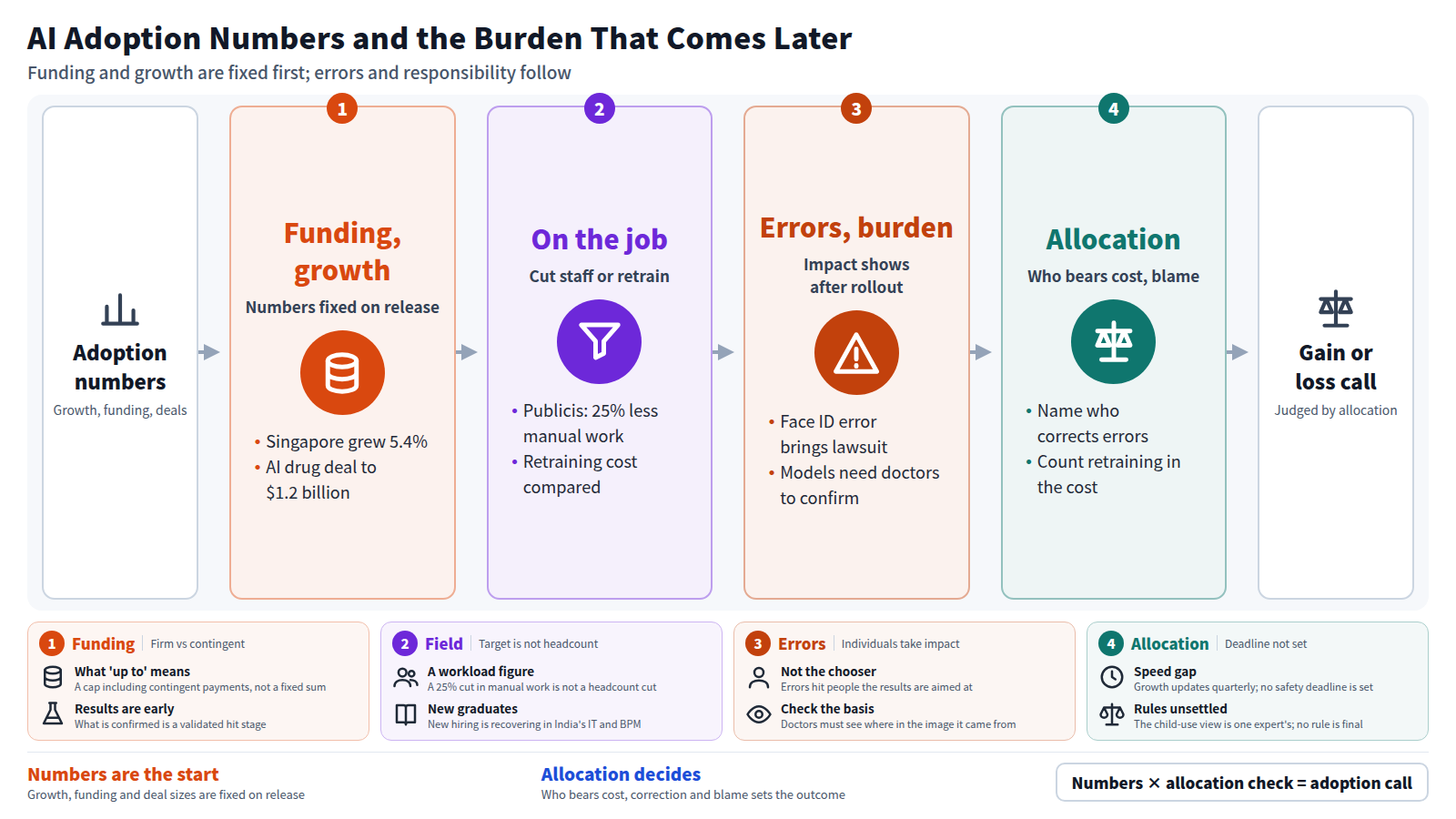
AI funding and growth numbers are updated significantly every quarter. Singapore recorded 5.4% growth on the back of AI demand, with AI drug discovery partnerships worth up to $1.2 billion signed. Meanwhile, employment remains uncertain after Publicis promised to cut manual labor by 25%, and a grandmother who sued over facial recognition errors is seeking $10 million. The speed at which funds are raised and the speed at which affected people learn of the burden are not at the same time. Below, read the scale of the numbers alongside the strain it is already placing on the field, on individuals, and on safety measures. The extent to which the effects of introduction should be recognized cannot be determined until we consider who will be responsible for allocating the costs and responsibilities.
Workplace swinging between personnel reductions and retraining
Publicis has set a goal of reducing manual labor by 25% through AI, but the impact on employment reportedly remains unclear (Storyboard18). The numbers show a reduction in workload, not a reduction in headcount. However, once a quarter of the manual labor is eliminated, it has not yet been decided whether the same people will use that time to do other work, or whether the number of people will be revised. If you try to figure out how many people will be reduced by looking only at the target value, you will easily make mistakes in your judgment.
Even with the same introduction, trends in the field are starting to diverge. It has been reported that HSBC and Kroger are increasing the number of layoffs due to AI, and the cost comparison with retraining is being discussed (AICERTs). While retrenchment lowers short-term labor costs, retraining requires training costs and time. Which one is cheaper depends on the scope of the work being replaced and whether the remaining staff can take on the new work. When readers look at their companies and workplaces, they need to look not just at the amount of cuts, but also at the cost of reskilling and who will be responsible after the cuts are made.
The direction of change is somewhat different in the job fields for new graduates. The Economic Times reports that the job categories for new graduates are changing due to the trend of placing more emphasis on AI skills, and that the number of new hires in India's IT and BPM fields is recovering. It is easy to imagine that if introductory manual work is transferred to AI, jobs for new employees will be lost first, but the fact that there are cases of hiring returning shows that some companies are allocating funds toward training human resources who can handle AI. Here, how AI literacy is developed is a variable that determines the impact on employment.
The range of users is also expanding. The OpenAI Forum is said to have held discussions on the use of AI for public opinion polling experts (EdTech Innovation Hub). The fact that the discussion of utilization has extended to professional occupations shows that reskilling is not an issue limited to specific occupations. Additionally, the 2026 edition of the AI Implementation Report (Knowledge at Wharton) will also serve as material for checking the actual state of implementation. Effects cannot be measured simply by the fact that introduction has progressed; results cannot be compared unless we also look at whether they were used for reduction or training.
The choice between reductions and growth is not only a question of corporate finances, but also of allocation, as to who will take on the costs and responsibilities first. In the next section, we will see how this distribution manifests itself in terms of individuals and safety.
Chain of funding and collaboration for drug discovery
From small private placements to government procurement, funding for AI drug discovery flows through different channels at each stage. Canada's Rakovina Therapeutics (TSXV:RKV) has completed a C$1.99 million private placement and explains why it will direct the funds toward AI-driven cancer drug discovery (kalkine.ca). Although the scale is small, it is an example of the first stage of raising funds for AI and allocating it to research.
On the partnership and contract side, the numbers go up a notch. Deep Origin has announced a multi-target AI drug discovery collaboration with BioAge Labs, saying it has confirmed a validated hit on the first target (Yahoo Finance Singapore). ITOCHU Corporation has signed a capital alliance agreement with MOLCURE Inc. (BioSpectrum Asia) for AI drug discovery in Japan. Zealand Pharma and Generate sign up to $1.2 billion AI obesity drug deal (WTVB). The expression "maximum" here should be read as referring to an upper limit that includes the amount payable subject to performance conditions. Although the headline contract amount may be large, a fixed payment and a future conditional amount are two different things.
The flow of funds is not limited to the private sector. ThinkTrends has been awarded a $49 million IDIQ contract from the U.S. Food and Drug Administration (FDA) to support AI and data implementation (The Globe and Mail). Regulators themselves will be procuring AI and data infrastructure. On the market side, Nuvin Asset Management, which manages $2.6 trillion, released a market commentary stating that AI is reshaping the economic structure of the biopharmaceutical industry. Regarding the life science IT market, an analysis suggests that IQVIA, Oracle, Accenture, Veeva Systems, and SAP are targeting $82.24 billion by 2035 (Yahoo Finance UK). Furthermore, Nanyang Biologics, a USD 1.5 billion AI drug discovery biotech in Singapore, was reported to be listed on the Nasdaq (The Business Times).
If you look at them side by side, what is ahead is funding, valuation, and contract value, and what can be seen as results are only early-stage results such as Deep Origin's ``verified hit''. Confirmation of a hit is the beginning of the long process of drug discovery, and just the announcement of a listing or a large contract does not indicate the accuracy of subsequent clinical trials or approval. Readers should look at the breakdown of the firm and contingent portion of the contract amount, and whether the funds are tied to verified results. The next section looks at how these financial movements redistribute costs and responsibilities in the field.
Trust in predictive models that support diagnosis and treatment
Predictive models that use images and multimodal data are moving away from the research stage and closer to the clinical pathway. For upper tract urothelial cancer, a multimodal clinical decision support system, CLIP-CGPNet, for predicting postoperative recurrence was reported (Journal of imaging informatics in medicine). For breast cancer, HCF-Net, which preoperatively classifies molecular subtypes from dynamic contrast-enhanced MRI, is configured as a cascade fusion along the clinical treatment pathway (same journal). In the case of mucinous adenocarcinoma of the lung, some research has been published to classify subtypes and predict prognosis by integrating multimodal data (translational cancer research). What all three have in common is that they place the model at a specific point in the decision-making process, such as whether to choose before or after surgery. It is necessary to check not only the accuracy numbers but also which situations should be replaced or supplemented.
On the other hand, whether doctors accept the answers provided by the model remains a separate issue. Explainability and clinical trust are being addressed squarely in the use of deep learning to predict treatment response for glioblastoma (Journal of imaging informatics in medicine). Research to predict P53 mutant hepatocellular carcinoma using MRI radiomics is targeting not only the inside of the tumor but also the area around the tumor (translational cancer research). An interview with UMass Chan Medical School about AI in radiology also positions the technology from the perspective of doctors who read images. It is not enough for the prediction to be accurate, but a prerequisite for practical use is for doctors to be able to confirm where in the image the prediction was based.
The same concept exists outside of medicine. It is reported that AI-equipped drones are being used by producers not only for patrolling crops, but also for a wider range of uses (Growing Produce). Even if field observations become more precise, it is up to the producer to decide how to use that information to make decisions about operations and inputs. Whether it's diagnostics or agriculture, the value of an installation depends less on performance numbers and more on how the field handles its output and who takes over when something goes wrong. This is directly connected to the next question, which is to look at the effects of technology including the allocation of costs and responsibilities.
Request for drawing the line to protect individuals and children
Facial recognition misidentification has already been brought to court. A grandmother who was mistakenly identified as the perpetrator of a bank theft using AI facial recognition has filed a lawsuit seeking $10 million in compensation, ABC News reports. This means that the decision to link a person to the culprit began with the machine's matching results. In the area of mental health, South Korea announced safety guidelines for mental health AI (Healthcare IT News). This is an example of a government documenting how far it can be left to AI before its use becomes widespread. Whether it's facial recognition or counseling support, errors affect the individuals who receive the results, not those who choose the system. Those considering the introduction need to check not only the accuracy numbers, but also who can correct errors and who will take responsibility when they occur.
In the type of AI that creates relationships, the object of drawing is closer to the user's inner self. Universidad de Córdoba (UCO) says its AI girlfriend app has personality settings and privacy features. While the system that allows users to choose their personality suits the user's preferences, it also raises the issue of how to handle records of intimate conversations. Regarding children, an expert wrote in Florida Politics arguing that Florida should not entrust children to chatbots. This contribution represents the opinion of an individual expert and does not imply that regulations have been finalized. However, having privacy features and being able to interact with minors are two different questions. Parents, schools, and providers need to decide on the scope of use for each age group, apart from the presence or absence of functions.
Techniques for reading emotions and biases can also be used to support such judgments. Optimizations inspired by wolf behavior have improved the performance of speech emotion recognition across languages, according to Bioengineer.org. If emotions can be handled in different languages, the situations in which it can be used will expand. However, those implementing the system are required to verify that the system does not misidentify people with specific languages or speaking styles. Penn Today reports on efforts to use AI to detect media bias and use it as a basis for voters and readers' decisions. Unless we make sure that the criteria used to judge bias are not biased, this tool may not help readers make decisions, but instead may force them to view a certain way. For both emotion recognition and bias detection, the question is whether to use them after disclosing the basis for the judgment and the tendency for errors, rather than relying on the results as is.
What we have seen so far is that in situations where harm first occurs to individuals, it is necessary to decide first who will investigate and who will take responsibility. Next, we look at how those costs and responsibilities are distributed among companies and society.
Time axis of growth, politics and security measures
Singapore posted 5.4% growth on the back of AI demand, with monetary policy unchanged (Bloomberg.com). While the numbers are strong, they only show that the demand-side tailwinds showed up in the statistics first. Around the same time, an AI funding group reportedly supported Scott Wiener's run for Congress with $3 million (Mission Local). Through funding, the distance between those who receive the fruits of growth and those who decide the rules is narrowing. Meanwhile, Harris warned that there is little time left for AI security measures and urged cooperation between the United States and China (Reuters). Growth rates are updated quarterly and elections remain on schedule, but no one has set a deadline for security measures. The starting point for this section is the point where three different time axes are moving side by side.
This time difference is also reflected in the on-site schedule. Nursing home operators Cascadia, CarDon, and FellowshipLIFE talked about their roadmap for using AI (Skilled Nursing News). The attitude of proceeding with implementation in stages shows that the system is operating on an operational time scale that is independent of the speed of growth or elections. On the creative side, Air held a rooftop event with artist Joe Bloom to talk about AI and creativity (Ad Age). Work schedules for nursing care and opportunities for dialogue in creative writing are trying to organize the way things are perceived in each field.
Now, let's change the location of the question. The AI robot that appears in Marvel's "Vision Quest" poses the question of whether machines can think for themselves (Moneycontrol.com). Although this is a fictional story, it overlaps with the question of drawing the line between what should be left to machines and what should be handled by humans when readers decide to introduce it. Growth rate figures and political funding amounts do not draw the line for us.
Returning to the reader's judgment, what we should be looking at is not the size of the numbers, but what speed the moving object is and which burden will be applied first. If Harris' warnings are correct, the grace period could be shorter than the timetable on the ground. However, the length of the moratorium is not set in stone, and remains within the range he described as a warning. Whether or not the debate catches up with the pace will eventually come back to the question of allocation: who will bear the costs and responsibilities.
The cases treated in each section have a common arrangement. The growth rate, amount of funding, and scale of the partnership will be finalized as numbers at the time of announcement. On the other hand, the handling of personnel, decisions replaced by predictive models, corrections and responsibilities when errors occur, and deadlines for safety measures are determined after implementation. The burden appears first on the latter side, and it is the people in charge of the field and the individuals to whom the results are directed that receive the burden. Therefore, the effectiveness of introduction cannot be judged by independent figures such as reduction amount, accuracy, and growth rate. Only by confirming who will pay for it, who can correct mistakes, and who will take responsibility, will it be possible to determine whether the same implementation will be a benefit or a detriment for us. The size of the numbers remains the starting point, and the focus of judgment is on allocation.
Q1: Who in your workplace decides to allocate the time and effort freed up by AI to what tasks? Q2: When AI produces incorrect results, are there procedures for finding and correcting them and who is responsible in writing? Q3: Do the numbers that measure the effectiveness of the introduction include the cost of retraining, the cost of dealing with errors, and the burden on those affected?
Finally, three questions
- Who in your workplace decides to allocate the time and effort freed up by AI to what tasks? Q2: When AI produces incorrect results, are there procedures for finding and correcting them and who is responsible in writing? Q3: Do the numbers that measure the effectiveness of the introduction include the cost of retraining, the cost of dealing with errors, and the burden on those affected? - When AI produces incorrect results, are there procedures for finding and correcting them, and who is responsible in writing? Q3: Do the numbers that measure the effectiveness of the introduction include the cost of retraining, the cost of dealing with errors, and the burden on those affected? - Do the numbers measuring the effectiveness of implementation include the cost of retraining, the cost of dealing with errors, and the burden on those affected?
📚 Sources (all material)
Every item this issue drew on. External links open in a new tab. 32 items.
AI and the Economy
AI and Finance
Living and Working with AI
AI and Healthcare
AI, Welfare and Long-term Care
AI and International Politics
AI Around the World
AI, Philosophy & Thought
AI, Arts & Creativity
AI in Medicine (Cancer Care, Rare Diseases)
AI and Agriculture
AI Regulation, Safety and Geopolitics
AI and the Pharma Industry
- Why Rakovina Therapeutics Inc. (TSXV:RKV) Is Funding AI-Led Cancer Drug Discovery After Raising C$1.99 Million in a Private Placement — kalkine.ca
- Deep Origin Announces Multi-Target AI-Driven Drug Discovery Collaboration with BioAge Labs; Validated Hits Confirmed against First Target — Yahoo Finance Singapore
- ITOCHU Corp signs capital alliance agreement with MOLCURE Inc. for AI-based drug discovery in Japan — BioSpectrum Asia
- Nuveen Asset Management released a market commentary stating that artificial intelligence (AI) is reshaping the economic structure of the biopharmaceutical industry. Nuveen manages assets of 2.6 trillion dollars (about 4008 trillion won). — 매일경제
- Global Life Sciences IT Market Opportunities and Strategies to 2035 | Capitalize on AI, Cloud and Bioinformatics as IQVIA, Oracle, Accenture, Veeva Systems and SAP Target $82.24B — Yahoo Finance UK
- Nasdaq listing awaits Singapore’s US$1.5 billion AI drug-discovery biotech Nanyang Biologics — The Business Times
- Zealand Pharma, Generate strike AI obesity drug deal worth up to $1.2 billion — WTVB
- ThinkTrends Lands $49 Million IDIQ Contract from the U.S. Food and Drug Administration for AI and Data Implementation Support — The Globe and Mail
AI and Cancer Research
- CLIP-CGPNet: A Multimodal Clinical Decision Support System for Postoperative UTUC Recurrence Prediction. — Journal of imaging informatics in medicine
- HCF-Net: a Hierarchical Cascade Fusion Network Aligned with Clinical Treatment Pathways for Preoperative Molecular Subtyping of Breast Cancer on Dynamic Contrast-Enhanced MRI. — Journal of imaging informatics in medicine
- Integrating multimodal data for precise subtyping and prognostication in patients with pulmonary mucinous adenocarcinoma. — Translational cancer research
- Explainability and Clinical Trust of Deep Learning in Glioblastoma Treatment Efficacy Prediction: A Comprehensive Framework. — Journal of imaging informatics in medicine
- Magnetic resonance imaging-based radiomics for predicting P53-mutated hepatocellular carcinoma: intratumoral and peritumoral analysis. — Translational cancer research