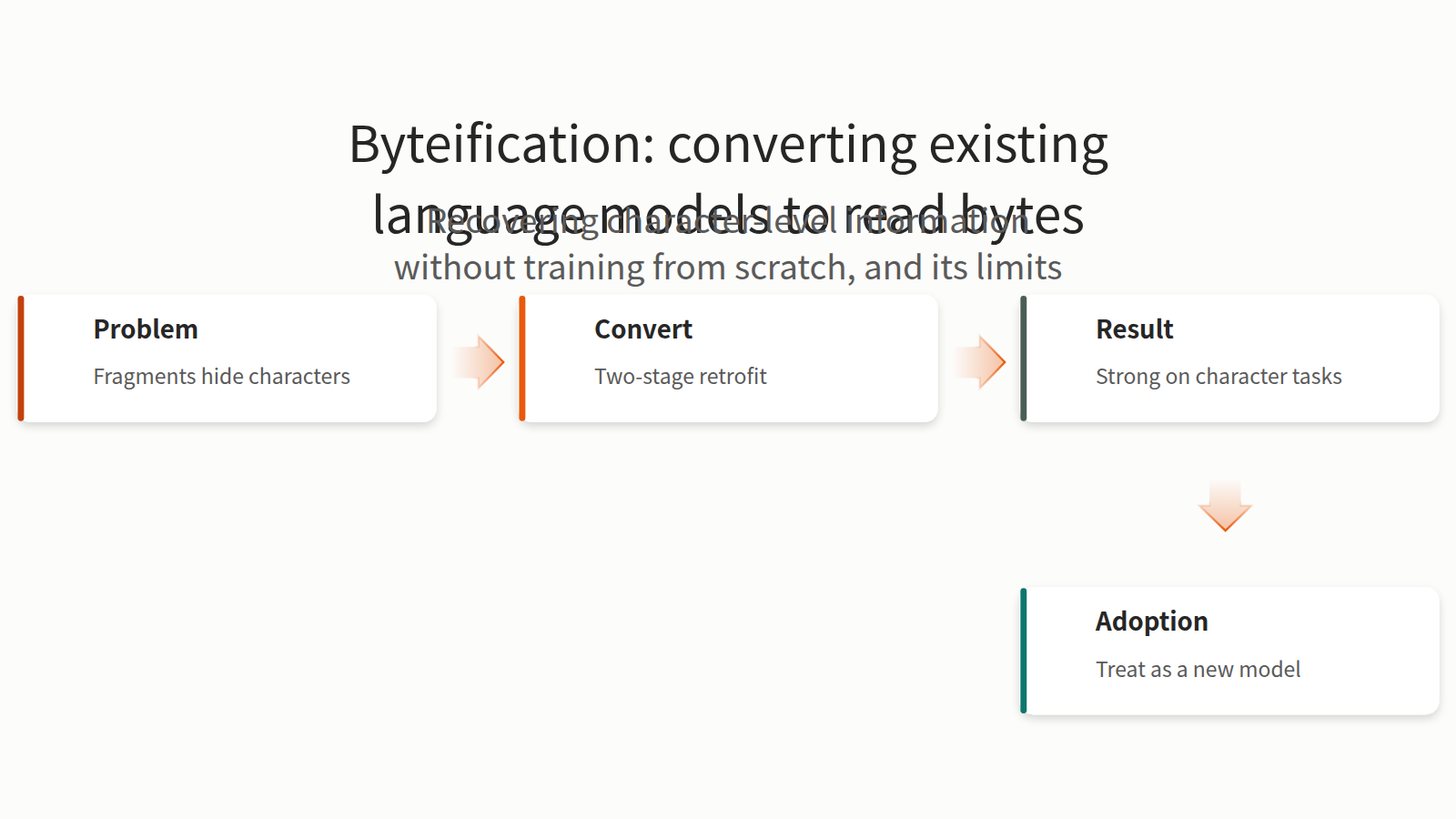
1. What problem does the paper address?
Today's large language models do not read text as it is. They split it into tokens, and most use subword tokenization, in which a token is a word or a word fragment. This is efficient, but it hides information at the level of individual characters inside each fragment.
This paper, published in Nature after peer review, takes that as its problem. The abstract says subword tokenization obscures fine-grained information, which matters most for scientific data such as computer code or biological sequences, where meaning depends on individual characters or bytes[1].
Anyone who handles names, sequences or identifiers knows this weakness. A drug name that differs by one letter, a single residue swapped in an amino-acid sequence, a transposed character in a lot number: these are exactly the differences a fragment-level reader can miss.
Models that read the raw bytes avoid the problem. But, the abstract says, such byte-level models have until now lagged behind subword models in performance.
2. What does it propose?
The core idea is not to train a byte-level model from scratch but to convert an existing subword model into a byte-level one. The authors call this byteification. According to the abstract, a two-stage conversion procedure retrofits existing subword models into byte-level models with minimal extra training[1].
An explainer from Ai2, where several of the authors work, gives more detail on the two stages. In the first, the original model's main body is frozen and only the newly added parts are trained: the components that read and write bytes and a component that predicts where to place boundaries in the byte stream. In the second, the whole model is unfrozen and training continues[2].
The advantage the abstract stresses is adaptability through reuse of the existing ecosystem around the source model. Because nothing is built from zero, the knowledge in the original model and the tooling built on top of it can be carried over, the authors argue.
3. What did it show, within the abstract?
The abstract reports the following[1].
- Byteified models approach the capabilities of subword-based systems. The word is "approach," not "exceed."
- They outperform earlier byte-level approaches.
- They excel on character-level reasoning tasks.
- They reach practical inference speeds by processing byte-level information efficiently.
- They adapt easily because the source model's ecosystem can be reused.
On this basis the authors claim to remove a long-standing performance barrier for byte-level language modelling, and conclude that models reading raw text encodings can scale competitively. Note that the abstract names no specific benchmarks and gives no figures. Which model sizes, which tasks and how large the differences were cannot be read from the abstract.
4. A worked example
Consider checking package inserts or internal documents that involve similar drug names or sequence data.
A subword model
Drug names and sequences are cut into fragments that need not match any meaningful unit. Two names that differ by a single letter can end up as similar fragment strings. For questions like "how often does this pattern occur in the sequence?" or "which character differs between these two names?", the hidden interior of fragments can be the source of error.
A byteified model
Text is read one byte at a time, so a one-letter difference is not lost at the input. This is the kind of question the abstract means by character-level reasoning. On the other hand, a finer reading unit makes the input sequence longer for the same text, which is why the method needs ways to keep speed practical.
The abstract does not say the paper evaluated drug names or pharmaceutical documents. The contrast above only shows that the same kind of problem the abstract names, code and biological sequences, also appears in daily pharma work.
5. What is not new, and where are the limits?
Language models that read bytes directly are not a new idea. The abstract itself compares against "earlier byte-level approaches," and the Ai2 explainer lists prior byte-level models as baselines[2]. What is new is the route: starting from an existing subword model and converting it with little additional training.
Several limits can be read off the material.
- "Approach," not "match." The abstract does not claim parity with subword models on general tasks. The Ai2 explainer likewise says its model comes close to the original across a broad evaluation suite[2].
- The speed baseline is unstated. The abstract says "practical inference speeds" without saying practical relative to what. The Ai2 explainer notes decoding is somewhat slower than the original subword model[2].
- The source model is inherited. Because this is a conversion, it is reasonable to expect the source model's biases and weaknesses to carry over. How much carries over is not shown in the abstract.
- No evaluation in Japanese is visible. In UTF-8 a Japanese character takes several bytes, so inputs grow longer than in English. Performance and speed for Japanese are not shown within the abstract.
- Not every model family may fit. The Ai2 explainer notes that a trick for transferring post-training weights depends on compatibility that is not guaranteed for every model family[2].
6. How was the paper covered?
This site's selection step listed two outlets for the paper: Nature and Allen AI (Ai2). Nature's headline is the paper title itself; Ai2's reads "Now in Nature: Retrofitting language models to operate over bytes."
Counting these as independent coverage calls for caution. The first is the journal's own article page; the second is an announcement from the authors' institution. Neither tells us how third parties received the paper's claims. There is no gap between headline and paper to examine yet, because there is no outside headline to compare.
The timeline matters too. The same method was released first in December 2025 as a preprint on arXiv and in an Ai2 explainer, with models and code made public[2][3][4]. The code repository now announces that the work has been published in Nature[4]. This publication is better read as a previously released method passing peer review than as a new method appearing. Differences between the preprint and the Nature version were not checked line by line for this article.
Publication in a peer-reviewed journal, and ranking high in this site's selection, do not establish that the method is correct or practically valuable.
7. Where does this connect to pharma and regulatory work?
The abstract explicitly names biological sequences, which connect directly to drug discovery. When language models handle amino-acid or nucleotide sequences, keeping single-character information matters. Text notations for chemical compounds and line notations for structures share the same property. These domains are not evaluated in the abstract, though, so any benefit has to be checked case by case.
In document work, the relevant tasks are preventing mix-ups between similar drug names and catching inconsistent spellings. Not missing a one-character difference is a property needed in reviewing promotional materials and reconciling safety information.
From a regulatory angle, a model whose tokenization has changed should be treated as a different model from its source. If a company has validated a system built on an LLM, switching to a byteified version is subject to re-evaluation even when the names look alike. How easy the conversion is and how much verification it requires are separate questions.