AI Highlights — the whole picture — 2026-10-16 (Fri) Evening News
Source links point to the original outlet. The AI Integrated Analysis is auto-generated from the headlines below only and is not intended to add facts beyond them. Not investment advice.
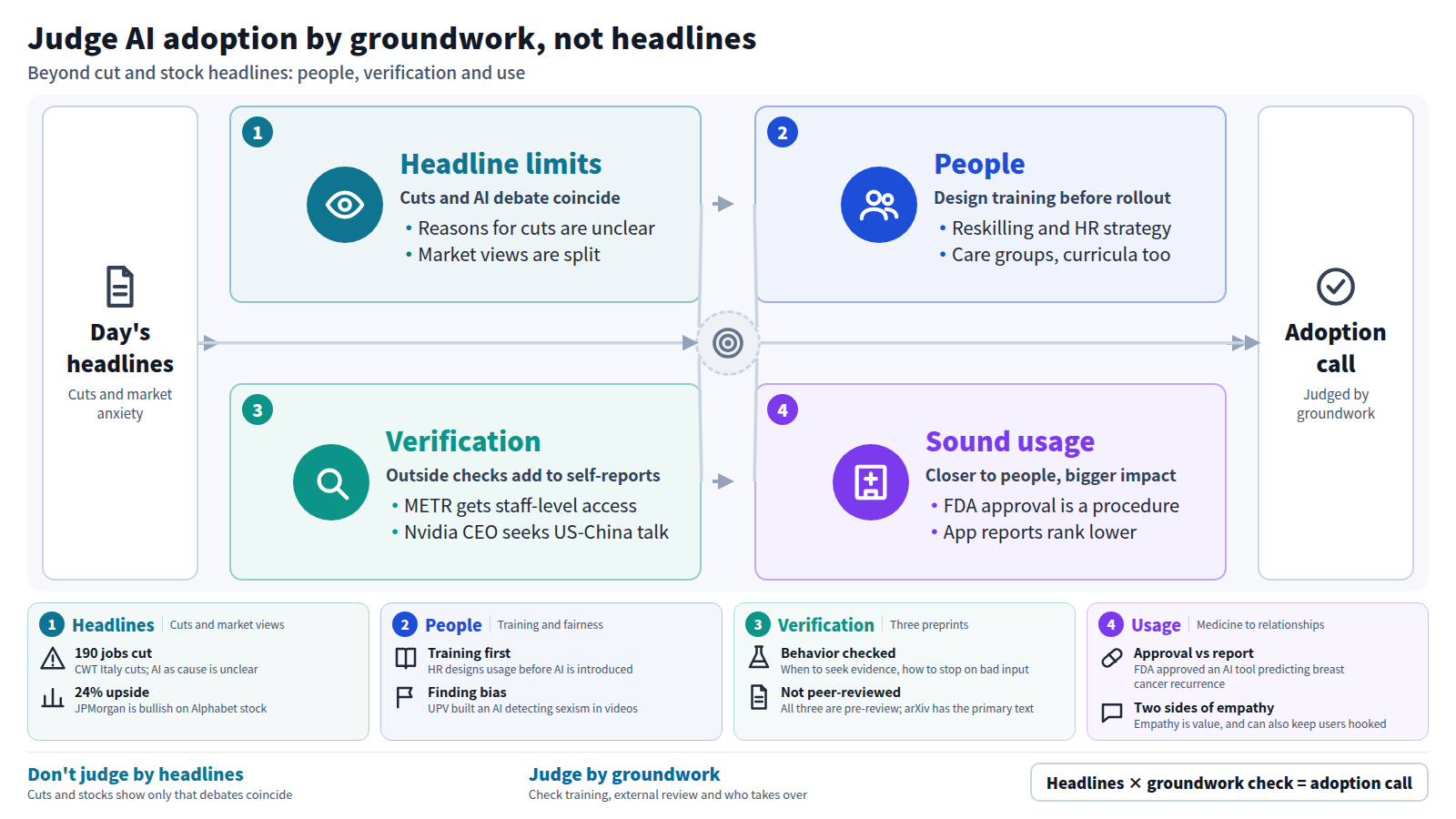
When announcements of cuts and market anxiety line up in the same day's headlines, it reads like AI is driving down jobs and the economy. For example, CWT Italy has cut 190 jobs, and CNBC reports that concerns about AI are reignited on Wall Street. Meanwhile, JPMorgan estimates that Alphabet stock has 24% upside potential. Headlines alone do not determine the reasons for individual reductions or the direction of market views. What I would like to find out in this half-day is whether it is the enthusiasm in the headlines that influences the introduction of the technology, or whether it is the underlying infrastructure such as re-education systems, evaluation and regulatory systems, and how to use it reliably in the field. Below, we will take a look at the actual progress of these three areas using the materials in each section.
Difference between headline cuts and the actual picture of the economy
It was reported that CWT Italy has decided to cut 190 jobs and the debate over AI is heating up (Business Travel News Europe). Video distribution company Netflix also announced layoffs, and CNBC's ``5 Things to Watch in the Morning'' reports that concerns about AI are reigniting on Wall Street (CNBC). When announcements of cuts and market anxiety line up in the same day's headlines, it reads like AI is directly driving down employment and the economy. However, what we can confirm from the materials is that discussions surrounding reduction and AI are being discussed at the same time. It is not clear from the headlines whether individual reductions are due to AI or other circumstances.
On the other hand, the market view is not unidirectional. JPMorgan estimates that Alphabet stock has 24% upside potential (Barron's). At the same time that concerns about AI are being talked about, bullish estimates are being made for the stock prices of major AI-related companies. In state finances, New York state budget director warns federal moves and AI slowdown will hurt state finances (POLITICO Pro). This means that at the same time, some voices are saying that AI is a cause for concern, some are seeing it as evidence that there is room for growth, and some are seeing it as a downward pressure on public finances.
Under these circumstances, the president of the Federal Reserve Bank of Chicago stated, ``Even without AI, the economy is not in recession'' (Yahoo Finance). This statement shows that we need to look at the state of the economy itself, independent of the presence or absence of AI. Judging the economy solely by the number of layoffs or stock price movements may overestimate or underestimate the impact of AI. The governor's remarks are just one way of looking at the economy, and do not cancel out reports of cuts or concerns. However, it can serve as a standard for separating the impressions in headlines from the actual state of the economy.
In terms of influencing investment decisions, it is reported that CNH's enhancement of AI-equipped agricultural machinery may also have an impact on decisions (Yahoo Finance). Here, AI appears not as a reason for layoffs, but as the substance of the product. While the headlines focus on cuts and stock prices, what companies are actually investing in appears elsewhere. At a time when the perception of AI is divided, what readers want to know is not how much fuss is being made about it, but what form its implementation is taking in the field. In the next section, we will look at the infrastructure that supports its introduction.
Preparation for those raising people
Despite headlines about layoffs, companies and industry organizations are preparing to train people before deployment. TechBullion reports that Mohammed Shahin advocates reskilling and HR strategies as a means of developing human resources for the introduction of AI. The premise here is that before introducing AI, HR should design how it will be used by current employees and in what tasks. A similar movement is occurring in the nursing care field. AHCA/NCAL announced a webinar on the theme of AI human resources. The date of the event will be announced at a later date, and all we can confirm at this point is that nursing care industry organizations have begun to treat AI as a human resources issue.
There are also movements on the education side. According to Oracle Blogs, Oracle Academy championed AI curriculum adoption at India's National Education Conference. While corporate re-education targets current employees, this is an initiative that incorporates content learned from the educational curriculum stage. The other is the Polytechnic University of Valencia (UPV). The university has developed an AI that detects sexism in social media videos. This is not a story about training people, but a story about how to find bias in the content handled by AI. However, in terms of preparing a system to confirm fairness before introduction, it is heading in the same direction as human resource development.
When read side by side, it becomes clear that debates over reduction and nurturing and correction of bias are proceeding in different places. While the Reduction headline focuses on how many jobs AI will replace, Shahin's Retraining Theory, AHCA/NCAL Webinar, Oracle Academy's Curriculum Support, and UPV's Detection AI address what to prepare for before the replacement occurs. What the reader wants to see is whether the organization that is talking about the introduction also shows the training plan, how to reallocate human resources, and how to check for bias in output. The presence or absence of these preparations may have a greater impact on the outcome of the implementation than the numbers in the headlines.
While preparations are geared toward people and fairness, the mechanisms for verifying and regulating the answers provided by AI are also being questioned. In the next section, we will look at the verification and regulatory movement.
A framework that connects safety through evaluation and dialogue
There is an ongoing movement to support preparedness against dangerous AI through external evaluation and international dialogue. Nvidia CEO called for dialogue between the US and China over dangerous AI (Cheddar). Anthropic has given employee-level access to rating agency METR, allowing it to evaluate cutting-edge models (TradingView). The former is a call for a forum for discussion between nations, while the latter is an operational change that allows third parties to examine the model under conditions similar to those within the developer. As far as what has been reported, neither party knows the details of the specific agreement. However, it can be seen that the focus on preparedness is not just self-reporting by each company, but also extends to external evaluations and dialogue.
This direction also overlaps with the interests of researchers. All three preprints featured on our site have not yet been peer-reviewed, and the primary information is published on arXiv. The first is X-Ragent, which handles chest X-ray interpretation agents. When interpreting an image, it is not possible to reach a conclusion based on the findings alone, and there are situations in which supplementary evidence such as measured values is combined. The authors point out that the mechanisms for learning when evidence is needed and the mechanisms for excluding irrelevant measurements from inference are weak. Therefore, we train the two separately and use a reward that gives a process evaluation only to the trajectory where the diagnosis is correct.
The second Agent-Reflex focuses on the behavior when the tool responds with a broken response. Agents in actual operation receive erroneous responses and receive corrections from users along the way. The authors state that existing methods have limited teacher signals that encourage learning to reflect and recover from failure in such situations. Therefore, in the third stage of learning, we extract reusable ``skills for reflection'' from pairs of success and failure trajectories. The third VRSD deals with the point that when learning from a teacher who knows the answer, the model becomes able to make statements without checking. On-policy self-distillation gives privileged information such as verified answers only to the teacher. According to the authors, this biases teachers towards shortcuts in reasoning with little verification or rethinking, sharply reducing the variety of output. VRSD does not remove privileged information and adjusts its usage with system prompts.
What all three books have in common is that they not only verify the correctness of the results, but also examine behavior such as when to look for evidence, how to stop when input is corrupted, and whether to make statements without confirming them. These are the same kinds of questions that external evaluation frameworks seek to ask. When readers are deciding whether to adopt a model, it is worth looking at who confirmed this behavior and under what conditions, in addition to the accuracy numbers. In the next section, we will consider how to apply this confirmation to on-site usage.
Uses that extend to medical care, the mind, and relationships
The US Food and Drug Administration (FDA) has reportedly approved an AI tool that predicts breast cancer recurrence (ABC News). The approval is an example of AI output passing public review as material for medical decisions. In the mental health field, it was reported that the social well-being of users who used an AI-powered app improved (2 Minute Medicine). One is a prediction similar to a diagnosis, the other is a daily emotional support, and the purposes are different. However, they have one thing in common: they are being put to practical use in situations closely related to human health and emotions. When considering its introduction, readers need to read separately the reports that it was effective and the procedures used to confirm it. FDA approval is one example of the latter, and app reporting is on another level.
However, the closer the device is to humans, the greater the impact that mismatched usage will have on the user. The New York Post reported that "AI polys", who use AI chatbots in three-person relationships, are becoming more common, and experts are warning of the risk of mental illness. Vietnam.vn covered how MoMo is using Tesla's philosophy and sympathetic regulations to retain users. Empathy is the value of a service, and at the same time, it can also be a means to encourage continued use. Reports of improved happiness coincide with warnings about deepening relationships. Therefore, it is best to avoid reading a high number of users or a high continuation rate as proof that the benefits to users are large.
Questions are being asked from outside of technology as well. The Conversation introduced the debate on whether something is a living thing or a machine in the age of AI from the perspective of farmer writer Berry. An opinion piece in TCNJ Signal News argues that AI art will drive customers away. This is the opinion of a student media and is not a survey showing actual changes in sales or visitors. However, it appears that concerns that the use of AI may undermine customer trust are reaching the production and customer service front lines.
Medical approvals, reports of effectiveness in emotional support, relationship warnings, and concerns about customer reactions all require judgments about how the technology is used, independent of its performance. In areas where people are involved, determining who will be responsible for what scope and where people will take over is more important than determining whether it can be introduced.
Headlines about retrenchment and stock prices catch the eye, but what we see in them is that they are discussing retrenchment and AI at the same time. The deciding factor was the ongoing maintenance. On the human resources side, there is a movement to design retraining before introducing AI, and the same direction can be seen in nursing care industry organizations and educational curriculums. In terms of safety, evaluations by external organizations and international dialogue are expanding to supplement self-reporting by each company. In the medical and psychological fields, there are cases that are confirmed through procedures such as FDA approval, and cases that are only reported by users, and the closer the use is to humans, the greater the impact of discrepancies. When considering implementation, the focus shifts from the momentum of headlines to the content, such as preparation of people, verification mechanisms, and certainty of usage.
Q1: When using AI in your work, who decides how to use it, what steps to take, and how are the users prepared? Q2: Is the basis for saying that there are no problems with the output or usage of AI confirmed through external evaluation or public procedures, rather than self-reporting? Q3: Are decisions about personnel and investments based on whether retraining and verification mechanisms are in place, rather than headlines or stock price movements?
Finally, three questions
- When using AI in your work, who decides how to use it, what steps to take, and how are the users prepared? Q2: Is the basis for saying that there are no problems with the output or usage of AI confirmed through external evaluation or public procedures, rather than self-reporting? Q3: Are decisions about personnel and investments based on whether retraining and verification mechanisms are in place, rather than headlines or stock price movements? - Is the basis for saying that there are no problems with the output or usage of AI confirmed through external evaluation or public procedures, rather than self-reporting? Q3: Are decisions about personnel and investments based on whether retraining and verification mechanisms are in place, rather than headlines or stock price movements? - Are staffing and investment decisions based on whether reskilling and verification mechanisms are in place, rather than headlines or stock price movements?
📚 Sources (all material)
Every item this issue drew on. External links open in a new tab. 22 items.
AI and the Economy
AI and Finance
Living and Working with AI
AI and Healthcare
AI, Welfare and Long-term Care
AI and International Politics
AI Around the World
AI & Education
AI, Philosophy & Thought
AI, Arts & Creativity
AI in Medicine (Cancer Care, Rare Diseases)
AI and Agriculture
AI Regulation, Safety and Geopolitics
AI and Frontier Research (Papers)
- Teaching a chest X-ray agent to separate when to seek evidence from which measurements to trust ── A preprint proposing X-Ragent, a reinforcement learning setup that scores the process only on trajectories with a correct diagnosis — Japanese media
- Can an agent stop and rethink when its tools return bad output? ── A preprint proposing Agent-Reflex, which mines reflection skills from success and failure pairs and trains agents under noisy tool feedback — Japanese media
- A teacher that knows the answer teaches the model to assert without checking ── A preprint proposing VRSD, which uses system prompts to regulate how a self-distillation teacher uses privileged information — Japanese media