AI & Healthcare News — 2026-10-15 (Thu) Evening News
Source links point to the original outlet. The AI Integrated Analysis is auto-generated from the headlines below only and is not intended to add facts beyond them. Not investment advice.
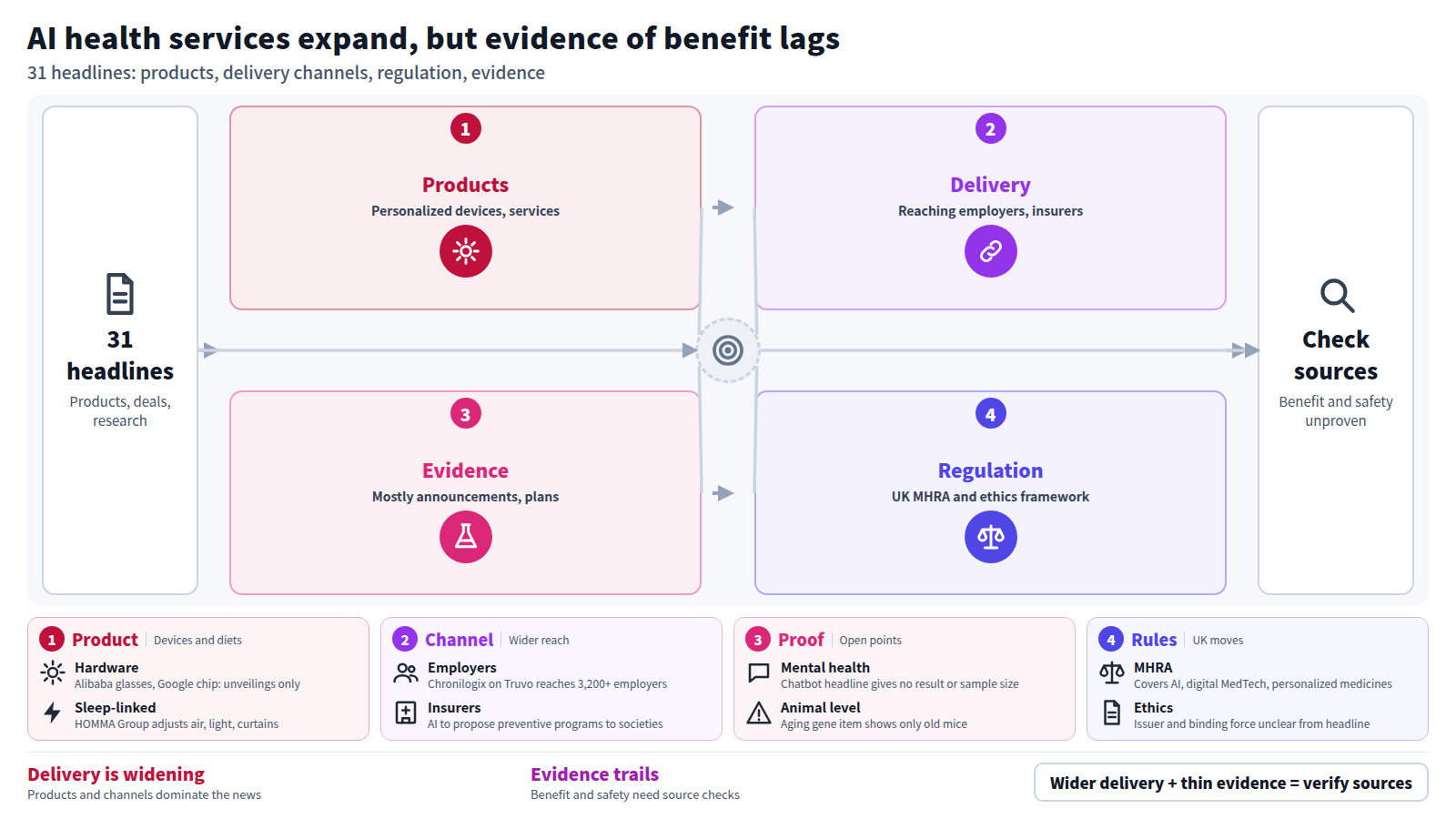
Overview
Movement this period was mostly in structure rather than in measured health outcomes: UK medical device regulation is being reshaped for the AI era (RAPS, Med-Tech Insights), and employer-facing and insurer-facing delivery of AI coaching and personalized plans is expanding (hngnews.com, Trend Hunter). On mental health, headlines point to open questions about chatbots and trust rather than new trial results (Université de Montréal, fox8live.com). Wearable hardware launches continued (Caixin Global, news.sbs.co.kr).
Mental health
- A Université de Montréal item asks "How do chatbots affect your mental health?" The headline gives no measured result, sample size, or evidence stage (Université de Montréal). - A separate item is titled "AI, Anxiety and Trust"; the headline gives no data (fox8live.com). - Samsung published a piece on AI-powered home appliances and everyday wellbeing; the headline reports no measured outcome (samsung.com).
Exercise and physical activity
- Alibaba unveiled AI glasses in a push into the wearable hardware market (Caixin Global). - Google unveiled a next-generation low-power AI chip targeting wearable devices (news.sbs.co.kr). - Wearable Devices launched Mudra Studio Kit for AI-powered touchless control of smart glasses (Pluang). - A Ray-Ban Meta glasses review for 2026 was published (Muzique Magazine). - These are product and hardware items; none of the headlines report health outcomes or evidence of benefit.
Sleep
No notable developments. (The one sleep-related headline in the English-language material was a finance-themed piece, not a health item.)
Nutrition and diet
- Walmart and SCAN are combining health coverage with nutrition in AI-powered Medicare plans (Trend Hunter). - Chosunbiz reports that AI is powering K-foodtech to personalize diets and drive global expansion (Chosunbiz). - Generate Biomedicines and Zealand Pharma teamed up on an AI-driven obesity drug pact worth up to $1.2 billion (finance.biggo.com). This is a drug-discovery deal, not a diet or lifestyle result. - No headline reports outcomes such as weight change or adherence.
Prevention and screening
- A Mahikeng Grade 9 learner was named an American Lung Cancer Scholar for AI screening research (Good Things Guy). The headline gives no detection rates or study population. - A Cybernews item reports AI researchers smoking to signal faith in AI cures (Cybernews). The headline does not describe any evidence. 【Chronic disease self-management】 - A tool for people living with diabetes analyzes how meals can affect glucose (Yahoo). The headline gives no validation data or evidence stage. - Chronilogix is now listed on Truvo, putting AI coaching within reach of more than 3,200 employers as a "first line of care" (hngnews.com). No outcome data are given in the headline. - Duke researchers are set to test an agentic AI system for cardiovascular care (The Duke Chronicle). This is a planned test; no results are reported.
Older adults and caregiving
- AI-powered security tools are being applied to prevent nursing home elopements (McKnight's Long-Term Care News). - AI misinformation targeting local seniors ahead of Election Day is a reported concern (FourStatesHomepage.com). - A Maeil Business Newspaper item reports a newly discovered gene that uses AI to slow aging, with old mice administered something. The headline is truncated, and this is animal-level evidence only (매일경제). - Other items in this group concern utility grids and aesthetic trends and are not health developments. 【Digital therapeutics and regulation】 - The UK's Medicines and Healthcare products Regulatory Agency (MHRA) announced a strategy to streamline regulation in the AI era (RAPS). - The MedTech regulator published a 2030 Strategy to modernize patient-centered regulation for AI, digital MedTech, and personalized medicines (Med-Tech Insights). - A new ethical framework maps how medical AI diagnostics must behave (Bioengineer.org). - No specific product approvals are named in these headlines.
Workplace health
- Workers who fear AI replacement show worse workplace behavior (Phys.org). - Machine learning pinpoints warning signs of compassion fatigue in psychiatric nurses (Bioengineer.org). The headline gives no sample size or evidence stage. - Business Reporter describes new risks that AI adoption at the workplace presents (Business Reporter). - HR Executive says companies are wasting AI on work that should not exist (HR Executive), and another item says AI release cadence outruns engineers' capacity to absorb it (news.lavx.hu). - An annual HR conference in 2026 highlighted AI, human capability, and responsible leadership (Prothom Alo English).
Developments in Japan
- Several outlets report that AI will propose preventive healthcare programs to health insurance societies, with a system being built (MEDIFAX web, Okinawa Times, Kita-Nippon Shimbun webunPlus). - The health management system "HM-neo(R)" added a feature giving personalized health advice using generative AI (Niconico News). - HOMMA Group developed, with two other companies, a room-control system linked to sleep that automatically adjusts air conditioning, lighting, and curtains according to sleep stage (Minna no Koho Senden-bu). - The headlines give no outcome data for these initiatives.
Statements by key figures
No notable developments.
AI video and explainers
No notable developments.
- AI-assisted adaptive radiation therapy acts like a GPS as it targets areas impacted by breast cancer, doctors say — CBS News10/14 21:59 UTC
- Healthier Living: How AI-Powered Home Appliances Can Support Everyday Wellbeing — samsung.com10/14 23:03 UTC
- AI, Anxiety and Trust — fox8live.com10/14 02:11 UTC
- How do chatbots affect your mental health? — Université de Montréal10/14 20:26 UTC
- Management - The new risks that AI adoption at the workplace presents — Business Reporter10/14 18:09 UTC
- Alibaba Unveils AI Glasses in Push for Wearable Hardware Market — Caixin Global10/15 04:42 UTC
- Ray-Ban Meta Glasses Review 2026: Are Meta AI Glasses Worth It? — Muzique Magazine10/14 18:30 UTC
- Google Unveils Next-Gen Low-Power AI Chip, Targeting Wearable Devices — news.sbs.co.kr10/15 01:50 UTC
- Wearable Devices launches Mudra Studio Kit for AI-powered touchless control of smart glasses. — Pluang10/13 13:05 UTC
- Seers eyes National Growth Fund as it charts new path for US expansion of medical AI — 머니투데이10/14 02:36 UTC
- Warren Buffett advises "making money while you sleep": Could AI be the solution? — Vietnam.vn10/15 07:40 UTC
- AI-Powered Medicare Plans: Walmart and SCAN Combine Health Coverage with Nutrition… — Trend Hunter10/13 22:38 UTC
- AI powers K-foodtech to personalize diets and drive global expansion - CHOSUNBIZ — Chosunbiz10/14 04:38 UTC
- Mahikeng Grade 9 Learner Named American Lung Cancer Scholar for AI Screening Research — Good Things Guy10/15 06:00 UTC
- Living With Diabetes? This AI-Powered Tool Analyzes How Your Meals Can Affect Your Glucose — Yahoo10/15 00:30 UTC
- Chronilogix Now Listed on Truvo, Putting AI Coaching Within Reach of More Than 3,200 employers as a First Line of Care — hngnews.com10/14 12:09 UTC
- Duke researchers set to test agentic AI system for cardiovascular care — The Duke Chronicle10/15 02:49 UTC
- Harnessing AI-powered security tools to prevent nursing home elopements — McKnight's Long-Term Care News10/14 22:31 UTC
- How AI misinformation can target local seniors ahead of Election Day — FourStatesHomepage.com10/14 18:57 UTC
- A new gene has been discovered that uses artificial intelligence (AI) to slow aging — 매일경제10/15 06:29 UTC
- IFS Unleashed: How And Why Utilities Are Confronting Ageing Grids With Billion-Dollar AI-Planned Investment Decisions — SMBtech10/14 21:47 UTC
- AI and ageing well: Experts share the aesthetic trends that will dominate 2027 — EVOKE10/14 16:00 UTC
- MHRA announces strategy to streamline regulation in the AI era — RAPS10/14 20:06 UTC
- New Ethical Framework Maps How Medical AI Diagnostics Must Behave — Bioengineer.org10/14 23:13 UTC
- Workers who fear AI replacement show worse workplace behavior — Phys.org10/14 16:00 UTC
- Machine Learning Pinpoints Warning Signs of Compassion Fatigue in Psychiatric Nurses — Bioengineer.org10/15 02:33 UTC
- Companies are wasting AI on work that shouldn't exist — HR Executive10/14 12:20 UTC
- AI release cadence outruns engineers' capacity to absorb it — news.lavx.hu10/14 08:10 UTC
- Annual HR Conference 2026 highlights AI, human capability and responsible leadership — Prothom Alo English10/13 11:10 UTC
- NTT Technocross adds generative AI personalized health advice to HM-neo health management system — Japanese media10/15 08:15 UTC
- HOMMA Group: Three Companies Develop Sleep-Linked Room Control Adjusting Air Conditioning, Lighting and Curtains — Japanese media10/14 22:09 UTC