AI and Rare Diseases ── Rare blood disorders ── 2026-10-16
Rare blood disorders: treatment, trials and AI
- Abstract
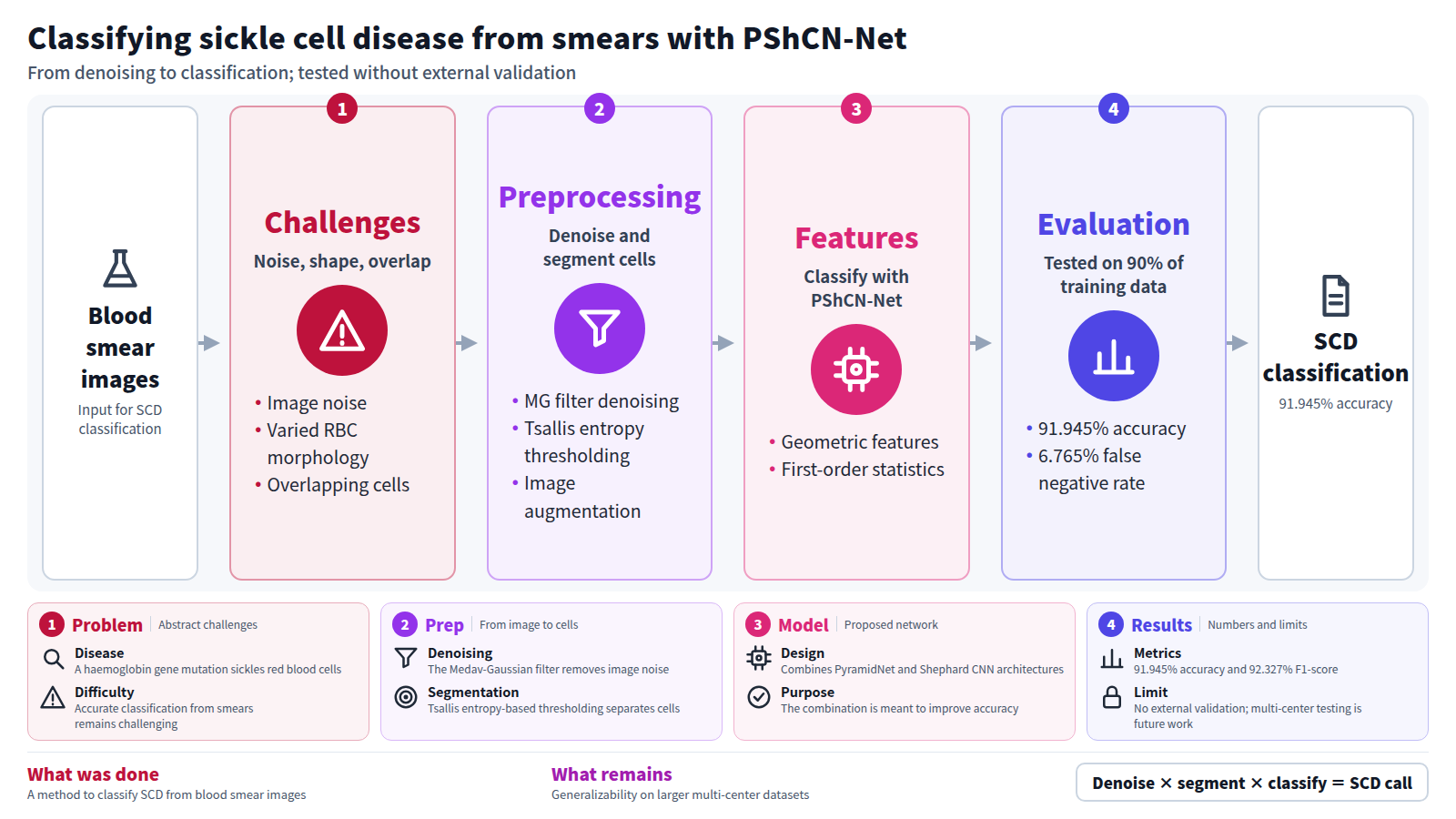
Sickle cell disease (SCD) poses serious health risks and requires accurate classification for effective treatment. In SCD, red blood cells (RBCs) mutate into a sickle shape due to a haemoglobin gene mutation, impairing oxygen delivery and causing blockages in blood vessels. However, accurate SCD classification from blood-smear images remains challenging due to image noise, variations in RBC morphology and overlapping cells. To address these challenges, this study introduces a deep learning (DL)- based approach named Pyramid Shepard convolutional neural network (PShCN-Net) for classifying SCD using blood smear images. The process begins with image denoising using the Medav-Gaussian (MG) filter, followed by cell segmentation with Tsallis entropy-based thresholding. Image augmentation is applied to enhance model robustness, and geometric and first-order statistical features are extracted. Classification is then performed using the proposed PShCN-Net, which combines the PyramidNet and Shephard convolutional neural network architectures for improved accuracy. PShCN-Net attains 91.945% accuracy, 93.235% true positive rate, 92.345% true negative rate, 91.437% precision, 92.327% F1-score, 7.655% false positive rate and 6.765% false negative rate when tested on 90% of the training data. Future work will focus on validating the PShCN-Net using larger and diverse multi-center blood-smear datasets to further assess its generalizability and clinical applicability.
Journal IF-equivalent: 5.2 (OpenAlex 2-year mean citedness, value as of 2026-10-06, retrieved 2026-10-07; not the official Clarivate IF)Reference: Ponnada S, Majji R, Rout AK, Selvaraju S. Sickle cell disease classification using Medav-Gaussian filter and Pyramid Shepard CNN. Sci Rep. 2026 Oct 13 [Epub ahead of print]. doi:10.1038/s41598-026-75109-8.Checked: Abstract only