AI and Rare Diseases ── 2026-10-16
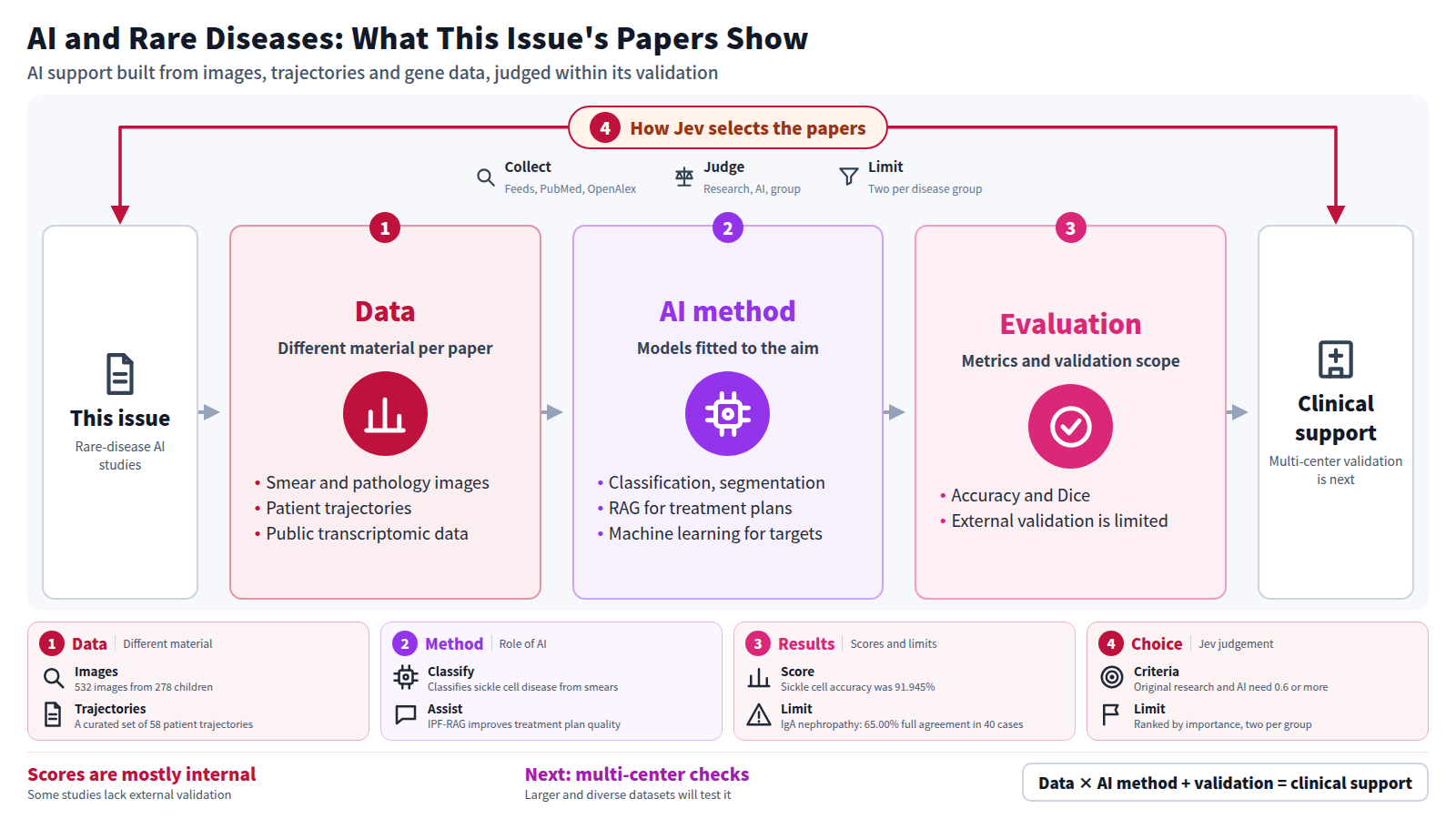
New papers on rare diseases (other than neurological and cancer) and AI, collected from journal feeds, PubMed (searched across all journals) and OpenAlex (a public index used instead of Google Scholar), judged by Jev (an AI that makes language judgements): original research, AI central, which of 8 disease groups, treatment or trials, and then ranked by importance up to a daily limit. Journals are not filtered by impact factor; each paper shows its journal's IF-equivalent (OpenAlex two-year mean citedness) and the date of that value. Each entry shows the full original abstract.
Read by disease: Platforms(0) · Inborn errors of metabolism(0) · Genetic syndromes(0) · Rare blood disorders(1) · Immune and connective tissue(0) · Heart and lung(2) · Kidney, liver and gut(1) · Skin and bone(0)
Rare-disease diagnosis and drug discovery platforms and AI
No new qualifying paper for this issue.
Inborn errors of metabolism: treatment, trials and AI
No new qualifying paper for this issue.
Genetic syndromes and paediatric rare diseases: treatment, trials and AI
No new qualifying paper for this issue.
Rare blood disorders: treatment, trials and AI
- Abstract
Sickle cell disease (SCD) poses serious health risks and requires accurate classification for effective treatment. In SCD, red blood cells (RBCs) mutate into a sickle shape due to a haemoglobin gene mutation, impairing oxygen delivery and causing blockages in blood vessels. However, accurate SCD classification from blood-smear images remains challenging due to image noise, variations in RBC morphology and overlapping cells. To address these challenges, this study introduces a deep learning (DL)- based approach named Pyramid Shepard convolutional neural network (PShCN-Net) for classifying SCD using blood smear images. The process begins with image denoising using the Medav-Gaussian (MG) filter, followed by cell segmentation with Tsallis entropy-based thresholding. Image augmentation is applied to enhance model robustness, and geometric and first-order statistical features are extracted. Classification is then performed using the proposed PShCN-Net, which combines the PyramidNet and Shephard convolutional neural network architectures for improved accuracy. PShCN-Net attains 91.945% accuracy, 93.235% true positive rate, 92.345% true negative rate, 91.437% precision, 92.327% F1-score, 7.655% false positive rate and 6.765% false negative rate when tested on 90% of the training data. Future work will focus on validating the PShCN-Net using larger and diverse multi-center blood-smear datasets to further assess its generalizability and clinical applicability.
Journal IF-equivalent: 5.2 (OpenAlex 2-year mean citedness, value as of 2026-10-06, retrieved 2026-10-07; not the official Clarivate IF)Reference: Ponnada S, Majji R, Rout AK, Selvaraju S. Sickle cell disease classification using Medav-Gaussian filter and Pyramid Shepard CNN. Sci Rep. 2026 Oct 13 [Epub ahead of print]. doi:10.1038/s41598-026-75109-8.Checked: Abstract only
See all 1 Rare blood disorders papers →
Autoinflammatory, immunodeficiency and rare connective-tissue diseases: treatment, trials and AI
No new qualifying paper for this issue.
Rare cardiovascular and respiratory diseases: treatment, trials and AI
- Abstract
Background: Idiopathic pulmonary arterial hypertension (IPAH) exhibits cancer-like features, yet its pathogenesis remains unclear. Given molecular similarities between IPAH and malignant pleural mesothelioma (MPM), this study aimed to uncover shared transcriptomic patterns.
Methods: GEO datasets for IPAH and MPM were analyzed. Overlapping DEGs and WGCNA modules were identified. PPI network analysis combined with LASSO, random forest, and SVM-RFE was used to identify candidate biomarker genes. A classification model was constructed and evaluated using leave-one-out cross-validation and bootstrap optimism correction. Immune infiltration was evaluated by ssGSEA. Molecular docking and MD simulations assessed drug binding to candidate target proteins. qRT-PCR validated candidate biomarker gene expression.
Results: Six concordantly upregulated and eleven concordantly downregulated DEGs were shared between IPAH and MPM. Upregulated genes were enriched in cell cycle regulation, while downregulated genes were enriched in neutrophil chemotaxis. WGCNA identified 58 overlapping genes. CXCR2, S100A9, and LCN2 were identified as candidate biomarker genes. A ROTS sensitivity analysis confirmed that all 1710 MPM DEGs were reproducible and directionally concordant at the matching FDR <0.05 threshold despite the imbalanced case–control ratio. The classification model achieved AUCs of 0.909 and 0.875 in training and external validation sets, with a LOOCV AUC of 0.879 and an optimism-corrected AUC of 0.896. Immune infiltration revealed increased Th17 cells but decreased neutrophils in IPAH. CXCR2 and S100A9 expression correlated with neutrophil infiltration; LCN2 expression correlated with metabolic reprogramming. Navarixin showed the strongest binding affinity to CXCR2 (−10.1 kcal/mol). MD simulations confirmed stable binding of the CXCR2-Navarixin complex. qRT-PCR confirmed significant downregulation of all three genes in IPAH patients.
Conclusion: This hypothesis-generating study identifies shared transcriptomic signatures between IPAH and MPM, highlighting CXCR2, S100A9, and LCN2 as candidate biomarkers linked to immune dysregulation and metabolic reprogramming. The computational and correlative nature of these findings, together with the limited size of the external validation cohort, requires confirmation through functional experiments and validation in larger, independent, and multicentre cohorts before clinical translation can be considered.
Journal IF-equivalent: 3.0 (OpenAlex 2-year mean citedness, value as of 2026-10-15, retrieved 2026-10-16; not the official Clarivate IF)Reference: Zhang N, Wang C, Wang R, Guo X, Yu J, Wang J, et al. Machine learning, molecular docking, and experimental validation identify shared molecular signatures between idiopathic pulmonary arterial hypertension and malignant pleural mesothelioma: a retrospective study. Front Genet. 2026 Oct 14;17:1894027. doi:10.3389/fgene.2026.1894027.Checked: Abstract only - Abstract
Personalized clinical management of idiopathic pulmonary fibrosis (IPF) is hindered by its complex longitudinal course and fragmented, unstructured data. Although large language models (LLMs) and retrieval-augmented generation (RAG) show promise in clinical decision support, current methods face challenges in addressing dynamic disease progression due to static knowledge corpora, a lack of temporal awareness, and susceptibility to semantic noise and hallucinations. To address this, we propose IPF-RAG, a temporal-aware RAG framework for longitudinal IPF care. Driven by a curated dataset of 58 patient trajectories, the framework comprises two core modules. The Temporal Retrieval Module augments semantic matching with temporal-aware evidence anchoring, establishing temporal correlations between disease progression and medical orders. Subsequently, the Structured Enhancement Module integrates this temporal knowledge into structured prompts, applying medical logic constraints to guide LLMs toward evidence-based reasoning. Experiments on internal and external datasets, evaluated by automated assessments and clinical experts, demonstrate that IPF-RAG improves the quality of LLM-generated treatment plans across multiple dimensions. These findings indicate that the proposed approach effectively assists LLMs in clinical decision-making for complex chronic diseases.
Journal IF-equivalent: 5.0 (OpenAlex 2-year mean citedness, value as of 2026-10-13, retrieved 2026-10-15; not the official Clarivate IF)Reference: Zheng X, Rui X, Long T, Wang L, Lv Z, Wang J, et al. IPF-RAG: temporal-aware retrieval-augmented generation for idiopathic pulmonary fibrosis care. Front Digit Health. 2026 Oct 14;8:1883739. doi:10.3389/fdgth.2026.1883739.Checked: Abstract only
See all 2 Heart and lung papers →
Rare kidney, liver and gastrointestinal diseases: treatment, trials and AI
- Abstract
Oxford MEST-C assessment of pediatric immunoglobulin A nephropathy (IgAN) relies on pathologists’ interpretation of complex renal biopsy structures. Automated segmentation may support standardized quantification but is challenged by scale variation, weak boundaries, and small lesions. We developed DU-KAN, a stage-adapted U-KAN framework combining a shallow convolution–MaxViT dual-branch encoder with adapted heterogeneous feature fusion and wavelet–prototype skip enhancement. A single-center dataset of 532 periodic acid–Schiff-stained images from 278 children was partitioned at the patient level. On the held-out test set of 55 patients, DU-KAN achieved a mean Dice of 69.58% across eight classes, including background (95% patient-level bootstrap CI, 66.23–71.91), exceeding U-KAN by 3.56 percentage points (95% CI, 1.90–5.26). Foreground mean Dice was 65.42%. On the Synapse abdominal CT benchmark, mean Dice across eight organs was 87.21%, supporting cross-task architectural generalization, rather than external validation in pediatric IgAN. Segmentation outputs were further aggregated into case-level MEST-C-related indicators. In an exploratory 40-case evaluation, complete agreement across the five assessed indicators was 65.00% (26/40), while sensitivity was 37.50% for E (3/8) and 50.00% for T (1/2). The 97.50% agreement for T largely reflected the predominance of negative cases and did not establish reliable positive-case detection. DU-KAN improves the internal segmentation performance and achieves structured pathological quantification, which can provide auxiliary reference for clinical judgment of renal pathologists.
Journal IF-equivalent: 5.4 (OpenAlex 2-year mean citedness, value as of 2026-10-15, retrieved 2026-10-16; not the official Clarivate IF)Reference: Fu J, Cui H, Zhu Y, Gao T, Zhang P, Gao C. DU-KAN: A Dual-Domain Enhanced Deep-Learning Framework for Digital Pathology-Based Oxford MEST-C Assessment in Pediatric IgA Nephropathy. Bioengineering. 2026 Oct 13;13(10):1191. doi:10.3390/bioengineering13101191.Checked: Abstract only
See all 1 Kidney, liver and gut papers →
Rare skin and bone diseases: treatment, trials and AI
No new qualifying paper for this issue.