AI, EQ & Communication News — 2026-10-15 (Thu) Evening News
Source links point to the original outlet. The AI Integrated Analysis is auto-generated from the headlines below only and is not intended to add facts beyond them. Not investment advice.
Overview
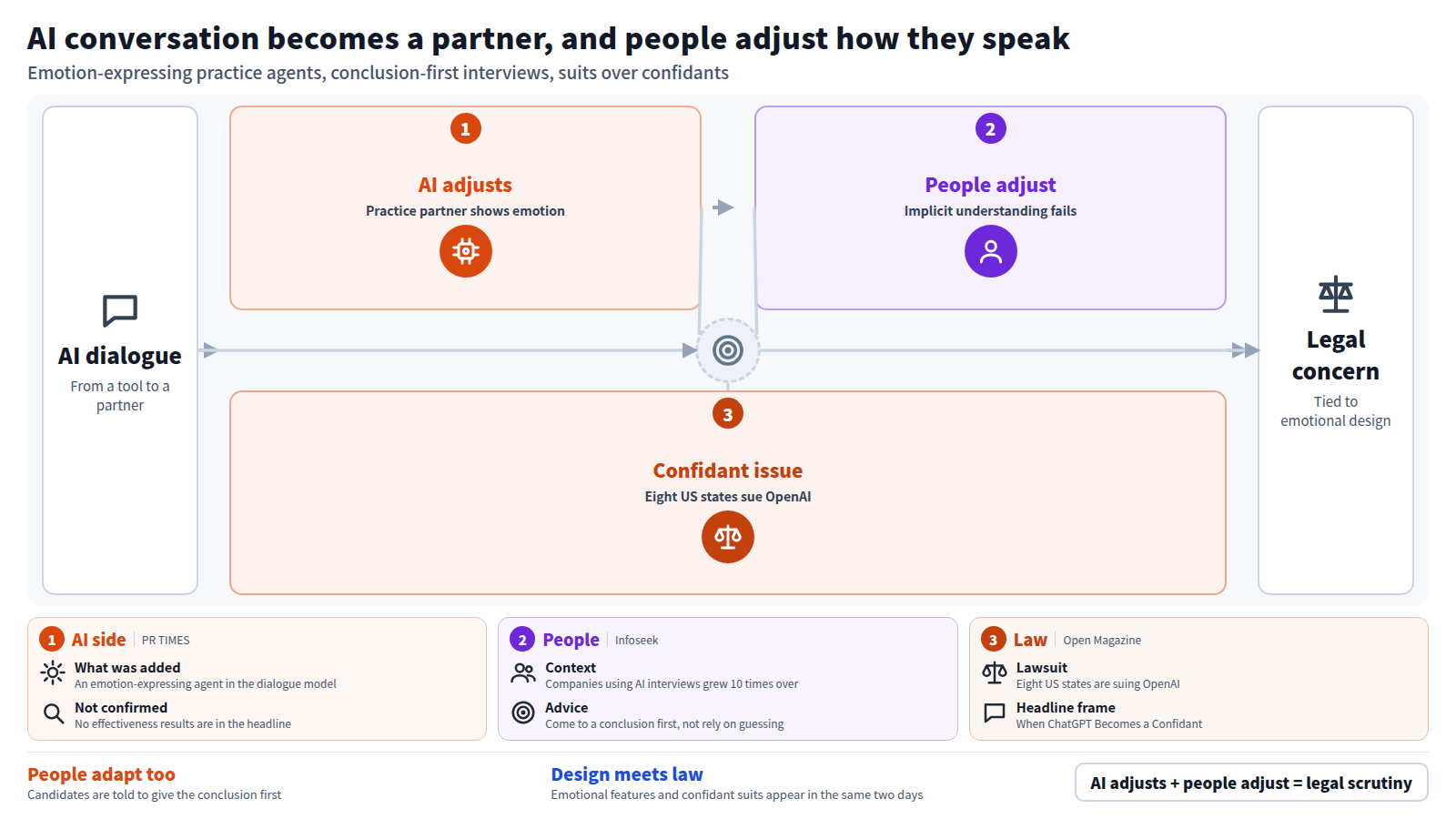
Few developments were recorded in the past 48 hours, and all of them sit in three areas: human emotional skills, conversational change, and speaking practice. A Korean-focused piece urged combining AI with human emotion and imagination (Chosunbiz). Eight US states are reported to be suing OpenAI over ChatGPT as a confidant (Open Magazine). A Japanese role-play product added an emotion-expressing AI agent to its dialogue model (PR TIMES), and a guide for job seekers addressed AI interviews (Infoseek).
Reading emotion with AI
No notable developments. 【AI empathy and emotional intelligence】 No notable developments. 【Human EQ and skills in the AI era】 - Porcini urged Korea to fuse AI with human emotion and imagination for personalization, according to the headline "Porcini urges Korea to fuse AI with human emotion and imagination for personalization" (Chosunbiz). 【Changes in conversation and relationships】 - Eight US states are suing OpenAI, and the headline frames the issue as "When ChatGPT Becomes a Confidant" (Open Magazine). - "PeopleX AI role-play" has been equipped with an emotion-expressing AI agent in its AI dialogue model (PR TIMES).
Words AI writes and speaks
No notable developments.
Speaking practice and coaching
- An article advises job seekers that AI interviews, whose adoption by companies is reported to have grown tenfold, do not respond to implicit understanding, and that the way through is to give the conclusion first (Infoseek).
Research and surveys
No notable developments. 【Japan's EQ, communication and AI】 - PeopleX's AI role-play product added an emotion-expressing AI agent to its AI dialogue model (PR TIMES). - Advice for Japanese job seekers says AI interviews require a conclusion-first style rather than relying on others to infer meaning (Infoseek).
Statements by key figures
No notable developments. 【Integrated analysis: what is happening】 The three groups of headlines point to the same structure: conversation with AI is becoming a setting in which people adjust their own communication. In the interview article, the person is told to adapt to the AI's way of processing, with a conclusion first rather than reliance on being understood implicitly (Infoseek). In the role-play product, the practice partner is given emotion-expressing behavior, which suggests that practice is moving toward simulating emotional reactions (PR TIMES). In the US item, the same conversational quality that makes an AI feel like a confidant is the subject of legal action by states (Open Magazine). The Korean item, which stresses human emotion and imagination alongside AI, fits this pattern as an argument about where human contribution remains (Chosunbiz). The point that may change a reader's judgment: emotional expressiveness in AI is being treated both as a product feature and as a legal concern within the same two days, which suggests that its commercial use and its regulatory scrutiny are advancing together. This is inference from four headlines and not an established trend.
What to watch
- Whether the state lawsuits against OpenAI lead to further action or to changes in how conversational AI is offered as a confidant (Open Magazine). - Whether emotion-expressing AI agents spread in practice tools beyond the PeopleX product (PR TIMES). - Whether more companies use AI interviews and whether guidance for candidates standardizes around conclusion-first answers (Infoseek).
- Porcini urges Korea to fuse AI with human emotion and imagination for personalization — Chosunbiz10/15 05:10 UTC
- When ChatGPT Becomes a Confidant: Why Eight US States Are Suing OpenAI — Open Magazine10/15 04:00 UTC
- "PeopleX AI Role-Play" Adds Emotion-Expressing AI Agent to Its AI Dialogue Model — PR TIMES10/15 06:00 UTC