AI and Rare Diseases ── Heart and lung ── 2026-10-16
Rare cardiovascular and respiratory diseases: treatment, trials and AI
- Abstract
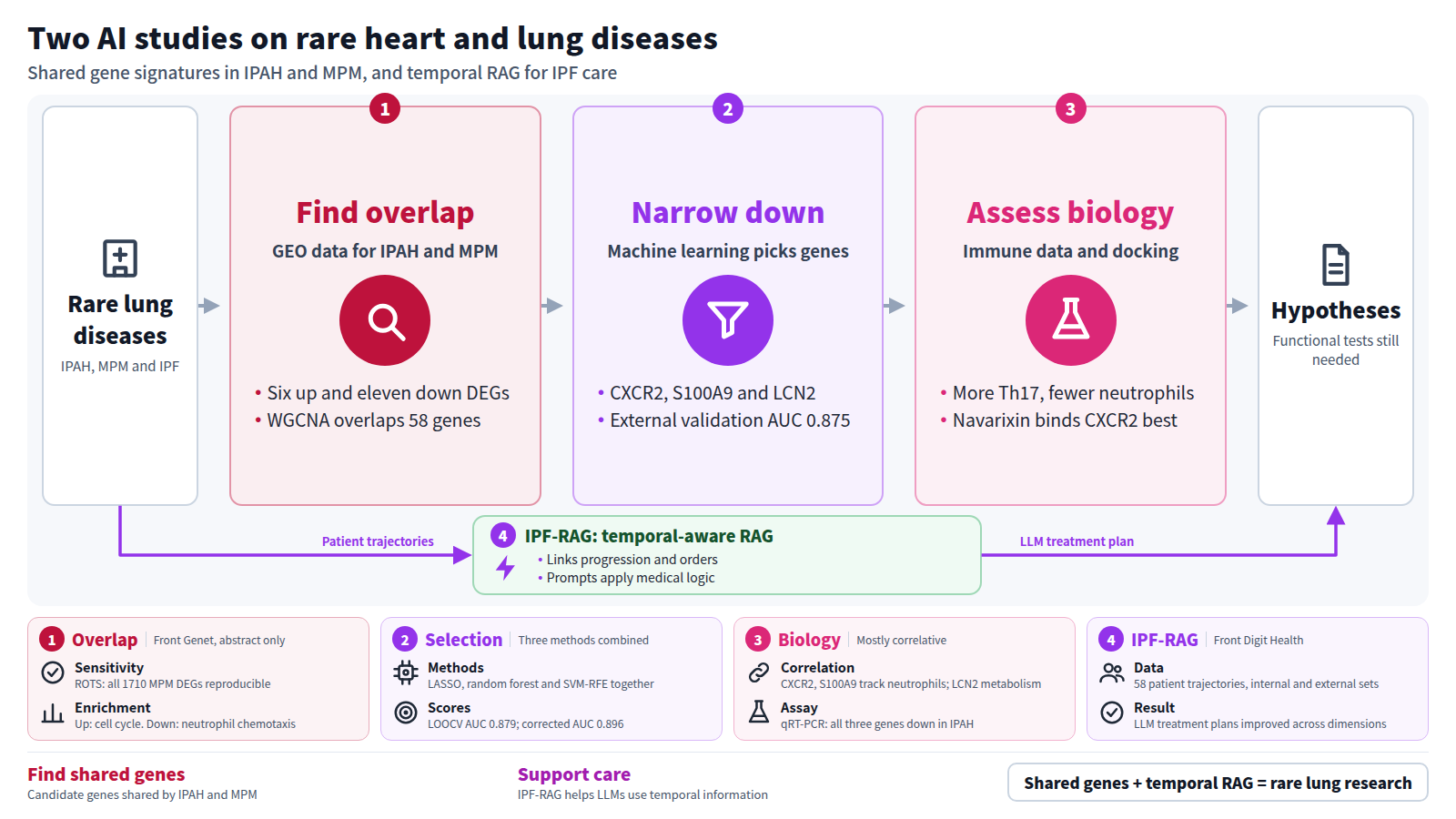
Background: Idiopathic pulmonary arterial hypertension (IPAH) exhibits cancer-like features, yet its pathogenesis remains unclear. Given molecular similarities between IPAH and malignant pleural mesothelioma (MPM), this study aimed to uncover shared transcriptomic patterns.
Methods: GEO datasets for IPAH and MPM were analyzed. Overlapping DEGs and WGCNA modules were identified. PPI network analysis combined with LASSO, random forest, and SVM-RFE was used to identify candidate biomarker genes. A classification model was constructed and evaluated using leave-one-out cross-validation and bootstrap optimism correction. Immune infiltration was evaluated by ssGSEA. Molecular docking and MD simulations assessed drug binding to candidate target proteins. qRT-PCR validated candidate biomarker gene expression.
Results: Six concordantly upregulated and eleven concordantly downregulated DEGs were shared between IPAH and MPM. Upregulated genes were enriched in cell cycle regulation, while downregulated genes were enriched in neutrophil chemotaxis. WGCNA identified 58 overlapping genes. CXCR2, S100A9, and LCN2 were identified as candidate biomarker genes. A ROTS sensitivity analysis confirmed that all 1710 MPM DEGs were reproducible and directionally concordant at the matching FDR <0.05 threshold despite the imbalanced case–control ratio. The classification model achieved AUCs of 0.909 and 0.875 in training and external validation sets, with a LOOCV AUC of 0.879 and an optimism-corrected AUC of 0.896. Immune infiltration revealed increased Th17 cells but decreased neutrophils in IPAH. CXCR2 and S100A9 expression correlated with neutrophil infiltration; LCN2 expression correlated with metabolic reprogramming. Navarixin showed the strongest binding affinity to CXCR2 (−10.1 kcal/mol). MD simulations confirmed stable binding of the CXCR2-Navarixin complex. qRT-PCR confirmed significant downregulation of all three genes in IPAH patients.
Conclusion: This hypothesis-generating study identifies shared transcriptomic signatures between IPAH and MPM, highlighting CXCR2, S100A9, and LCN2 as candidate biomarkers linked to immune dysregulation and metabolic reprogramming. The computational and correlative nature of these findings, together with the limited size of the external validation cohort, requires confirmation through functional experiments and validation in larger, independent, and multicentre cohorts before clinical translation can be considered.
Journal IF-equivalent: 3.0 (OpenAlex 2-year mean citedness, value as of 2026-10-15, retrieved 2026-10-16; not the official Clarivate IF)Reference: Zhang N, Wang C, Wang R, Guo X, Yu J, Wang J, et al. Machine learning, molecular docking, and experimental validation identify shared molecular signatures between idiopathic pulmonary arterial hypertension and malignant pleural mesothelioma: a retrospective study. Front Genet. 2026 Oct 14;17:1894027. doi:10.3389/fgene.2026.1894027.Checked: Abstract only - Abstract
Personalized clinical management of idiopathic pulmonary fibrosis (IPF) is hindered by its complex longitudinal course and fragmented, unstructured data. Although large language models (LLMs) and retrieval-augmented generation (RAG) show promise in clinical decision support, current methods face challenges in addressing dynamic disease progression due to static knowledge corpora, a lack of temporal awareness, and susceptibility to semantic noise and hallucinations. To address this, we propose IPF-RAG, a temporal-aware RAG framework for longitudinal IPF care. Driven by a curated dataset of 58 patient trajectories, the framework comprises two core modules. The Temporal Retrieval Module augments semantic matching with temporal-aware evidence anchoring, establishing temporal correlations between disease progression and medical orders. Subsequently, the Structured Enhancement Module integrates this temporal knowledge into structured prompts, applying medical logic constraints to guide LLMs toward evidence-based reasoning. Experiments on internal and external datasets, evaluated by automated assessments and clinical experts, demonstrate that IPF-RAG improves the quality of LLM-generated treatment plans across multiple dimensions. These findings indicate that the proposed approach effectively assists LLMs in clinical decision-making for complex chronic diseases.
Journal IF-equivalent: 5.0 (OpenAlex 2-year mean citedness, value as of 2026-10-13, retrieved 2026-10-15; not the official Clarivate IF)Reference: Zheng X, Rui X, Long T, Wang L, Lv Z, Wang J, et al. IPF-RAG: temporal-aware retrieval-augmented generation for idiopathic pulmonary fibrosis care. Front Digit Health. 2026 Oct 14;8:1883739. doi:10.3389/fdgth.2026.1883739.Checked: Abstract only