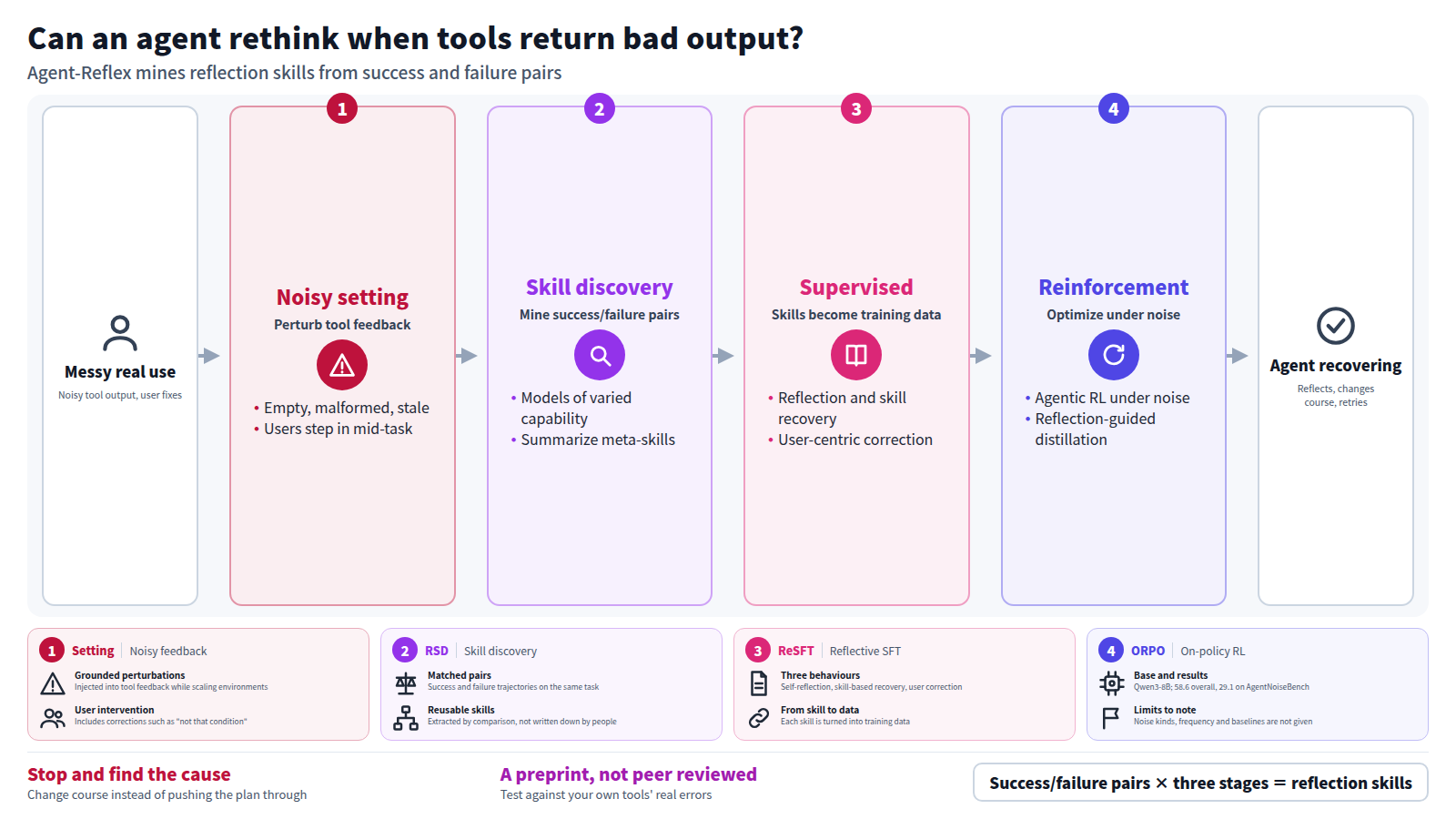
1. Tools return bad output, and users step in mid-task
Large language models are no longer used only as single-turn chatbots; they increasingly run as agents that carry out long sequences of steps. The abstract focuses on two situations those agents meet in real deployments. Tools connected through MCP, a common protocol for letting models call external tools, can return noisy feedback. And users may intervene partway through to correct the agent.[1]
Neither is unusual in practice. A search tool returns nothing, returns malformed data, or returns stale information. A user says "not that condition, this one." What the agent needs in these moments is not to push its original plan through but to stop, work out what went wrong, and change course. The authors call this reflection and failure recovery, and they argue that existing methods provide limited supervision for learning either.
2. The core idea: extract reflection skills from success and failure pairs
Agent-Reflex is a training framework for encouraging agents to reflect on their own, organized in three stages. The core of the method sits in the first stage: rather than having people write down how to reflect, it extracts reusable reflection skills by comparing successful and failed attempts at the same task.
In the first stage, Environment Reflection Skill Discovery (RSD), the authors inject grounded perturbations into tool feedback while scaling up training environments. They then sample a pool of language models with different capabilities, mine matched pairs of success and failure trajectories, and summarize reusable reflection meta-skills from them.
In the second stage, Reflective Supervised Fine-Tuning (ReSFT), each skill is turned into training data for three behaviours: self-reflection, skill-based recovery, and user-centric correction. The third stage, On-Policy Reflective Policy Optimization (ORPO), combines agentic reinforcement learning under noisy interactions with reflection-guided on-policy distillation. On-policy distillation, in which a teacher scores sequences that the student generated itself, comes from earlier work.[5]
3. What the abstract reports
- Base model: Qwen3-8B.
- Results: 58.6 overall on five long-horizon tool-use benchmarks and 29.1 on AgentNoiseBench, ahead of strong environment-scaling and reflection baselines.
- Scope: experiments on six agent benchmark suites are reported as showing the method works.
- Analysis: the authors say the method improves tolerance to noise while keeping training dynamics stable. The code is public.[3]
The abstract does not say whether the overall 58.6 is an average of the five benchmarks or some other aggregate. It does not name the baselines or give the size of the margins. The lower AgentNoiseBench score also says something: tool use under noisy conditions is far from solved.
4. A worked example: when a literature search tool misbehaves
Here is a pharmaceutical example to show what reflection and recovery look like. It illustrates the idea; whether the paper covers tasks of this kind cannot be determined from the abstract.
User: Collect case reports of liver injury associated with this ingredient and list them.
Agent: (calls the literature search tool) The result is empty. The query format may not match the tool's specification. I will split the conditions and search again.
Agent: (searches again) Results returned. In some entries, though, the journal name appears in the publication-year field. The output is malformed, so I will re-check those citations.
User: Search by brand name too, not just the generic name.
Agent: Understood. I will add the brand name, rerun the search, and merge the results with the earlier ones, removing duplicates.
The exchange contains the three behaviours the abstract names, in order: doubting the tool's output (self-reflection), splitting the query and retrying (recovery), and folding in the user's correction (user-centric correction). Compared with an agent that has not learned to reflect, the difference looks like this.
Agent without reflection training
Treats the empty result as "no reports found" and stops. Puts the malformed entries into the list as they are. Handles the user's correction as a new, unrelated request.
Agent with reflection training (the authors' aim)
When output differs from what was expected, looks for a cause and tries another approach. Re-checks malformed entries. Folds the user's correction into the existing plan without discarding earlier work.
5. What is not new, and where the limits are
The idea that a language agent can reflect in words and use that reflection on its next attempt appears in earlier work such as Reflexion.[4] On-policy distillation is also established. The contribution here is the procedure for mining reflection skills from success and failure pairs, and the three-stage design that feeds those skills into both supervised and reinforcement learning.
There are several limits. First, how the noise was made. The perturbations are described as grounded, but the abstract does not say what kinds of disruption were injected or how often. Whether they match the failures seen in real deployments is unknown.
Second, how user interventions were produced. The model is trained on user-centric correction, but the abstract does not say whether those interventions were written by people or simulated by a model.
Third, reflection is not always helpful. An agent that doubts correct tool output too readily will waste effort on retries. The abstract reports better tolerance to noise but says nothing about the cost of unnecessary reflection when there is no noise.
6. Why it drew attention now
The selection pipeline placed this paper under Agents & Autonomy. Its cluster size is 1, but two signal families fired: 49 upvotes and 2 comments on the Hugging Face paper page, and 75 GitHub stars on the released code.[2] Votes from readers and from implementers together suggest the paper is more than a passing mention. Neither, however, says anything about whether the claims are correct.
The keywords attached to the paper are long-horizon reasoning, tool use, reinforcement learning and on-policy distillation. When agents run for long periods in real environments, their plans break down through interaction with tools and users. This paper belongs to a line of work that tries to make recovery from that breakdown something agents are trained on, not only something they are evaluated on.
7. Where this connects to pharmaceutical and regulatory practice
An agent used inside a company would connect to literature databases, safety databases and document management systems. These do not always respond cleanly. If an agent folds empty, truncated or oddly formatted results straight into a report, the errors end up where people are unlikely to spot them.
The reflection and recovery studied here resemble deviation handling in quality management: notice that a result is not what was expected, look for the cause, change the procedure and try again. In regulated work, though, recovering is not enough. What happened and what was changed must be recorded. The agent's reflections and retries need to be kept in a form people can read afterwards.
Benchmark results from a preprint do not guarantee performance with a company's own tools. Anyone considering such an agent should first collect the real errors and formatting problems their own tools produce, and test how the agent behaves against them.