AI Highlights — the whole picture — 2026-10-15 (Thu) Evening News
Source links point to the original outlet. The AI Integrated Analysis is auto-generated from the headlines below only and is not intended to add facts beyond them. Not investment advice.
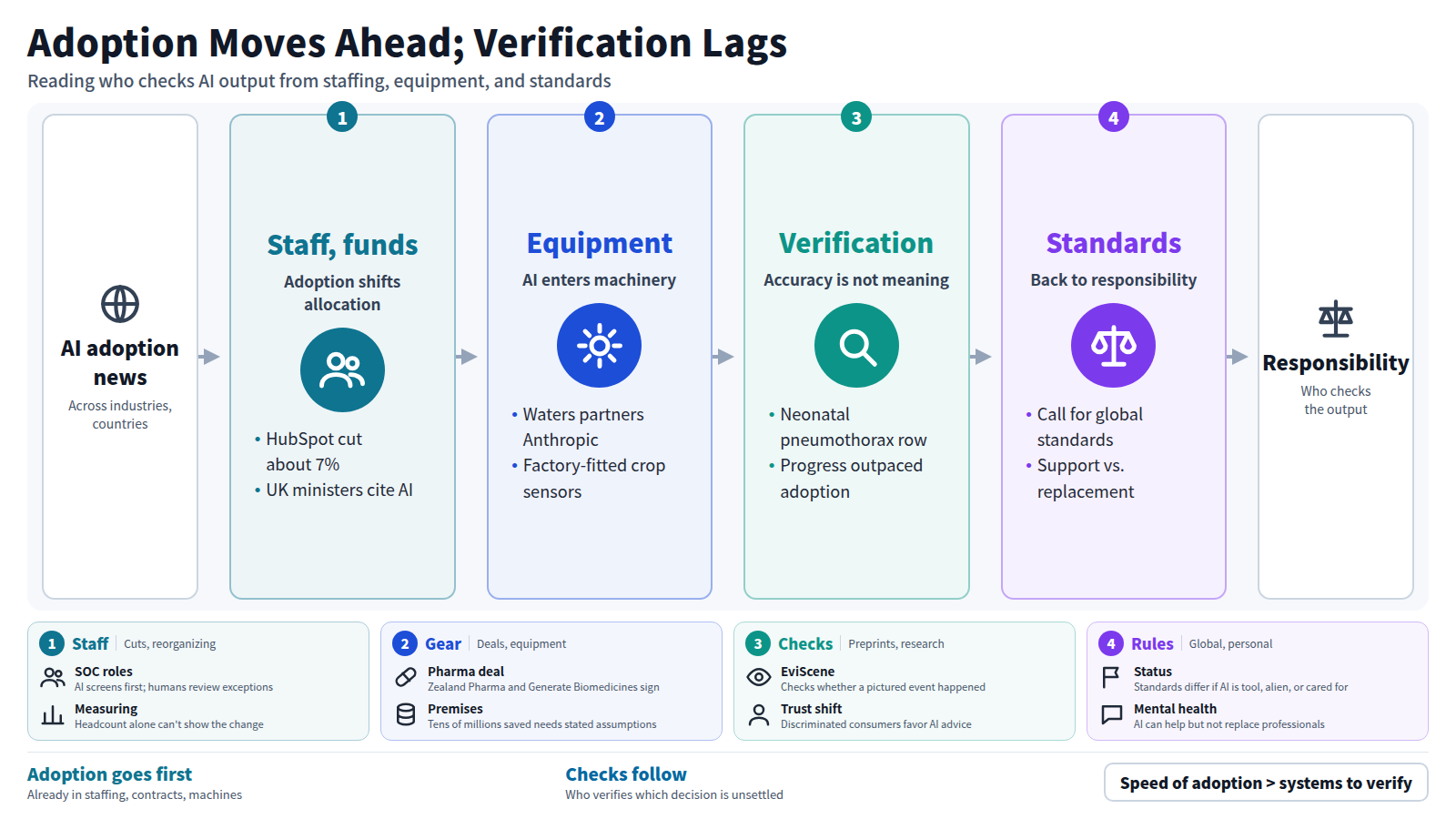
HubSpot will cut about 7% of its workforce as part of a reorganization, and UK ministers have said the staff turnover will involve AI. Meanwhile, pharmaceutical labs and agricultural tractors are starting to ship AI as part of their contracts and equipment. The developments reported in the last half-day indicate that AI has entered the stage of actually driving the allocation of personnel and capital across industries and countries. However, the procedures for checking what decisions the output can be used for and the establishment of an entity responsible for the results have not kept up with the speed of introduction. The controversy surrounding the detection of neonatal pneumothorax has shown that high accuracy does not directly translate into clinical significance. It is not enough to simply list what AI can do; the focus of future reading will be to look at who confirms what and how.
Organizational reorganization and personnel reductions have emerged as the price of introducing AI
HubSpot has cut about 7% of its workforce as part of an AI-centered reorganization (Yahoo Finance). British ministers have said AI has been implicated in staff turnover and job cuts in recent months (London Evening Standard). Wall Street banks are reportedly facing growing risks in both AI lending and AI implementation (Reuters). Although the three reports cover different industries and countries, they overlap in that the introduction of AI actually changes the allocation of personnel and funds. We have passed the stage where we can only talk about the effects of the introduction in terms of ``productivity,'' and it is now necessary to look at whose work and whose funds were used to pay for it.
However, the movement on the ground is not just in the direction of reduction. At the Security Operations Center (SOC), AI is responsible for the initial screening, with human supervision. Security Boulevard depicts a day in the life of a threat analyst at an autonomous SOC as a human examines and makes decisions based on the results sorted by AI. Analysts' jobs haven't disappeared; they've moved from reading tons of alerts themselves to reviewing AI filters and responding to exceptions. If the job title remains the same but the content changes, the magnitude of the change cannot be measured solely by the increase or decrease in the number of people.
The way people express their value is also being reconsidered. Forbes JAPAN discussed the human abilities that will become more valuable in the age of AI, from the standpoint that we should stop calling them "soft skills." In addition, the Bipartisan Policy Center in the United States has focused on the impact of AI on the nursing care workforce, stating that it is necessary to discuss the impact of introducing AI even in occupations that have traditionally been supported by humans. Both questions reconsider the boundaries between tasks that will be replaced by AI and tasks that will remain on the human side.
If we look at the materials we have discussed so far, we can see that the reduction figures are the result of organizational restructuring proceeding, and how the contents of each job category will be reorganized will differ from site to site. Decisions to reduce personnel or to keep people and change their roles are based on the assumption that the AI output is correct. The next question is who should check the output, how should it be done, and who should be held responsible if an error occurs.
Introduction by industry is now at the stage of equipment and partnership
In pharmaceuticals and agriculture, AI is moving beyond the proposal and analysis stage and is beginning to be incorporated into actual contracts, equipment, and equipment. Zealand Pharma has signed a research and licensing agreement with Generate Biomedicines to develop AI-designed protein therapeutics for metabolic diseases (The Manila Times). Analytical instrumentation company Waters has partnered with Anthropic to advance AI-driven autonomous laboratory workflows (BioPharma APAC). In agriculture, PerPlant teams up with Valtra to factory-install AI crop sensors on tractors (AgFunderNews). This is a movement for AI to become part of the machinery being shipped and the processes in the lab, rather than as an afterthought.
The foundation continues to be developed in terms of computational resources, research, and human resources. China launched eight satellites for AI calculations (Global Times). This shows that the location of computation is no longer limited to terrestrial data centers. According to Carnegie Mellon University, three researchers from the university will participate in Google's ``AI and the Economy'' research (Carnegie Mellon University). Frameworks for measuring the economic impact of AI are beginning to emerge outside of business. In Japan, Microsoft Japan's AI education support is expanding ``skill acquisition and education reform,'' and there are cases where costs have been reduced by tens of millions of dollars (DX Magazine).
What changes for the reader is the unit of view. Rather than looking at the performance of the model or the flashiness of the announcement, it is better to look specifically at which contracts, which equipment, and which processes AI was used in, and get closer to the actual state of implementation. When AI enters equipment or processes, such as factory-installed sensors or autonomous labs, the output flows directly to the next task. Results, such as those resulting in savings of tens of millions of dollars, cannot be evaluated until the assumptions behind the calculations are presented.
The story so far has been biased towards the move towards introducing AI. As equipment and partnerships progress, the question of who will check the output and at what stage becomes more specific and closer to the site.
Difficulty in verification: accuracy, clinical significance, and structure of judgment
The controversy over AI detection of neonatal pneumothorax (Bioengineer.org) highlights the gap between detection accuracy and clinical significance. Even if findings on images can be detected with high accuracy, whether or not this will lead to determining the necessity of treatment and outcome is another question. An article (AIM Media House) looking back on the pharmaceutical industry over the last 10 years states that ``technological advances have outpaced adoption.'' It is pointed out that the performance of the model is advanced first, and the steps to evaluate it on-site and incorporate it into the work follow later. What these two stories have in common is that just because the numbers are good doesn't mean anything in the field. When readers look at the numbers in the performance table, the question they should ask is, "What decisions can those numbers be used for?"
Studies that attempt to bridge this gap are also available as preprints. All have been published on arXiv and have not been peer-reviewed. The first is EviScene, an agent that evaluates the reality of images. Even if we can tell whether an image was created by AI, we can't tell whether the event depicted actually occurred. Sometimes the real photo is circulated as a story from a different place on a different day. The authors called this method "image factual evaluation" and proposed a system in which the question is reframed from the image alone, without providing the statement of argument, and a system is used to collect external evidence and return a judgment and rationale. The second is Jeva, a dedicated structure that does not leave the decision of selecting one of the candidates or answering ``not applicable'' to the sentence generator. The authors argued that the structure of the judgment question could not be respected if the questions were asked to answer as sentences, and presented a design that satisfies four requirements: the answer does not change even when rearranged, and it is possible to clearly indicate ``not applicable.'' The third is a framework that learns the other party's beliefs and intentions as latent expressions and uses them as material for action selection. When multiple agents collaborate, the aim is to replace the parts that have been supplemented by devising prompts and memory mechanisms with explicit expression. All three cases can be read as attempts to move the procedure for checking output from retrofitted inspections to inside the design.
On the other hand, the behavior of the people on the verification side is not constant. Research (The Conversation) shows that consumers who have experienced discrimination are more likely to choose AI recommendations over human advice. This is a form in which distrust of humans is replaced by trust in AI. In this case, trust may shift not as a result of the AI's output being verified, but as a result of distrust in humans. The situation in which a recommendation is selected before verification can catch up cannot be seen just by looking at the accuracy numbers.
The discussion up to this point has been about how to check the correctness of individual outputs. The next question is who will be responsible for the confirmed results and who will take responsibility if an error occurs.
Creating international standards and drawing lines regarding hearts and relationships
Harris has called for international standards for AI (KFBK News Radio), stated that the window for AI safety is closing, and called for cooperation with China (Forbes). The reason cited for rushing to create standards is the recognition that the development of norms has not kept up with the speed at which technology is advancing. What is important for readers is that what is required here is a cross-country arrangement that goes beyond the voluntary efforts of each company. The question of who has the system to verify this is moving beyond companies and domestic regulations to the coordination of competing countries.
However, in determining standards, it is necessary to consider how the subject should be positioned. The "Godfather" of AI points out that AI is "alien" (PC Gamer). Although they are created by humans, they are seen as beings that cannot be understood in the same way as humans. In response, Musk said, "Don't hurt the feelings of AI" (Cybernews). He is in a position to care about the model's welfare. The standards required will differ depending on whether you view AI as a tool, a different type of intelligence, or an object of consideration. Along with the calls for standards to be set urgently, the fact that the status itself has not been determined indicates the difficulty of achieving international agreement.
The fluctuations in positioning become more concrete in situations that are close to the hearts and relationships of individuals. The Universidad de Córdoba (UCO) discusses whether an AI girlfriend app can make you fall in love, and the emotional connection that users have with AI is the subject of research. When it comes to mental health, experts warn that while AI can help, it cannot replace qualified professionals (Medical Xpress). A psychiatrist has also taken up the question of whether AI should be used for mental health consultations and explained how to make that decision (Newswise). A new report asks whether AI can make art museums more "humane" and puts the very meaning of art at issue (The Conversation).
What all three situations have in common is the need to draw a line between AI supporting people and replacing roles traditionally held by humans. If you are a user, this will help you discern what an app or consultation service is trying to take over. Those implementing the system are required to decide in advance the scope of roles that require qualifications and responsibilities that can be entrusted to machines. Both international standards and personal boundaries come back to the same question: who is responsible for output?
The stories in each section are connected in one point: the introduction goes first, and the confirmation mechanism follows later. Restructuring and layoffs have made it clear who's work and whose money will be moved by the introduction of AI. In pharmaceuticals and agriculture, AI is being incorporated into contracts and equipment, moving beyond the proposal stage and becoming part of the on-site process. Discussions surrounding verification have confirmed that there is a gap between numerical accuracy and meaning in the field. Statements calling for international standards and disagreements over how AI should be positioned indicate that the entity responsible for checking is no longer limited to companies. The more numbers that indicate performance increase, the more important it becomes to clarify who checks those numbers, for which decisions, and who takes responsibility if an error occurs, which will determine the value of introducing it.
Q1: Can the person in charge explain in his or her own words what decisions the output of the introduced AI will be used for on-site decisions, and who will be checking the results and when? Q2: How do you define the gap between performance numbers and their meaning in the field as standards for supervision and quality, and document where responsibility lies when errors occur? Q3: Regarding the allocation of personnel and funds for the introduction of AI, are the effects and costs shown in the same place, and is the investment in a system for verification being judged alongside the introduction cost?
Finally, three questions
- Is it possible for the person in charge to explain in their own words which decisions the output of the introduced AI will be used for on-site decisions, and who will be checking the results and when? Q2: How do you define the gap between performance numbers and their meaning in the field as standards for supervision and quality, and document where responsibility lies when errors occur? Q3: Regarding the allocation of personnel and funds for the introduction of AI, are the effects and costs shown in the same place, and is the investment in a system for verification being judged alongside the introduction cost? - How do you define the gap between performance numbers and their meaning in the field as standards for supervision and quality, and document where responsibility lies when errors occur? Q3: Regarding the allocation of personnel and funds for the introduction of AI, are the effects and costs shown in the same place, and is the investment in a system for verification being judged alongside the introduction cost? - Regarding the allocation of personnel and funds for the introduction of AI, are the effects and costs shown in the same place, and is the investment in a system to confirm it considered alongside the introduction cost?
📚 Sources (all material)
Every item this issue drew on. External links open in a new tab. 26 items.
AI and the Economy
AI and Finance
Living and Working with AI
AI and Healthcare
AI, Welfare and Long-term Care
AI and International Politics
AI Around the World
AI & Education
AI, Philosophy & Thought
AI, Arts & Creativity
AI in Medicine (Cancer Care, Rare Diseases)
AI and Agriculture
AI Regulation, Safety and Geopolitics
AI and the Pharma Industry
- Zealand Pharma and Generate Biomedicines Enter Collaboration and License Agreement to Develop Protein Therapeutics Engineered with AI for Metabolic Diseases — The Manila Times
- Waters Partners with Anthropic to Advance AI-Driven Autonomous Laboratory Workflows — BioPharma APAC
- "Technological Progress Outpaced Adoption" — The Real Lesson From a Decade of AI in Pharma — AIM Media House
AI and Frontier Research (Papers)
- Beyond "Was It Made by AI?": An Agent That Checks Whether the Scene in an Image Actually Happened ── A preprint proposing EviScene, which refines its own questions from the image and gathers outside evidence without being given a claim to verify — Japanese media
- Agents That Model What Their Partner Knows and Intends ── A preprint proposing a framework that learns a partner's beliefs and intentions as a latent representation and uses it to choose actions — Japanese media
- Choosing Among Options Without Asking a Model to Write the Answer ── A preprint proposing Jeva, a decision-specific architecture whose choices do not change when options are reordered and which can say "none of these" — Japanese media