1. Some chest X-ray reads cannot be settled by looking alone
Reading a chest X-ray is not only a matter of naming what is visible. The abstract starts from this point. Interpretation often requires combining visual findings with evidence specific to the task, rather than relying on direct visual recognition alone.[1]
Tool-augmented medical agents have been one answer to this. The agent hands parts of the work to external modules, such as cropping a region for a closer look or segmenting an organ to measure its size, and then folds the results into its reasoning. For chest X-rays, earlier work proposed an agent that chains such tools for multi-step reasoning, along with an evaluation set called ChestAgentBench.[3]
Being able to call tools is not the same as calling them well. The authors name two gaps in existing agents. First, they lack an explicit mechanism for learning when auxiliary evidence is actually needed. Second, they lack a way to stop quantitative evidence that does not apply to the image from entering the diagnostic reasoning. The first leads to calling tools too often or not at all. The second is more dangerous: a number can lend weight to a wrong conclusion simply because it is a number.
2. The core idea: separate seeking evidence from admitting measurements
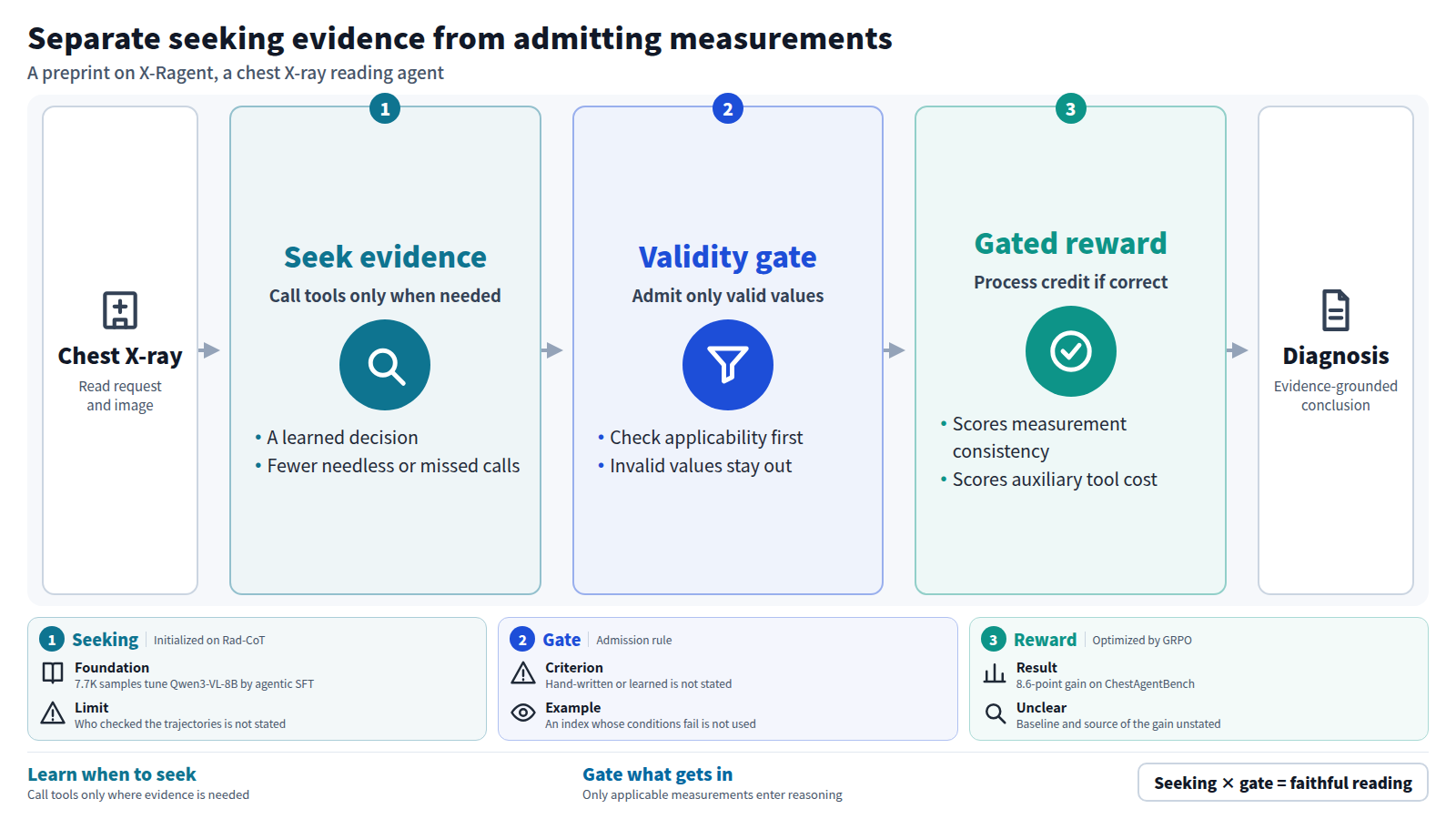
X-Ragent is a post-training framework for tool-augmented reinforcement learning. Its central design choice is to decouple two behaviours. One is deciding whether to go and look for auxiliary evidence, which the model learns. The other is a validity gate that checks whether a quantitative measurement applies to this image before the measurement is allowed into the reasoning. The first is a learned decision; the second is an admission rule for numbers.
Training has two stages. The authors first build Rad-CoT, a corpus of 7.7K samples that pairs causally ordered tool-use trajectories with diagnostic reasoning written in the style of a radiology report. They use it to initialize Qwen3-VL-8B through agentic supervised fine-tuning.
They then optimize the policy with Group Relative Policy Optimization (GRPO), an existing method that samples several answers to the same question and learns from how each compares with the rest of the group.[4] The contribution lies in the reward. Process-level terms, one for measurement consistency and one for the cost of using auxiliary tools, are applied only to trajectories whose diagnosis is correct. The authors call this an accuracy-gated reward. Its purpose is to prevent plausible-looking process behaviour from making up for an incorrect diagnosis.
3. What the abstract reports
- Data: Rad-CoT, 7.7K samples combining tool-use trajectories with report-style reasoning.
- Training: Qwen3-VL-8B initialized with agentic SFT, then optimized with GRPO under the accuracy-gated reward.
- Results: the strongest results across three chest X-ray benchmarks, including an 8.6-point improvement on ChestAgentBench, which was held out entirely from training.
- Authors' reading: by seeking evidence selectively and admitting only valid measurements, the system supports more faithful, evidence-grounded reasoning.
Several things are worth checking. The abstract does not say what the 8.6-point gain is measured against, whether the base model or another agent. It names only one of the three benchmarks. "Strongest results" depends on which systems were chosen for comparison. And the abstract does not show which part of the reward design accounts for the improvement.
4. A worked example: deciding not to use a measurement
To see what an inapplicable measurement means, consider one reading scenario. This example illustrates the idea; whether the paper covers this situation cannot be determined from the abstract. On chest X-rays, patient position and beam direction change how the heart appears, and a standard index of heart size may not be valid for every image.
Request: Assess whether this chest X-ray shows cardiomegaly.
Agent: (inspects the image) Reviewing the lung fields and mediastinum. A size measurement would help with the cardiac silhouette, so I will call the measurement tool.
Agent: (checks the gate) The acquisition conditions do not meet the assumptions behind this index. The measurement will not enter the reasoning.
Agent: I will judge from the visible findings without the number, and I will record that the measurement was rejected.
The point is that calling a tool and accepting its output are separate steps. The reward makes the same separation. Placing the two training signals side by side shows the difference.
Process reward always added
Even when the diagnosis is wrong, careful measurement and economical tool use still earn points. A trajectory can be reinforced for looking methodical while reaching the wrong answer.
Accuracy-gated reward (X-Ragent)
Measurement consistency and tool cost are scored only for trajectories with a correct diagnosis. A wrong diagnosis earns no process credit, however tidy the steps. The conclusion has to be right first.
5. What is not new, and where the limits are
Start with what is not new. Tool-using medical agents exist in earlier work, and ChestAgentBench itself came from such work.[3] GRPO is an established method, and running reinforcement learning after supervised fine-tuning is a common pattern in language-model post-training. The new parts are the split between evidence seeking and measurement admission, and the reward that restricts process credit to correct trajectories.
There are several limits. First, the criterion for whether a measurement applies. The abstract does not say what the gate looks at, or whether its rules were written by people or learned. Depending on how it was built, it may disagree with a radiologist's judgment.
Second, the scope of evaluation. Benchmark scores are usually accuracy on structured questions. The abstract says nothing about the quality of full reports, the kinds of findings missed, or effects on clinical decisions, and it does not describe the hospitals or imaging conditions behind the three benchmarks.
Third, the construction of Rad-CoT. The trajectories are described as causally ordered, but the abstract does not say who checked them or how. Whatever biases the training reasoning contains, the model will learn along with it.
Fourth, reproducibility. The selection data list zero GitHub stars and no public repository. This article has not confirmed whether code or data are available.
6. Why it drew attention, and why the cluster is still small
The selection pipeline placed this paper under Reasoning & Learning. Its cluster size is 1: no other paper on the same question turned up in this collection window, and the only signal that fired was votes on the Hugging Face paper page, with 67 upvotes, 1 comment and 0 GitHub stars.[2] Upvotes show that researchers noticed the paper. They say nothing about whether its claims hold or whether it has clinical value.
The paper's keywords still show where it sits: tool-augmented reinforcement learning, GRPO, agentic supervised fine-tuning, evidence-grounded reasoning. These terms recur across recent agent research. This site has recently covered papers on agents acting before their evidence is complete and on showing people the grounds for an agent's actions.
X-Ragent brings that line of work into a specific domain, medical imaging. The question is moving from "can the agent use tools?" to "when should it trust what the tools return?" One paper does not make a topic, though. Whether this direction grows into a cluster is something to watch over the coming weeks.
7. Where this connects to pharmaceutical and regulatory practice
Software that supports image diagnosis can be regulated as a medical device. Its assessment covers not only performance figures but also the conditions under which it may and may not be used. The idea of keeping inapplicable measurements out of the reasoning lines up with that notion of conditions of use. A system that decides when a measurement tool does not apply, and logs that decision, produces material that can support an explanation.
The accuracy-gated reward also resembles a quality-assurance principle. Following the procedure does not substitute for a correct result. The procedure is evaluated after confirming the outcome is right. What is routine in manufacturing and testing has been rewritten here as a reward design.
Benchmark results from a preprint cannot be read as clinical performance. Pharmaceutical companies are most likely to meet this kind of technology in support for image reads in clinical trials, or in checking the consistency of those reads. Even there, the record of which measurements were accepted and which were rejected must be kept, the final call must stay with physicians, and the record must be open to later review. What carries over to practice is less any specific number than the design idea: treat looking for evidence and accepting evidence as two different decisions.