AI, Philosophy & Thought News — 2026-10-15 (Thu) Evening News
Source links point to the original outlet. The AI Integrated Analysis is auto-generated from the headlines below only and is not intended to add facts beyond them. Not investment advice.
Overview
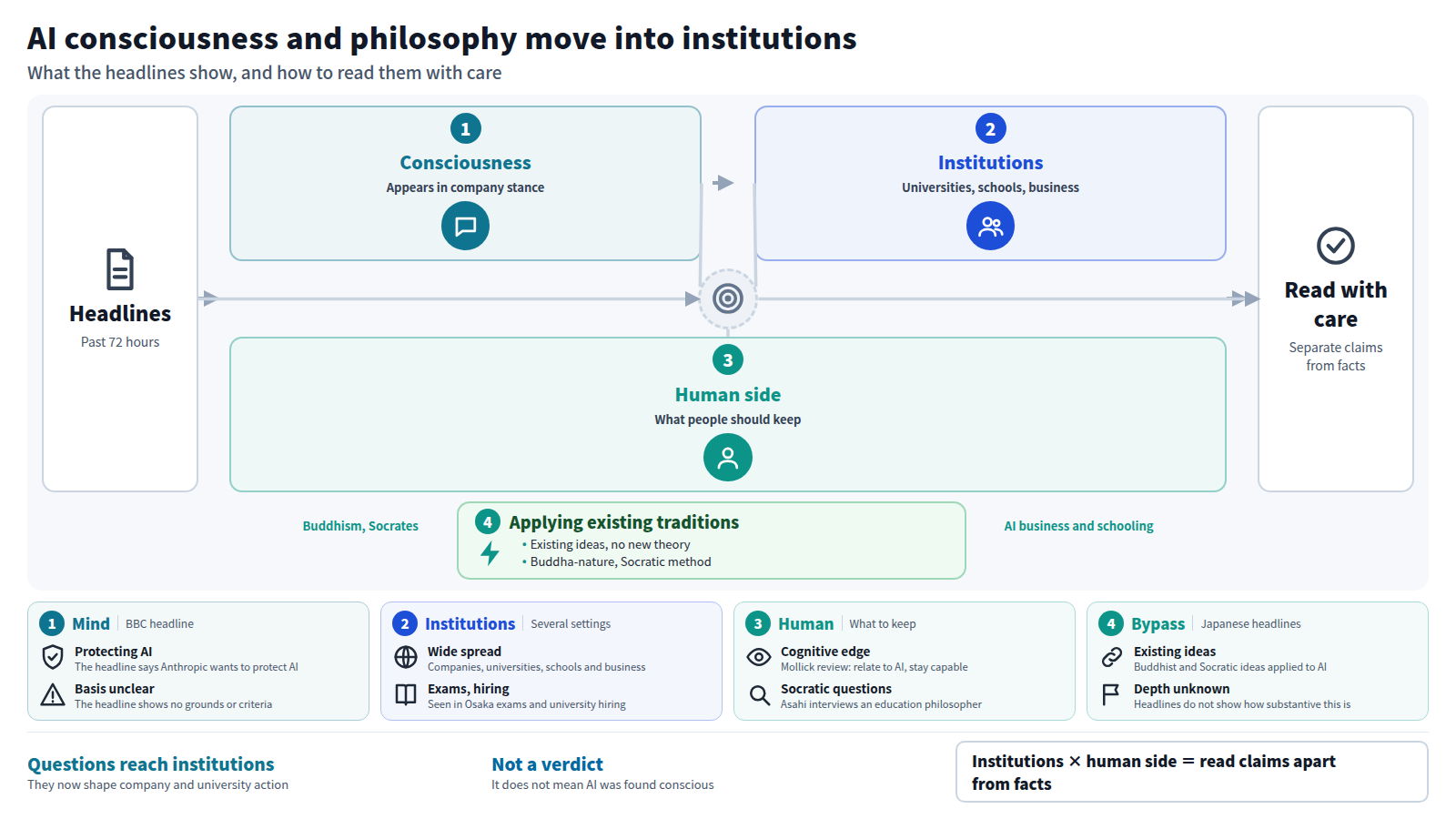
Headlines over the past 72 hours centered on whether AI systems might have experience worth protecting, on universities and schools building philosophy into AI-era education, and on Buddhist and Socratic traditions as frameworks for AI. Coverage came from BBC, Inside Higher Ed, MIT News, The New York Times, New Scientist, Nikkei Business and Asahi Shimbun. 【Philosophy of mind and consciousness】 - Anthropic is described as wanting to protect AI "from you," under the framing of a "consciousness crisis" (BBC). - A Cognitive Revolution episode on "Measuring Experience" in AI minds, paired with preserving history through 8mm memories, was listed (finance.biggo.com).
What it means to be human
- Universities are on an AI philosopher hiring spree (Inside Higher Ed). - MIT News ran a Q&A on the "collision" between AI, your brain, and society (MIT News). - The New York Times published an opinion piece titled "An A.I. Manifesto to End All A.I. Manifestoes" (The New York Times).
Knowledge and truth
No notable developments. 【Free will, responsibility and agency】 No notable developments.
Thinkers and intellectuals
- New Scientist reviewed Ethan Mollick's book Co-Existence, which it describes as showing how to build a real relationship with AI and keep your cognitive edge (New Scientist). 【Religion and spirituality and AI】 - Nikkei Business reported on Buddhism's appeal to business leaders and researchers worldwide, with headline references to an "AI with Buddha-nature" and "China's Inamori philosophy" (Nikkei Business). 【Philosophies of humanity's future】 No notable developments.
Japanese thought and AI
- Nikkei Business covered Buddhist ideas drawing attention from executives and researchers globally (Nikkei Business). - Asahi Shimbun ran an interview with an education philosopher on the "Socratic questions" considered essential in the AI era (Asahi Shimbun). - Asahi Shimbun's "Lesson for Tomorrow" series, week 3, took up "Question: Thinking about philosophy in the AI age," drawing on Osaka Prefecture public high school entrance exams (Asahi Shimbun).
Statements by key figures
No statements from the tracked figures (Yuval Noah Harari, David Chalmers, Shannon Vallor) appeared in the headlines. 【Integrated analysis: what is happening】 The headlines show the same pattern in several settings: questions once treated as abstract are being given institutional form. The consciousness question appears as a practical matter of whether and how to protect AI (BBC), universities are hiring philosophers (Inside Higher Ed), and schools are using philosophical questioning in exams and teaching (Asahi Shimbun). This suggests philosophy is being treated less as commentary and more as a working competence for dealing with AI.
A second pattern is that the human side of the relationship receives as much attention as the machine side. The MIT News Q&A, the Mollick review on keeping a "cognitive edge" (New Scientist), and the Socratic-questioning interview (Asahi Shimbun) all concern what humans should preserve in their own thinking. The reader's judgment may shift on one point: the debate appears to be moving from "does AI think?" toward "what should people do to remain capable thinkers alongside it?" This is inference from headlines alone.
Finally, non-Western traditions are entering the conversation as management and educational frameworks (Nikkei Business), though the headlines do not show how substantive this is.
What to watch
- Whether the "consciousness crisis" framing prompts concrete organizational policies, since the BBC headline describes a company acting to protect AI (BBC). - Whether university philosopher hiring turns into new programs or research centers (Inside Higher Ed). - Whether Buddhist and Socratic frameworks spread from commentary into actual management and school practice in Japan (Nikkei Business, Asahi Shimbun).
- Anthropic wants to protect AI – from you. Welcome to the consciousness crisis — BBC10/14 10:00 UTC
- AI Minds & 8mm Memories: Measuring Experience, Preserving History|The Cognitive Revolution — finance.biggo.com10/14 22:30 UTC
- Universities Are on an AI Philosopher Hiring Spree — Inside Higher Ed10/15 07:01 UTC
- Q&A: The “collision” between AI, your brain, and society — MIT News10/15 04:00 UTC
- Opinion | An A.I. Manifesto to End All A.I. Manifestoes — The New York Times10/14 19:00 UTC
- Co-Existence by Ethan Mollick review: How to build a real relationship with AI and keep your cognitive edge — New Scientist10/14 17:25 UTC
- 'Buddha-Nature AI' and 'Inamori Philosophy in China': Buddhism's Power Draws Global Executives and Researchers — Japanese media10/15 08:00 UTC
- What is the ``Socrates' question'' explained by an educational philosopher that is essential in the age of AI? — Japanese media10/14 23:00 UTC
- Lesson for Tomorrow, Week 3: Question – Thinking About Philosophy in the AI Era, From Osaka Public High School Exams — Japanese media10/14 20:00 UTC