1. What problem does the paper address?
What an LLM agent does is not fixed by its weights alone. The scaffolding around the model, its prompts, memory, workflows, and the tools and code it calls, matters a great deal. That scaffolding is called the harness. A growing line of work has agents rewrite their own harness based on execution experience.
This site has covered several preprints on harness self-improvement over the past few weeks. One raised the concern that repeated rewriting can overfit to the tasks used for evaluation[4]. As methods multiply, each paper describes in its own terms what gets rewritten, how changes are proposed, and on what grounds they are accepted.
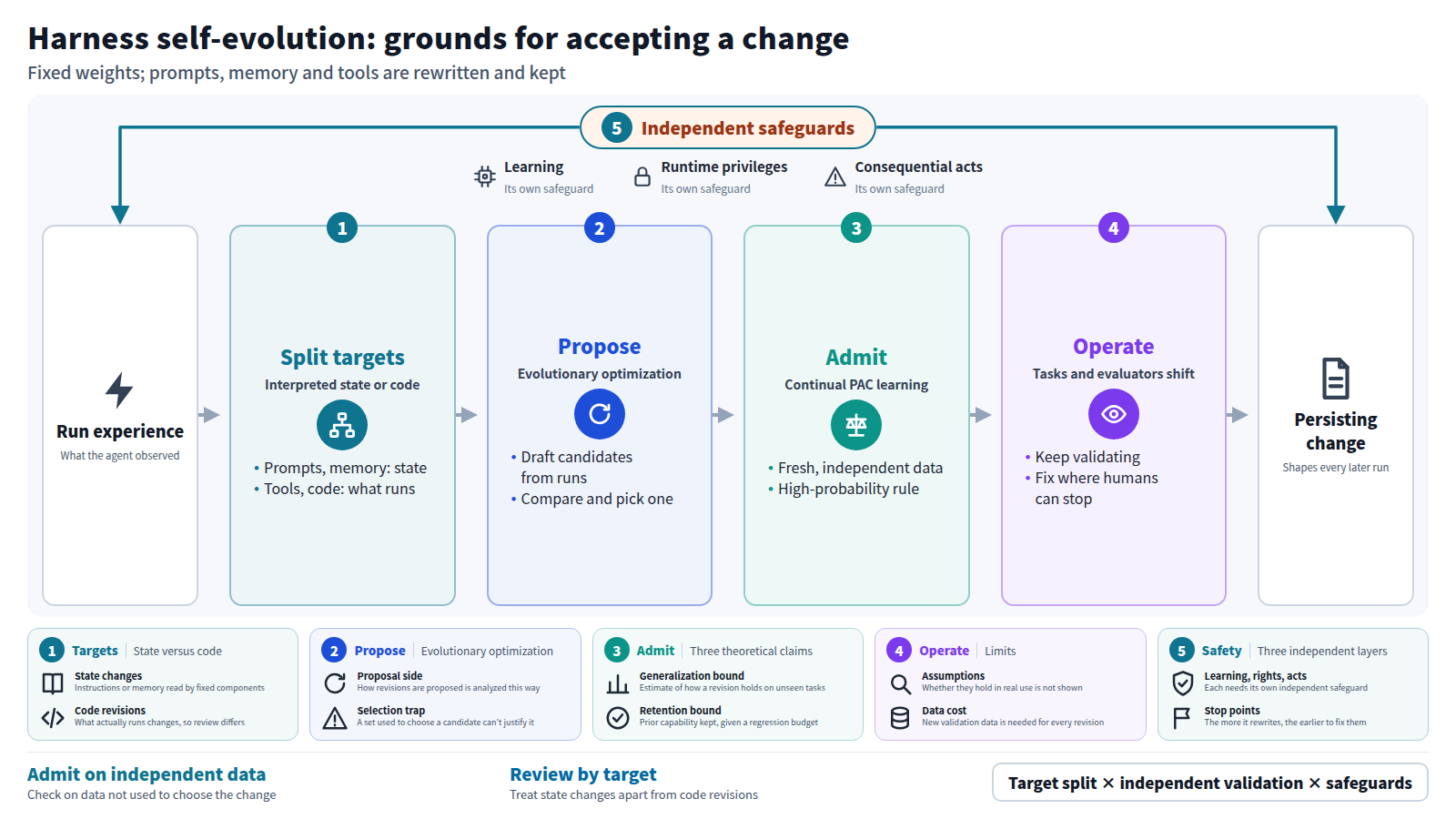
The paper discussed here, an arXiv preprint that has not been peer reviewed, tries to organize this "harness self-evolution" under one framework. In the abstract's definition, model weights stay fixed while prompts, memory, workflows and executable components are revised, and accepted revisions persist across runs[1]. Persistence is the crux. Once a change is accepted, it shapes every run that follows.
2. What does it propose?
The core move is to separate what is updated from how updates are proposed and admitted. According to the abstract, the framework treats update targets apart from proposal and admission mechanisms[1].
Among update targets it draws a further line. On one side are changes to interpreted state, such as instructions or memory read by fixed components. On the other are revisions to tools and code, repository-level control logic, and plugin composition. Rewriting the first leaves the execution frame intact; rewriting the second changes what actually runs. The point is not to call two changes with different risk profiles by the same name.
The proposal side is analyzed as evolutionary optimization, and the admission side through continual PAC learning, the branch of learning theory that asks how much data is needed to guarantee generalization with a given confidence.
3. What did it show, within the abstract?
The results are theoretical claims under explicit assumptions, not experimental numbers. The abstract lists three[1].
- An expected generalization bound: an estimate of how well a revision holds on unseen tasks.
- A retention bound conditional on historical regression budgets: how much prior capability is kept, given how much backsliding has been tolerated.
- A high-probability admission rule that uses fresh, independent validation data.
The paper also draws cases from prior work to illustrate model-harness co-design, distributed execution and plugin reuse. The abstract closes by saying reliable deployment needs continual validation as task distributions and evaluators change, with independent safeguards for learning, runtime privileges and consequential actions.
The abstract points to a 66-page discussion of related work, theory, algorithms, evaluation, applications and broader impact, published on GitHub. The version on arXiv is a shorter text; the long discussion lives on GitHub.
4. A worked example
Consider an agent that helps with internal inquiries, where automatic harness revision is being trialed.
An operations lead and a quality assurance lead
Operations: "Based on last week's failures, the agent proposed adding a sentence to its own instructions. Scores went up on our evaluation question set, so I'd like to adopt it."
QA: "Did you also use that question set to choose among the candidate revisions?"
Operations: "Yes. We compared several candidates and picked the best."
QA: "Then the score on that set can't justify adoption. Check it on questions that were never used in the selection. Also, this one changes instructions. If the next proposal rewrites tool code, it goes through a different review."
The two QA points map directly onto the paper's framework: use fresh, independent validation data for admission, and treat changes to state such as instructions separately from revisions to code.
5. What is not new, and where are the limits?
First, this paper does not present a new method backed by experiments. The GitHub repository and project page call the work a survey and describe it as a working draft[2][3]. The repository holds the draft, a reading list, a taxonomy and evidence-grading criteria; it contains no runnable agent implementation[2].
The theory comes with conditions. The generalization and retention bounds are derived under explicit assumptions, and how far those assumptions hold in real deployments is not shown in the abstract. The admission rule's demand for fresh, independent validation data means new data must be prepared for every revision, and how to pay for that remains open.
The authors are frank about weak evidence. Their project page judges that the thinnest evidence in existing work concerns activation, whether an accepted revision actually ran in the scored runs, and attribution, whether that revision caused the measured difference. It also notes that held-out data used for ranking or admission is no longer fully independent of the search[3].
One more point. This site's selection design excludes papers that are only surveys or position papers from counting as a hot topic. The paper is read here as an organizing framework, and should not be treated as reporting a primary finding.
6. Why is this topic clustering now?
In this collection window no other paper joined its cluster; the cluster size is 1. As a single paper, its visibility comes from 185 upvotes on Hugging Face and 43 GitHub stars. These numbers show reader and implementer interest, not correctness. Since the repository contains no runnable code, the stars are better read as interest in the reading list and materials than as implementation uptake.
No cluster formed this time, but the theme continues. Over recent weeks this site has covered preprints on component-wise harness self-improvement, regularized rewriting and composing harnesses. The keywords attached to this paper, continual validation, plugin composition and model-harness co-design, are issues those individual methods share. After methods multiply, organizing frameworks follow; this paper belongs to that stage.
7. Where does this connect to pharma and regulatory work?
The fact that accepted revisions persist across runs is, in regulated work, a change-control problem. If an agent rewrites its own instructions or tools, someone must record when, what and on what grounds a change was accepted, and keep versions so that it can be rolled back.
The paper's demand for independent validation data in its admission rule lines up with computerized system validation. Approval of a change should rest on checks against data not used in choosing that change. The split between instruction changes and code revisions likewise matches the practice of scaling review depth to the impact of a change.
The independent safeguards the abstract names, for learning, runtime privileges and consequential actions, are where design should start when agents are used to process safety information or draft documents for regulators. The more a system keeps rewriting itself, the earlier the points where people can stop it need to be fixed.