AI & International Politics News — 2026-10-16 (Fri) Evening News
Source links point to the original outlet. The AI Integrated Analysis is auto-generated from the headlines below only and is not intended to add facts beyond them. Not investment advice.
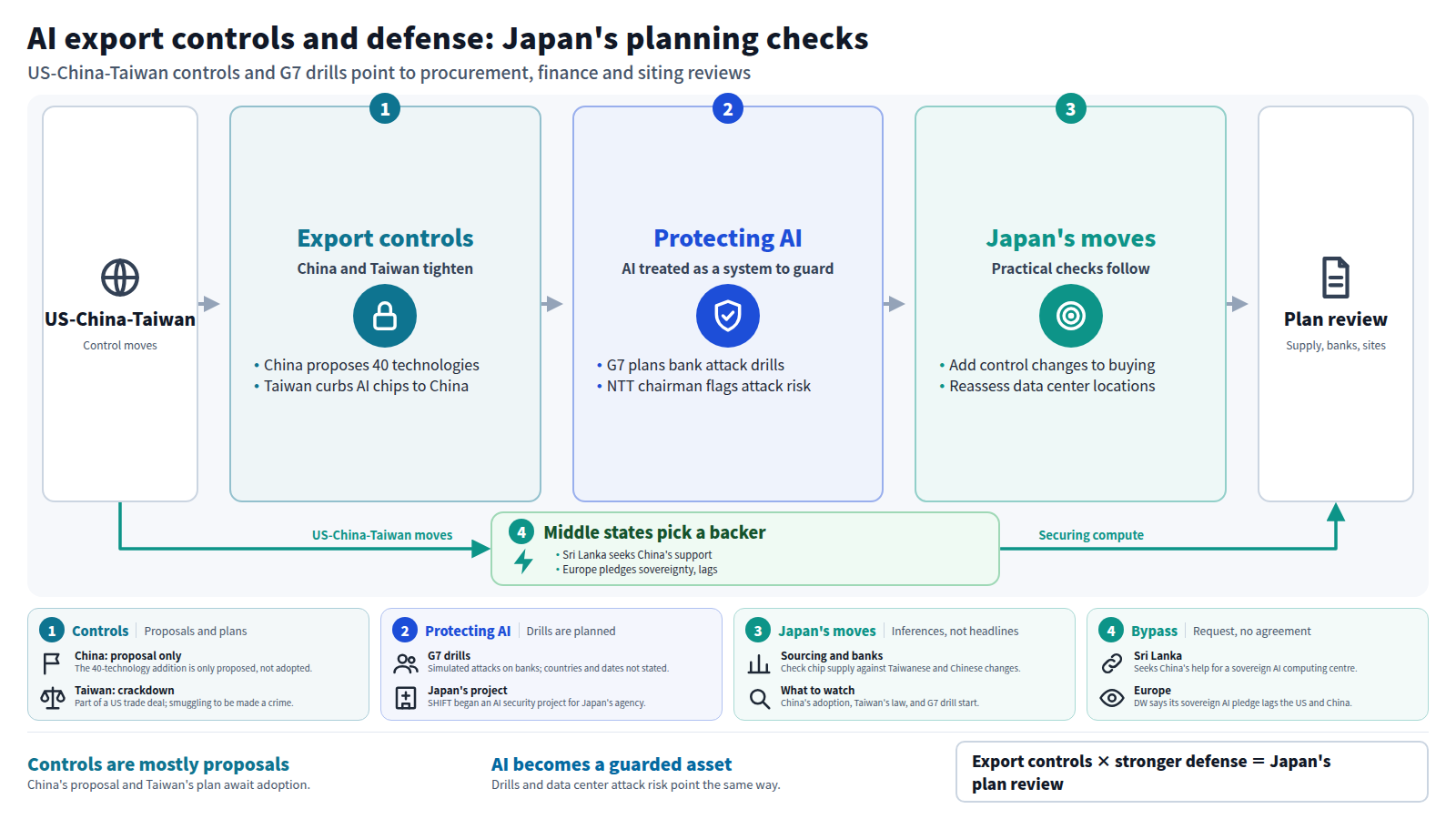
Overview
G7 economies are planning simulated AI cyberattack drills aimed at banks (Reuters, Financial Times, Technology Org). Taiwan is moving to curb AI chip exports to China as part of a US trade deal (Bloomberg), while China is weighing new export controls on AI, biotech and solar technologies (The Mighty 790 KFGO, South China Morning Post).
US-China competition
- China has proposed adding 40 AI, biotech and solar technologies to its export control list (The Mighty 790 KFGO). China is also mulling new tech export bans covering AI, biotech and solar power (South China Morning Post). - Taiwan is set to curb AI chip exports to China as part of a US trade deal (Bloomberg). - A US representative, Rep. Jacobs, argues in an opinion piece that Washington is getting the AI race "all wrong" (Newsweek). - The CEO of Reflection says the company's model puts it within "shooting distance" of China's AI models (CNBC Television). - At talks in Bangkok, the IMF warned of widening economic gaps amid an AI investment boom (Asia News Network). 【International organizations and agreements】 - No agreement was reported. Bloomberg ran a piece headlined "AI Race Heats Up Again a Month After Calls for a Slowdown" (Bloomberg). - Sri Lanka is seeking China's support for a National Sovereign AI Computing Centre. This is a request, not an agreement (Tech Review Africa). - The IMF warning from the Bangkok talks is covered in section 2 (Asia News Network). 【Diplomacy, summits and alliances】 - The G7 is set to launch exercises to guard against AI cyberattacks (Reuters). G7 economies plan simulated AI attacks on banks as cyber fears rise (Financial Times). The plan is for drills against AI cyberattacks on banks (Technology Org). These are plans; the headlines do not report that the exercises have started. - Europe pledges safe, sovereign AI but lags far behind the US and China (DW.com).
Security and military
- Japan's SHIFT has started a project on AI use in security, under a project of Japan's Defense Equipment Agency (Nikkei). The headline does not say whether anything has been deployed. - At an international conference, NTT Chairman Jun Sawada said data centers for AI face "attack risk" from conflicts and that the situation is serious (Infoseek). The headline gives the risk as his assessment. 【Elections and information warfare】 No notable developments. 【Export controls and state-to-state maneuvering】 - Taiwan is set to curb AI chip exports to China as part of a US trade deal (Bloomberg). Taiwan plans to tighten AI chip export controls (Intellectia AI). Taiwan will make it a crime to smuggle AI chips into China (Startup Fortune). - China has proposed adding 40 AI, biotech and solar technologies to its export control list (The Mighty 790 KFGO). China is also mulling new tech export bans on AI, biotech and solar power (South China Morning Post). Both are proposals or deliberations, not adopted measures. - A conservative AI safety group has proposed export controls and visa restrictions, according to an exclusive report (Semafor). This is a proposal from a private group.
Japan's diplomacy and AI
- Japan's SHIFT has started an AI-for-security project under Japan's Defense Equipment Agency (Nikkei). - NTT's Sawada warned of attack risk to AI data centers from conflicts and similar events (Infoseek). - A Korean-language Maeil Business Newspaper item says chronic geopolitical risk, rapid changes in business structure from technological innovation such as AI, and shifting patterns of weather disruption and disasters are adding to the burden of uncertainty on corporate management (Maeil Business Newspaper).
Statements by key figures
No notable developments. No statements from António Guterres (UN Secretary-General), Narendra Modi (Prime Minister of India) or Emmanuel Macron (President of France) appear in the material. 【Integrated analysis: what is happening】 - Export controls appear to be moving in several places at once. Taiwan's chip curbs are described as part of a US trade deal (Bloomberg), and China is separately weighing controls on AI, biotech and solar technologies (The Mighty 790 KFGO, South China Morning Post). This likely means the US, Taiwan and China are each shaping controls partly in response to the others, though the headlines do not state a causal link. - Smaller states are positioning between the large powers. Sri Lanka is seeking Chinese support for sovereign AI computing (Tech Review Africa), while Europe's sovereign AI pledges are described as lagging the US and China (DW.com). - The G7 plans address AI-enabled cyber risk to banks (Financial Times, Reuters). This suggests AI is being treated as a financial-stability issue as well as a technology contest. The conflict-related risk to data centers raised by NTT's chairman points the same way (Infoseek). - For Japanese companies and agencies, the likely implications are a need to check supply chains for AI chips and related technologies against Taiwanese and Chinese control changes, and to include data center security and bank cyber resilience in their risk planning. These are inferences, not statements in the headlines.
What to watch
- Whether China formally adopts the proposed addition of 40 technologies to its export control list, and how Taiwan's chip curbs are put into law (inferred from The Mighty 790 KFGO, Bloomberg, Startup Fortune). - Whether and when the G7 bank AI cyberattack drills actually begin, and which countries take part (inferred from Reuters, Financial Times). - Whether other countries follow Sri Lanka in seeking outside support for sovereign AI computing (inferred from Tech Review Africa).
- China proposes adding 40 AI, biotech, solar technologies to export control list — The Mighty 790 KFGO10/16 09:02 UTC
- Rep. Jacobs: Washington Is Getting the AI Race All Wrong | Opinion — Newsweek10/16 09:00 UTC
- Bangkok talks: IMF warns of widening economic gaps amid an AI investment boom — Asia News Network10/16 00:50 UTC
- G7 to launch exercises to guard against AI cyber attacks — Reuters10/16 02:57 UTC
- Europe pledges safe, sovereign AI but lags far behind US and China — DW.com10/16 09:13 UTC
- SHIFT launches AI-in-security project for Japan's Equipment Agency — Japanese media10/16 01:39 UTC
- The burden of uncertainty that makes business management difficult is increasing, such as chronic geopolitical risks, sudden changes in business structures due to technological innovations such as artificial intelligence (AI), and changing patterns of weather and disasters. As a company, we have to sacrifice some efficiency. — 매일경제10/16 08:03 UTC
- AI data centers face attack risk from conflicts, NTT chairman Sawada tells international conference — Infoseek10/16 08:00 UTC
- AI Race Heats Up Again a Month After Calls for a Slowdown — Bloomberg10/15 20:30 UTC
- Sri Lanka seeks China’s support for National Sovereign AI Computing Centre — Tech Review Africa10/15 19:35 UTC
- Taiwan to Curb AI Chip Exports to China as Part of US Trade Deal — Bloomberg10/16 05:49 UTC
- Exclusive / Conservative AI safety group proposes export controls, visa restrictions — Semafor10/16 08:56 UTC
- Taiwan Will Make It a Crime to Smuggle AI Chips Into China — Startup Fortune10/16 06:35 UTC
