AI & Finance News — 2026-10-16 (Fri) Evening News
Source links point to the original outlet. The AI Integrated Analysis is auto-generated from the headlines below only and is not intended to add facts beyond them. Not investment advice.
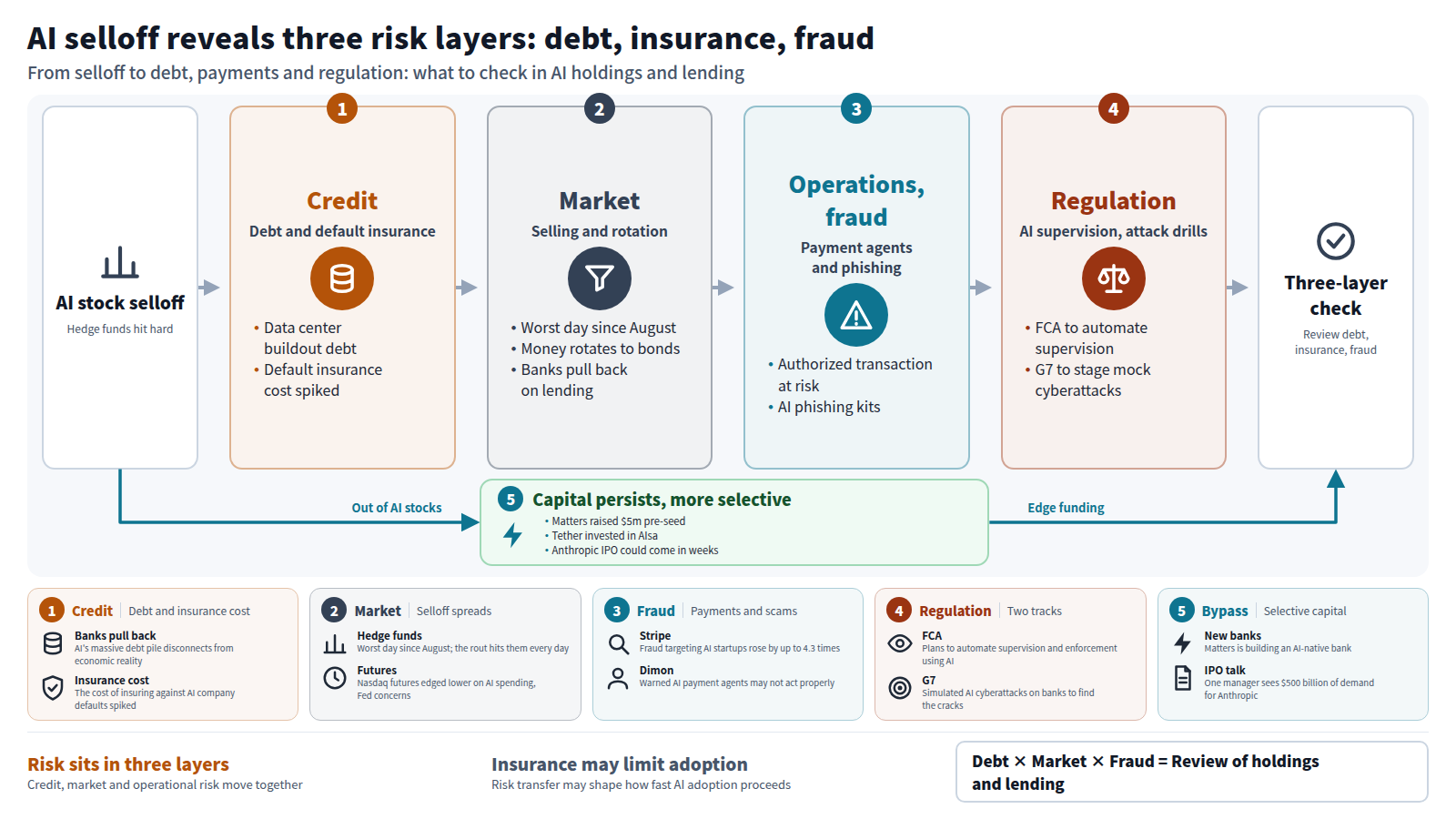
Overview
Selling in AI stocks deepened, with hedge funds suffering their worst day since August, and credit-market stress showed up as the cost of insuring against AI company defaults spiked (TradingView, Semafor). Doubts about the data center buildout hit both AI stocks and bonds (The Globe and Mail). Meanwhile, concern shifted to agentic payments and AI-enabled cyberattacks, with Jamie Dimon warning that AI payment agents may not act properly (Benzinga, PYMNTS.com, RNZ).
Banks
Banks are pulling back as AI's massive debt pile disconnects from economic reality (Axios). Citi spotted AI upside in two software stocks despite earnings and execution risks (Yahoo Finance). On the defensive side, the G7 will stage fake AI cyberattacks on banks to find the cracks first (Startup Fortune). Stockholm startup Matters raised $5m pre-seed to build an AI-native bank, and Spade is bringing transaction AI to banks of every size (The Next Web, FinTech Global). In Japan, Hokuyo Bank developed an AI-based congestion prediction model to share branch crowding forecasts by calendar and shorten waiting times (AIsmiley). A d Menu News piece discusses finance as a strong domain for AI and the future of "unmanned banks" (d Menu News).
Insurance
WSJ says AI has run into its next big obstacle: insurance (WSJ). Risk & Insurance covers the next phase of AI governance at ITC Vegas 2026, and Insurance Journal argues that model independence is an AI strategy insurers cannot afford to ignore (Risk & Insurance, Insurance Journal). Coalition warns that AI phishing kits are making micro businesses worth attacking (Insurance Business). Denver's Vertafore launched AI tools to automate insurance policy processing (ColoradoBiz). 【Asset management and market trading】 Hedge funds suffered their worst day since August as the AI stock selloff deepened, and Goldman Sachs found the rout hits hedge funds every day (TradingView, Yellow.com). Nasdaq futures edged lower as AI spending and Fed rate concerns weighed (Yahoo Finance). The Financial Times and WSJ ran pieces titled "Wall Street's AI wobbles" and "The Market's Rude Reminder on AI" (Financial Times, WSJ). Hanwha Asset Management hosted Cathie Wood and forecast 2030 growth on AI and robotics (Chosunbiz). Crypto traders are embracing AI for research, though whether it can be trusted to trade remains open (AMBCrypto). Bloomberg Television's market analysis says Asia tech's muted rebound shows AI doubts persist, and asks whether AI capex is a gamble or a jackpot (Bloomberg Television).
Fintech and payments
PYMNTS.com argues that agentic payments are about to break the meaning of an authorized transaction (PYMNTS.com). Coinbase (NASDAQ:COIN) warned of quantum key risk and allows AI payments (TradingView). In Japan, Tether made a strategic investment in AIsa, a payment infrastructure for AI agents (Atarashii Keizai via Yahoo! News Japan). Stripe disclosed that fraudulent payments targeting AI startups rose by up to 4.3 times, with subscription-based companies hit (CodeZine). 【Statements by financial leaders and officials】 - Jamie Dimon, CEO of JPMorgan Chase: warned that AI payment agents may not act properly (Benzinga). Dimon also said AI is moving so fast that even governments cannot stop it (Business Insider). - Larry Fink, CEO of BlackRock: flagged an AI risk different from the bubble (Yahoo Finance). - Jane Fraser, David Solomon, Brian Moynihan, Ted Pick, Ken Griffin, Paul Atkins: No notable developments.
AI-related stocks and funding
Investors are shifting away from AI stocks toward bonds and defensive sectors (Investing.com Australia). The cost of insuring against AI company defaults spiked (Semafor). Investor doubts over the data center buildout hit AI stocks and bonds (The Globe and Mail). One hedge fund manager sees $500 billion of demand for an Anthropic IPO, which could come in weeks rather than months (Benzinga). Jim Cramer named two non-AI stocks worth buying (CNBC). An op-ed argues that the greatest danger is not that the AI bubble will burst but that investors refuse to see it (DirectIndustry e-Magazine). 【Financial regulation and supervision】 The UK's FCA plans to automate supervision and enforcement using AI (FStech). Financial regulators are urging stronger cyber security amid AI-enabled cyberattacks (RNZ). The G7 plans simulated AI cyberattacks on banks (Startup Fortune). Professor George Georgiev addressed AI in financial markets with senior regulators in Brazil and Argentina (University of Miami News). A report says investment advisers reveal AI as a risk more often than a capability (Bioengineer.org). Japan's Financial Services Agency: No notable developments. 【Integrated analysis: what is happening】 The headlines point to a shift from enthusiasm to pricing risk. Equity selloffs, hedge fund losses, a rotation toward bonds and defensive sectors, and a spike in default-insurance costs suggest that money is moving out of AI exposure and that credit markets are now questioning how the buildout is financed (TradingView, Investing.com Australia, Semafor, Axios). Banks pulling back from AI debt appears consistent with this, though the headlines do not show the cause (Axios). A second cluster concerns operational risk. Agentic payments, AI payment agents, AI phishing kits and fraud against AI startups all raise the question of who is accountable when software acts (PYMNTS.com, Benzinga, Insurance Business, CodeZine). Insurers are treated as a possible bottleneck, which may mean that risk transfer for AI will shape how fast adoption proceeds (WSJ). Regulators appear to be moving on two tracks: using AI themselves (FCA) and stress-testing resilience against AI-enabled attacks (G7, RNZ). Meanwhile, funding continues at the edges, such as Matters, Tether's investment in AIsa and talk of an Anthropic IPO, so capital seems to be becoming more selective rather than disappearing (The Next Web, Yahoo! News Japan, Benzinga).
What to watch
- Whether the cost of insuring against AI company defaults and the bond-market doubts about the data center buildout keep widening, and whether banks pull back further (Semafor, The Globe and Mail, Axios). - Whether rules or industry standards emerge on liability and authorization for agentic payments, and how insurers respond (PYMNTS.com, WSJ). - The design and outcome of the G7's simulated AI cyberattacks on banks, and whether other regulators follow the FCA in using AI for supervision (Startup Fortune, FStech).
- Stockholm startup Matters raises $5m pre-seed to build an AI-native bank — The Next Web10/16 08:06 UTC
- Spade brings transaction AI to banks of every size — FinTech Global10/16 08:48 UTC
- Citi spots AI upside in two software stocks despite earnings and execution risks — Yahoo Finance10/16 02:43 UTC
- G7 Will Stage Fake AI Cyberattacks on Banks to Find the Cracks First — Startup Fortune10/16 08:35 UTC
- AI Runs Into Its Next Big Obstacle: Insurance — WSJ10/16 01:00 UTC
- ITC Vegas 2026: The Next Phase of A.I. Governance — Risk & Insurance10/16 07:13 UTC
- Viewpoint: Model Independence Is the AI Strategy Insurers Can’t Afford to Ignore — Insurance Journal10/16 05:49 UTC
- AI phishing kits are making micro businesses worth attacking, Coalition warns — Insurance Business10/16 08:49 UTC
- Denver’s Vertafore launches AI tools to automate insurance policy processing — ColoradoBiz10/16 01:13 UTC
- BlackRock CEO Larry Fink Flags a Different AI Risk, and It Isn’t the Bubble — Yahoo Finance10/16 07:20 UTC
- Anthropic IPO Could Come in ‘Weeks, Not Months’ — Top Hedge Fund Manager Sees $500 Billion Demand, Draws — Benzinga10/16 08:26 UTC
- Hedge funds suffer worst day since August as AI stock selloff deepens — TradingView10/16 04:03 UTC
- AI Stock Rout Hits Hedge Funds Every Day, Goldman Sachs Finds — Yellow.com10/16 05:33 UTC
- Hanwha Asset Management hosts Cathie Wood, forecasts 2030 growth on AI, robotics - CHOSUNBIZ — Chosunbiz10/16 06:37 UTC
- Banks are pulling back as AI's massive debt pile disconnects from economic reality — Axios10/16 09:00 UTC
- Wall Street’s AI wobbles — Financial Times10/16 04:01 UTC
- Nasdaq futures edge lower as AI spending, Fed rate concerns weigh — Yahoo Finance10/16 01:40 UTC
- Opinion | The Market’s Rude Reminder on AI — WSJ10/15 21:44 UTC
- Crypto traders embrace AI for research – But can they trust it to trade? — AMBCrypto10/16 04:00 UTC
- Agentic Payments Are About to Break the Meaning of an Authorized Transaction — PYMNTS.com10/16 08:04 UTC
- Key facts: NASDAQ:COIN warns quantum key risk; allows AI payments — TradingView10/16 07:00 UTC
- OP-ED. The AI Bubble : The Greatest Danger Is Not That It Will Burst, but That Investors Refuse to See It — DirectIndustry e-Magazine10/16 07:38 UTC
- Looking for non-AI stocks to own? Jim Cramer thinks these 2 names are worth buying — CNBC10/15 22:43 UTC
- Investor doubts over data centre buildout hit AI stocks, bonds — The Globe and Mail10/15 23:45 UTC
- Professor George Georgiev addresses AI in financial markets with senior regulators in Brazil and Argentina — University of Miami News10/15 21:44 UTC
- Financial regulators urge stronger cyber security amid AI-enabled cyber attacks — RNZ10/15 23:45 UTC
- Investment Advisers Reveal AI as Risk More Often Than Capability — Bioengineer.org10/15 23:44 UTC
- North Pacific Bank develops a ``congestion prediction model'' using AI. Share in-store congestion predictions on the calendar to reduce waiting times — AIsmiley10/16 06:37 UTC
- Tether makes strategic investment in AI agent payment platform AIsa — Japanese media10/16 07:44 UTC
- Fraudulent payments targeting AI startups rise up to 4.3 times, Stripe says — CodeZine10/16 07:45 UTC
- Why is finance a ``specialty area'' for AI? The future of ``unmanned banking'' as technology advances in the industry — Japanese media10/16 06:30 UTC
- Jamie Dimon says AI is moving so fast that even governments can't stop it — Business Insider10/16 05:28 UTCJamie Dimon / JPMorgan Chase CEO

