AI & Economy News — 2026-10-16 (Fri) Evening News

Source links point to the original outlet. The AI Integrated Analysis is auto-generated from the headlines below only and is not intended to add facts beyond them. Not investment advice.
Overview
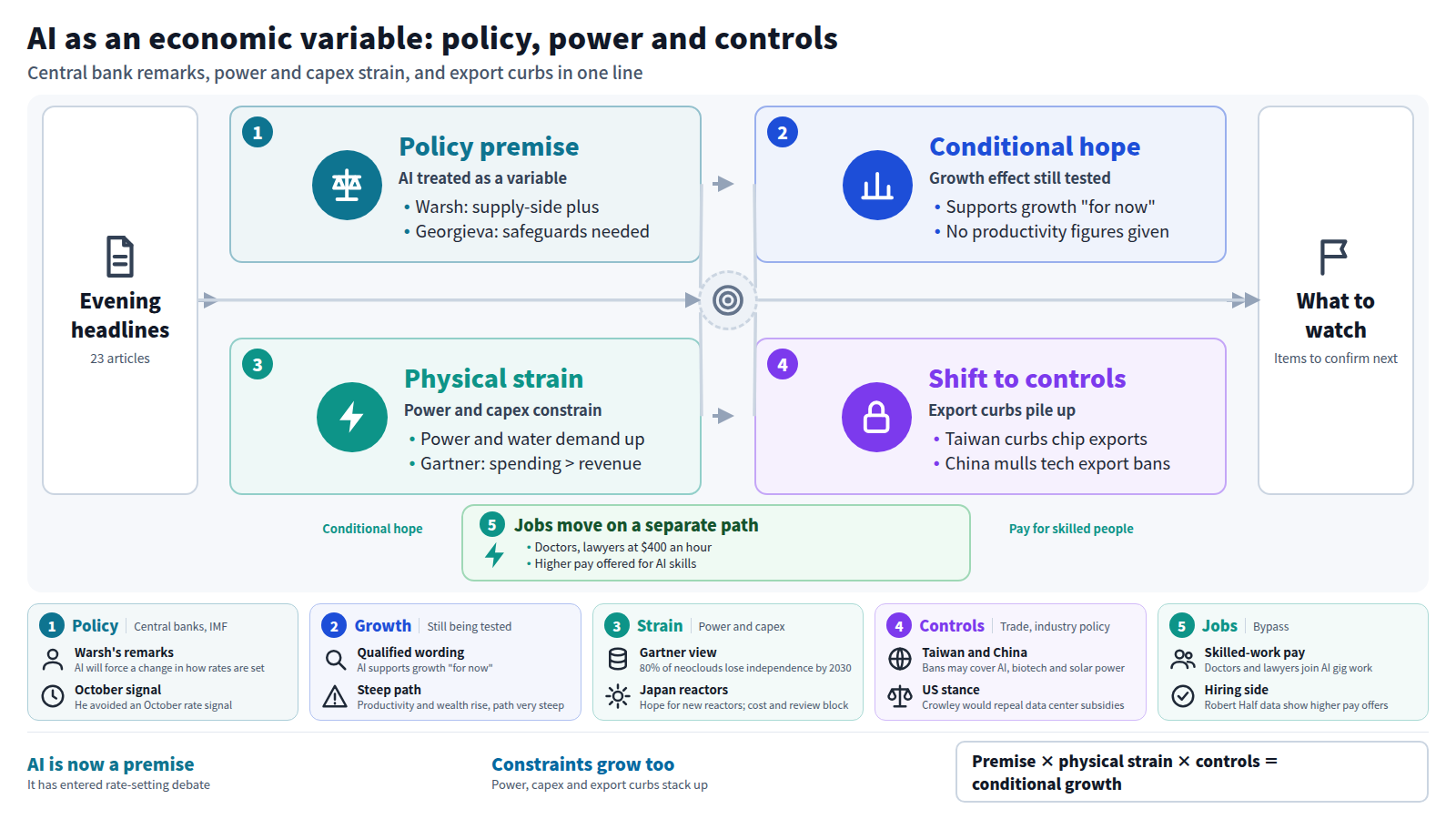
Fed Chair Kevin Warsh is described as seeing AI as a positive supply shock while avoiding an October rate signal (TradingView), and as saying AI will force the central bank to change how it sets rates (Startup Fortune). IMF Managing Director Kristalina Georgieva repeatedly warned that AI risks may exceed opportunities without safeguards (TradingView, Nation Thailand, Business Recorder). On trade, Taiwan is moving to curb AI chip exports to China as part of a US trade deal (Bloomberg), and China is weighing new tech export bans (South China Morning Post).
Macro and growth
One headline says a US dollar inflation paradox, AI credit risks and energy costs are repricing global growth (Investing.com). A former US commerce secretary says AI is supporting economic growth "for now" (WOODTV.com). Fed Chair Warsh sees AI as a positive supply shock but avoids an October rate signal (TradingView). Bank of Japan Governor Kazuo Ueda said the effects of the Middle East, AI and the exchange rate on the economy and prices need attention (Minkabu).
Productivity
China Daily describes AI's promise meeting the reality of work and productivity (China Daily). Other pieces frame AI as a second chance for workers and examine its effect on American workers (FTI Consulting, National Affairs). Warsh said AI raises productivity and wealth but the path is very steep (Chosun Ilbo). The headlines give no productivity figures.
Jobs and the labor market
Doctors and lawyers are joining AI's $400-an-hour gig economy (Bloomberg). Robert Half survey data show companies offering higher pay to applicants with AI skills (Facebook). Ogletree outlines California's new rules for AI at work for 2026 and beyond (Ogletree). No layoffs news appears in this batch.
Energy and power demand
Local reporting examines AI's growing demand for power and water (WCTI). HD Hyundai Electric and LG CNS are partnering on power infrastructure for AI data centers (THE ELEC). In Japan, next-generation reactors are seen as a hope for AI power demand, but cost and regulatory review remain high barriers, according to Ken Koyama (Weekly Economist Online). 【Central banks, international organizations and key figures】 Kevin Warsh, Fed Chair: said AI will force the central bank to change how it sets rates (Startup Fortune). Separately, Warsh sees AI as a positive supply shock and avoids an October rate signal (TradingView). Kristalina Georgieva, IMF Managing Director: said AI risks may exceed opportunities without safeguards and an ethical framework (TradingView, UA.NEWS). Georgieva also warned that debt and AI deepen global economic divides (Nation Thailand), wrote that the world can't afford to get AI wrong (Eurasia Review), and urged cooperation on AI and cyber risks (Business Recorder). Kazuo Ueda, Bank of Japan Governor: said the effects of the Middle East, AI and the exchange rate on the economy and prices need attention (Minkabu). No new statements from the other tracked figures.
Corporate capital spending
Gartner says 80% of neoclouds will lose independence by 2030 as AI infrastructure spending outpaces revenue (CRN Asia). HD Hyundai Electric and LG CNS are cooperating on AI data center power infrastructure (THE ELEC).
Trade and industrial policy
Taiwan is to curb AI chip exports to China as part of a US trade deal, and plans to tighten AI chip export controls (Bloomberg, Intellectia AI). China is mulling new tech export bans covering AI, biotech and solar power (South China Morning Post). A conservative AI safety group proposes export controls and visa restrictions (Semafor). Crowley says they would repeal data center tax subsidies and regulate AI and social media (Wisconsin Examiner). Anthropic opened a Singapore office and signed an MOU with the government on AI safety and adoption (Yahoo! News Japan). 【Integrated analysis: what is happening】 The headlines suggest AI is now being treated as a macroeconomic variable. Warsh frames it as a supply shock that may change rate-setting, while Ueda lists it alongside the Middle East and the exchange rate as a factor for the economy and prices (TradingView, Startup Fortune, Minkabu). Optimism about growth and productivity appears conditional: "for now" and a steep path are the recurring qualifiers (WOODTV.com, Chosun Ilbo). Power and capital spending look like the physical constraints. Rising power demand, nuclear hurdles in Japan and Gartner's view that spending outpaces revenue may point to strain between investment and returns (WCTI, Weekly Economist Online, CRN Asia). Policy appears to be shifting toward controls, with chip export curbs, possible Chinese export bans and calls to repeal data center subsidies. This may fragment supply chains, though the headlines do not show the outcome. The IMF's emphasis on divides and safeguards likely reflects concern that the benefits will be unevenly distributed.
What to watch
Whether Warsh's remarks on AI translate into a concrete change in rate-setting, and what signal follows in October. 2. The scope and timing of Taiwan's chip export tightening and any Chinese export bans, and how they interact. 3. Whether power supply, nuclear policy and data center subsidies become binding limits on AI investment.
- US Dollar Inflation Paradox: AI Credit Risks, Energy Costs Repricing Global Growth — Investing.com10/16 08:14 UTC
- Fed's Warsh sees AI as positive supply shock, avoids October rate signal — TradingView10/16 05:00 UTC
- Former commerce secretary says AI is supporting economic growth — for now — WOODTV.com10/15 21:50 UTC
- AI's promise meets the reality of work and productivity — China Daily10/16 08:35 UTC
- AI Gives Workers a Second Chance — FTI Consulting10/16 04:04 UTC
- AI and American Workers — National Affairs10/16 00:58 UTC
- Doctors and Lawyers Are Joining AI's $400-an-Hour Gig Economy — Bloomberg10/16 07:00 UTC
- Companies are offering higher pay to job applicants with AI skills, according to new survey data from hiring agency Robert Half. — Facebook10/15 23:22 UTC
- News 12 Investigates: AI's growing demand for power and water — WCTI10/15 23:48 UTC
- HD Hyundai Electric, LG CNS Partner on AI Data Center Power Infrastructure — THE ELEC, Korea Electronics Industry Media10/16 06:49 UTC
- Crowley says he would repeal data center tax subsidies, regulate AI and social media — Wisconsin Examiner10/16 08:35 UTC
- Taiwan to Curb AI Chip Exports to China as Part of US Trade Deal — Bloomberg10/16 05:49 UTC
- Exclusive / Conservative AI safety group proposes export controls, visa restrictions — Semafor10/16 08:56 UTC
- Breaking | China mulls new tech export bans covering AI, biotech and solar power — South China Morning Post10/16 08:31 UTC
- Fed Chair Kevin Warsh says AI will force the central bank to change how it sets rates — Startup Fortune10/16 05:15 UTC
- IMF chief says AI risks may exceed opportunities without safeguards and ethical framework — TradingView10/16 08:15 UTC
- Expectations for next-generation nuclear reactors due to AI power demand High cost, regulations and examination barriers Ken Koyama — Japanese media10/16 01:52 UTC
- Bank of Japan Governor Ueda: The impact of the Middle East, AI, and foreign exchange on the economy and prices requires attention — Japanese media10/16 06:36 UTC
- UK Government Backs AI Firms Tackling Public Services in £100 Million Competition — Japanese media10/16 02:05 UTC
- Anthropic Opens Singapore Office, Signs MOU with Government on AI Safety and Adoption — Japanese media10/16 07:50 UTC
- Warsh: AI Can Raise Productivity and Wealth, but the Path Will Be Very Steep — 조선일보10/16 05:02 UTC
- Georgieva: The World Can’t Afford To Get AI Wrong – OpEd — Eurasia Review10/15 23:09 UTCKristalina Georgieva / IMF Managing Director
- IMF chief Georgieva sounds alarm about AI, cyber risks; urges cooperation — Business Recorder10/16 07:08 UTCKristalina Georgieva / IMF Managing Director