Living and Working with AI News — 2026-10-16 (Fri) Evening News
Source links point to the original outlet. The AI Integrated Analysis is auto-generated from the headlines below only and is not intended to add facts beyond them. Not investment advice.
Overview
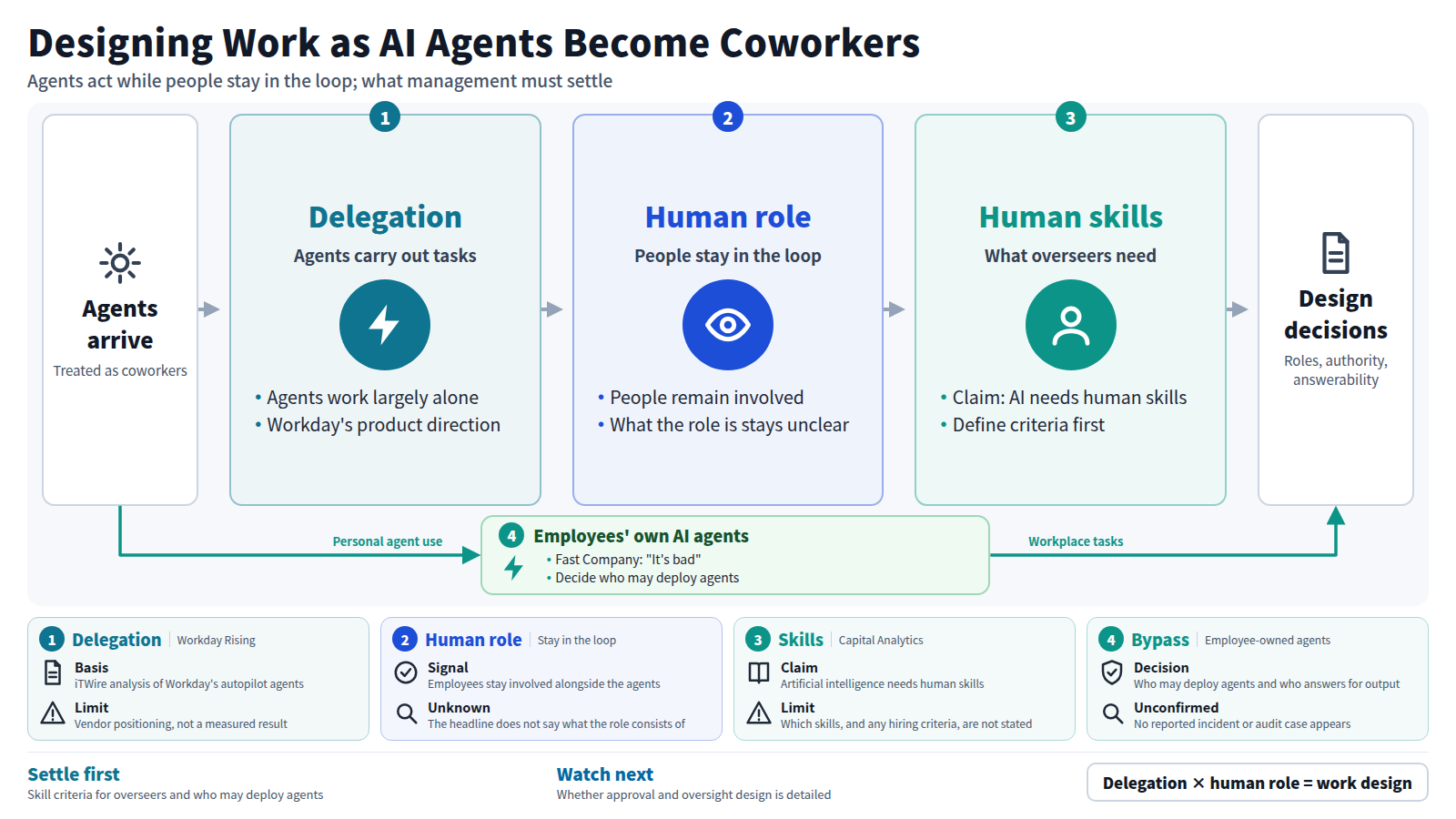
Coverage this week centered on how work is divided between employees and AI agents. Workday's event analysis (iTWire), a Fast Company piece and a HackerNoon piece all addressed it. Two more items covered human skills (Capital Analytics Associates) and the broader change in the working world (DW). The material consists of analysis and commentary headlines; no company decision, regulation or measured result appears in it.
Corporate management decisions
No notable developments.
Organizational structure
No notable developments.
Changes in employee roles
An iTWire analysis of Workday Rising 2026 (Part 1 of 2) says Workday's AI agents are now "autopilots" (software that carries out tasks largely on its own) and that Workday wants people to stay in the loop (iTWire). The headline points to a role in which employees stay involved alongside the agents. It does not say what that role consists of.
Required competencies
Capital Analytics Associates published a piece titled "Why artificial intelligence needs human skills" (Capital Analytics Associates). The headline alone does not say which skills it means or whether any employer has adopted them as hiring or evaluation criteria. 【Training and talent development】 DW ran a piece titled "How AI is changing the working world" (DW). The headline gives no detail on training design or on how early-career staff develop.
Organization building
No notable developments. 【Division of roles between AI agents and employees】 - Fast Company asks what happens when employees' own AI agents start coming to work, and its headline adds "Spoiler: It's bad" (Fast Company). The headline suggests the piece sees risk in staff bringing their own AI agents into the workplace, but it gives no specifics. - HackerNoon argues that AI agents are becoming employees and that "the Architecture of Work Has to Change" (HackerNoon). This is an opinion-style argument in the headline, not a reported deployment. - Combined with the Workday item above, the headlines show a vendor product direction (Workday) and two commentary pieces (Fast Company, HackerNoon). They do not show any reported incident, audit case or measured delegation scope. 【Humanoid-based production management】 No notable developments.
How to think about ROI
No notable developments. 【Investment balance between people and humanoids】 No notable developments. 【Labor administration and worker protection (regulators' view)】 No notable developments.
Developments by country
No notable developments.
Statements by key figures
No notable developments. 【Integrated analysis: how this bears on management decisions】 The headlines point to three questions management will likely need to settle. This is inference from a small set of headlines. - Role design: if AI agents operate largely on their own, as in Workday's case (iTWire), companies will likely need to define what employees still do. Workday's own framing is that people stay in the loop (iTWire). - Skills: the emphasis on human skills (Capital Analytics Associates) and the general discussion of a changing working world (DW) suggest that evaluation and training criteria may need revisiting. The headlines do not say how. - Governance of agents: the two commentary pieces suggest that agents brought in by employees (Fast Company) and agents treated as employees (HackerNoon) raise questions about how work and responsibility are structured. Management may need to decide who may deploy agents and who answers for their output.
These points rest on vendor positioning and commentary, not on measured outcomes or implementation reports.
What to watch
- Whether the second part of the iTWire analysis of Workday Rising 2026 details how the human role is defined (inference: it may clarify the approval and oversight design). - Whether concrete cases appear of employees' own AI agents entering the workplace, including any reported incidents (inference: this would test the concern raised by Fast Company). - Whether companies publish hiring, evaluation or training changes tied to human skills, rather than commentary alone.
- Why artificial intelligence needs human skills — Capital Analytics Associates10/15 13:00 UTC
- How AI is changing the working world — DW.com10/16 07:35 UTC
- What happens when your employees’ AI agents start coming to work? (Spoiler: It’s bad) — Fast Company10/15 18:47 UTC
- AI Agents Are Becoming Employees. The Architecture of Work Has to Change — HackerNoon10/16 01:50 UTC