AI and Rare Diseases ── Platforms ── 2026-10-17
Rare-disease diagnosis and drug discovery platforms and AI
- Abstract
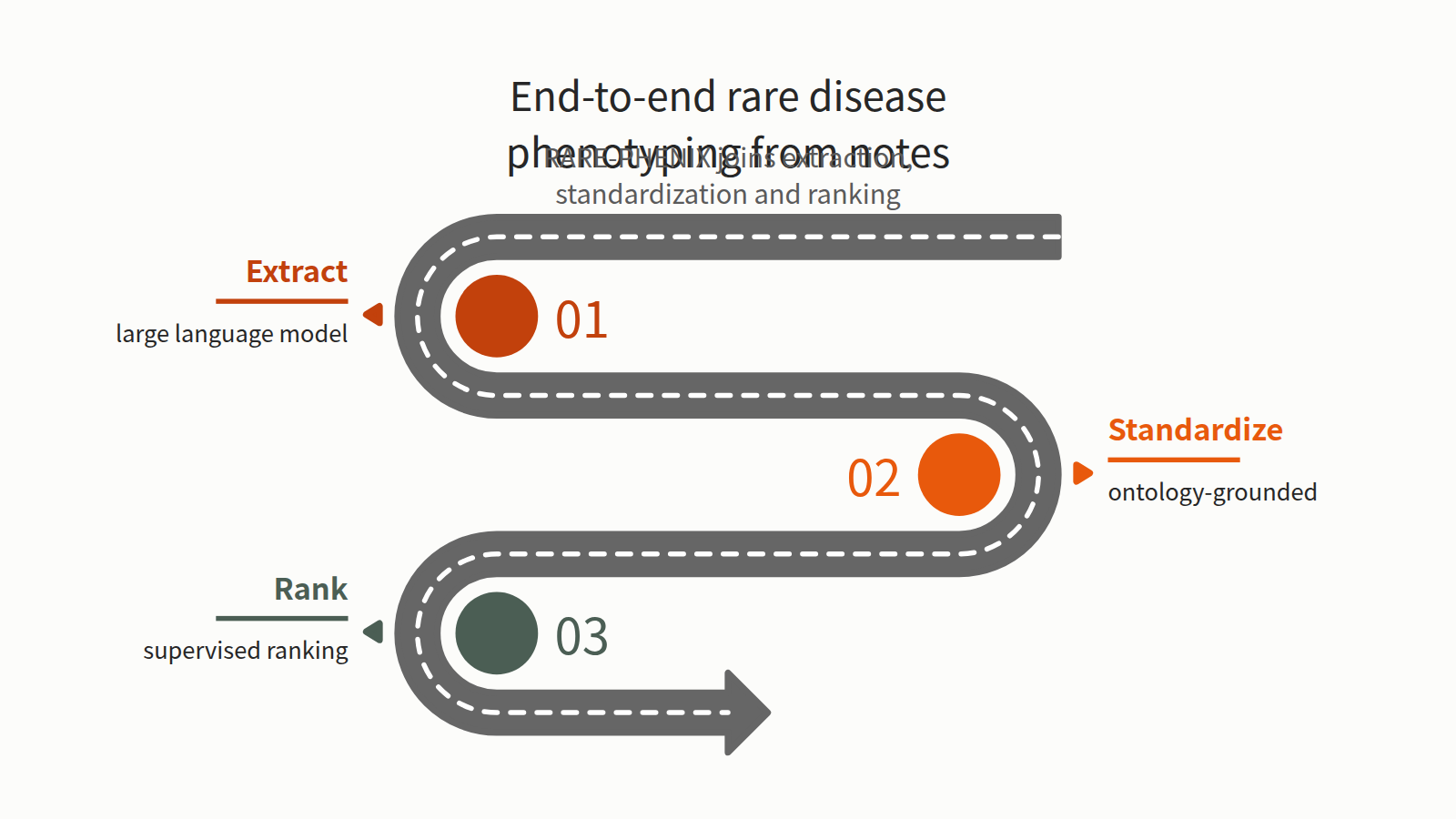
Phenotyping is fundamental to rare disease diagnosis, but manually curating structured phenotypes from clinical notes is labor intensive and difficult to scale. Existing artificial intelligence (AI) approaches optimize individual components of phenotyping but generally do not operationalize the full workflow of extracting features from clinical text, standardizing them to Human Phenotype Ontology (HPO) terms, and prioritizing rare disease-relevant HPO terms. We developed RARE-PHENIX, an end-to-end AI framework for rare disease phenotyping that integrates large language model-based phenotype extraction, ontology-grounded standardization to HPO terms, and supervised ranking of HPO terms. We trained RARE-PHENIX using data from 2671 patients across 11 Undiagnosed Diseases Network clinical sites, and externally validated it on 16,357 real-world clinical notes from 143 patients at Vanderbilt University Medical Center. Our findings suggest RARE-PHENIX generates structured, prioritized HPO terms highly concordant with clinician curation, demonstrates potential downstream disease-prioritization signal, and may support human-in-the-loop rare disease phenotyping in real-world settings.
Journal IF-equivalent: 13.7 (OpenAlex 2-year mean citedness, value as of 2026-10-09, retrieved 2026-10-10; not the official Clarivate IF)Reference: Shyr C, Hu Y, Tinker RJ, Cassini TA, Byram KW, Hamid R, et al. An artificial intelligence framework for end-to-end rare disease phenotyping from clinical notes using large language models. npj Digit Med. 2026 Oct 15 [Epub ahead of print]. doi:10.1038/s41746-026-03275-0.Checked: Abstract only