AI and Cancer Research ── Kidney ── 2026-10-18
Kidney cancer: treatment, trials and AI
- Abstract
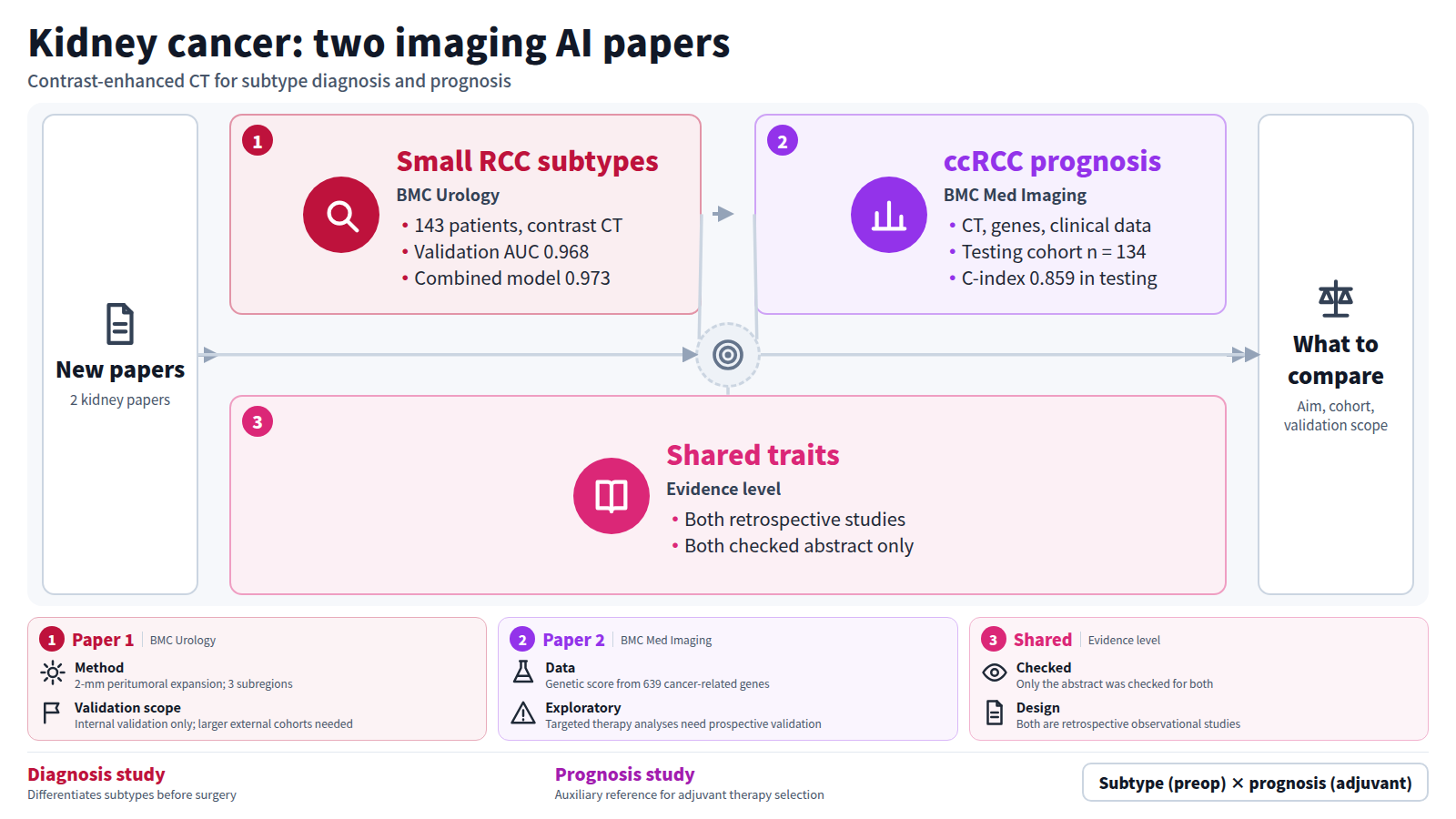
This study aimed to develop a deep learning model, a peritumoral radiomics model, a habitat radiomics model, and a conventional clinical-imaging model, and to explore their value in the preoperative differentiation of common pathological subtypes of small renal cell carcinoma (sRCC). A total of 143 patients with pathologically confirmed sRCC (92 clear cell RCC and 51 non-clear cell RCC) were retrospectively included. Patients were randomly divided into a training set ( n = 101) and a validation set ( n = 42) at a ratio of 7:3. Corticomedullary phase images were used for analysis. Tumor regions of interest (ROIs) were manually delineated using ITK-SNAP software, and peritumoral ROIs were generated by uniform 2-mm expansion. Unsupervised K-means clustering was performed on the intratumoral ROI based on local features to identify intratumoral subregions, and the optimal number of subregions was determined using the maximum Silhouette Coefficient. Radiomics features were extracted from peritumoral region and each subregion. The maximum cross-section of the tumor was obtained. Transfer learning was then applied to initialize the ResNet18 model with pre-trained parameters from the ImageNet dataset, and deep transfer learning features were subsequently extracted. Feature selection and dimensionality reduction were conducted using the max-relevance and min-redundancy (mRMR) algorithm and the least absolute shrinkage and selection operator (LASSO) method, with cross-validation applied within the training set. Univariate and multivariate logistic regression analyses were used to identify the independent clinical predictors. Based on the identified independent clinical predictors and the selected features, clinical, peritumoral, habitat, and deep learning models were developed. The model with the highest performance was combined with independent clinical predictors to build the combined model. The performance of the models was evaluated using the area under the curve (AUC), accuracy, sensitivity, and specificity, and clinical utility was assessed using decision curve analysis. The optimal number of clusters was 3. Logistic regression analysis identified cystic or necrotic areas and enhancement characteristics as independent clinical predictors. A total of 8 peritumoral radiomics features, 12 habitat radiomics features, and 7 deep learning features were ultimately selected. The deep learning model (AUC: 0.960, 95% CI: 0.927–0.993 in the training set; AUC: 0.968, 95% CI: 0.926–1.000 in the validation set) outperformed the clinical model (AUC: 0.798, 95% CI: 0.714–0.883; AUC: 0.794, 95% CI: 0.647–0.940), the peritumoral model (AUC: 0.885, 95% CI: 0.815–0.955; AUC: 0.886, 95% CI: 0.776–0.997), and the habitat model (AUC: 0.951, 95% CI: 0.904–0.998; AUC: 0.943, 95% CI: 0.881–1.000). The performance of the combined model, established by integrating the deep learning model with the clinical model, was further improved (AUC: 0.968, 95% CI: 0.939–0.997 in the training set; AUC: 0.973, 95% CI: 0.934–1.000 in the validation set). Decision curve analysis demonstrated that the combined model provided the highest net benefit. The radiomics and deep learning models based on contrast-enhanced CT enabled effective noninvasive differentiation of sRCC subtypes. Habitat radiomics can capture intratumoral heterogeneity and shows favorable diagnostic performance, while deep learning demonstrates superior discriminative ability. These approaches may assist in preoperative decision-making, although further validation in larger external cohorts is warranted.
Journal IF-equivalent: 2.4 (OpenAlex 2-year mean citedness, value as of 2026-10-16, retrieved 2026-10-17; not the official Clarivate IF)Reference: Liu Q, Wang Y, Duan B, Liu M, Ye Y, Tang Q, et al. Deep learning and habitat radiomics based on contrast-enhanced CT for differentiating pathological subtypes of small renal cell carcinoma. BMC Urol. 2026 Oct 15 [Epub ahead of print]. doi:10.1186/s12894-026-02417-6.Checked: Abstract only - Abstract
Clear cell renal cell carcinoma (ccRCC), the most common renal cell carcinoma subtype (60%-85%), remains challenging due to suboptimal TNM-based risk stratification and limited precision in adjuvant targeted therapy (5.4%-10.5% survival benefit with overtreatment risk). Perirenal fat, linked to ccRCC prognosis via volume and density, is underexplored in integration with radiogenomics (tumor molecular features) for comprehensive prognosis. Retrospective analysis included a training cohort (Xijing Hospital, n = 226) and testing cohort (TCIA/TCGA, n = 134) of resectable ccRCC patients with preoperative contrast-enhanced CT and exome sequencing data. CT-based tumor/perirenal fat radiomic features were extracted via 3D Slicer/PyRadiomics, with scores built using LASSO and stepwise Cox regression. Genetic scores derived from 639 cancer-related genes (top 20 mutated genes) and clinical scores (e.g., TNM stage) were constructed via Cox regression. A multimodal nomogram integrating these scores was validated using C-index, time-dependent AUC, and SHAP analysis. The nomogram outperformed unimodal scores, with C-indices of 0.856 (training) and 0.859 (testing). Time-dependent AUCs for 1-5-year PFS were consistently higher. SHAP identified tumor/perirenal fat scores, TP53 mutation, and grade G4 as key contributors.Multiple machine learning algorithms were used to predict four genes with prognostic value, and their correlations in multimodal data were analyzed. Subgroup analyses confirmed robust risk stratification. Patients with targeted therapy risk difference rate ≥ 47% had longer PFS with therapy (HR = 0.545, p = 0.038), while those with < 10% fared better without therapy (HR = 2.051, p = 0.035), with similar trends in high-risk subgroups. Targeted therapy-related analyses are exploratory and require prospective validation. This CT-based multimodal nomogram integrates radiomic, genomic, and clinical data to characterize ccRCC across scales, providing auxiliary reference for screening patients who may gain potential survival benefit from adjuvant targeted therapy, reducing overtreatment/undertreatment.
Journal IF-equivalent: 3.8 (OpenAlex 2-year mean citedness, value as of 2026-10-02, retrieved 2026-10-03; not the official Clarivate IF)Reference: Zhang YF, Ji YH, Wen DD, Liu C, Shi PW, Hou HZ, et al. CT-based multimodal radiogenomic model integrating tumor and perirenal fat features for prognosis in clear cell renal cell carcinoma. BMC Med Imaging. 2026 Oct 15 [Epub ahead of print]. doi:10.1186/s12880-026-02920-0.Checked: Abstract only