AI in Medicine News — 2026-10-17 (Sat) Evening News
Source links point to the original outlet. The AI Integrated Analysis is auto-generated from the headlines below only and is not intended to add facts beyond them. Not investment advice.
Overview
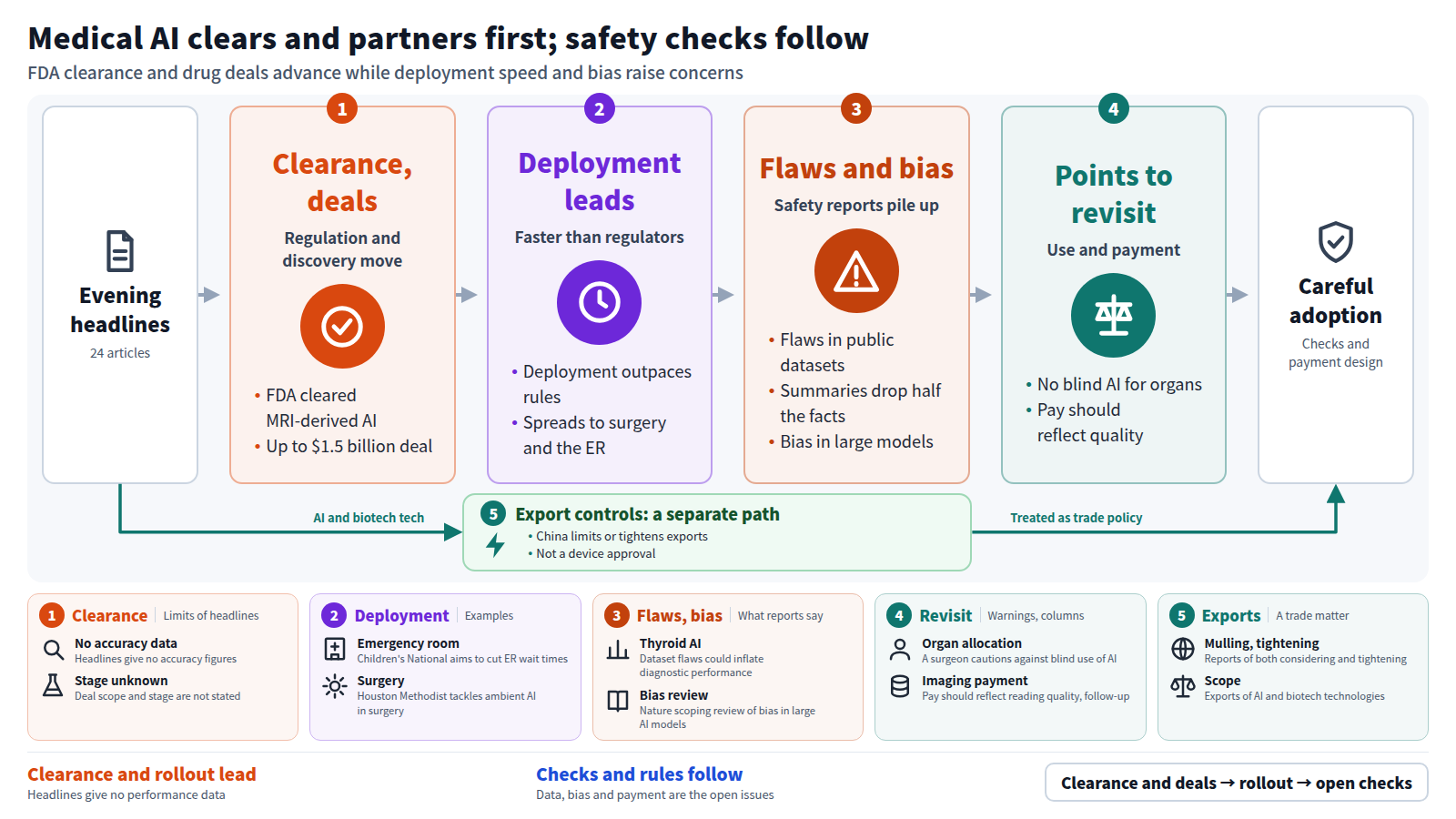
Diagnostics and regulation moved most: Japan-unrelated US clearance of an MRI-derived AI tool for breast cancer recurrence risk was reported (Diagnostic Imaging, LiveNOW from FOX), and China was reported to be considering or tightening export controls on AI and biotech technologies (FirstWord Pharma, Law360). In drug discovery, a deal worth up to $1.5 billion between AstraZeneca and Insitro was reported (WSJ). Reviews and studies on bias, deployment speed and data quality in medical AI also appeared (Nature, Bioengineer.org).
Diagnostics and imaging
- FDA cleared the first MRI-derived AI software for assessing breast cancer recurrence risk (Diagnostic Imaging). The headline gives no accuracy figures. - NeoGenomics is scaling AI digital pathology infrastructure with Indica Labs (Clinical Lab Products). No performance data in the headline. - Hidden flaws in public thyroid AI datasets could inflate diagnostic performance (Bioengineer.org). - An AI throat camera could replace swabs and bring flu diagnosis into the home (Bioengineer.org). The headline says "could", so this appears to be an early-stage claim; no evidence stage is given. - A Korea IT Times column in a series on medical imaging AI infrastructure argues that imaging AI payment must reflect reading quality, follow-up and patient benefit (Korea IT Times).
Clinical decision support
- A scoping review of bias in large AI models for medicine and healthcare was published (Nature). - A landmark review warns that hospitals are deploying AI faster than regulators can keep up (Bioengineer.org). - A surgeon cautions against "blindly" using AI for organ allocation (Healthcare Brew). - An AI model flags infant hip dysplasia before ultrasound using simple clinical signs (Bioengineer.org). No accuracy or study stage is given in the headline. - Other pieces cover how AI is improving clinical decision support systems (Nasscom) and how AI may help make clinical decisions (Labroots). 【Generative AI and medical documentation】 - "Clinicians from all specialties use AI to answer cardiology questions" (Cardiovascular Business). The headline gives no accuracy data. 【Hospital operations and care delivery】 - Children's National is using AI to reduce emergency room wait times (NBC4 Washington). No figures are given. - Houston Methodist is tackling ambient AI in surgery (MobiHealthNews). - Insurtechs are concerned as AI token bills keep climbing (Insurance Business). - A Substack weekly reading list includes AI, diagnosis and coding among its topics (Substack). 【Drug discovery and clinical trials】 - AstraZeneca struck an AI drug discovery deal with Insitro worth up to $1.5 billion (WSJ). The headline does not give the development stage. - The University of Toronto announced the AI-powered OpenPep platform to accelerate peptide drug discovery (University of Toronto). Stage not stated; the headline describes a platform, not a clinical result. - AI and digital biology are accelerating drug discovery, but the question is whether manufacturing can keep up (Mashable Benelux). - China is mulling limits on AI and biotech exports (FirstWord Pharma), and has tightened export controls on AI and biotech technologies (Law360).
Device approval and regulation
- Clearance: FDA cleared the first MRI-derived AI software for assessing breast cancer recurrence risk (Diagnostic Imaging). FDA also cleared an AI tool designed to predict whether breast cancer will recur (LiveNOW from FOX). Both appear to describe the same product; the product name is not given. - Export controls: China is reported to be limiting or tightening exports of AI and biotech technologies (FirstWord Pharma, Law360). This is a trade measure, not a device approval. - Europe's news publishers urged the European Commission to act on Meta's new AI terms (greatreporter). This is not specific to medicine.
Safety, errors and bias
- AI health summaries quietly drop half the medical knowledge they rewrite (Bioengineer.org). - Public thyroid AI datasets have hidden flaws that could inflate diagnostic performance (Bioengineer.org). - A scoping review examines bias in large AI models for medicine and healthcare (Nature). - Medical AI platforms report a settlement amid a discovery battle (Law360). - Deep Health AI India Ltd revised its FY26 audit report (scanx.trade). - Nasscom published a piece on agentic AI in healthcare covering use cases, ROI and implementation strategies (Nasscom). 【Research results (major journals)】 - Nature published a scoping review of bias in large AI models for medicine and healthcare (Nature). Findings are not given in the headline. - Labroots published a piece on how AI may help make clinical decisions (Labroots). - Persuasion carried an essay titled "AI Took My Job" (Persuasion); it is not tied to medicine by the headline.
Developments in Japan
- GENSHI AI released "GENSHI-MedQA-1M", a Japanese medical QA dataset of more than 1 million items, described as the largest of its kind in Japanese-language text (Infoseek). - A large-scale screening approach detects esophageal cancer without endoscopy, using non-contrast CT and AI (The Medical AI Times). No detection rate or study stage is given. - Items on AI scent diagnosis, hiring-capability diagnosis and purchasing diagnosis are not medical and are omitted.
Statements by key figures
No notable developments.
- Hidden Flaws in Public Thyroid AI Datasets Could Inflate Diagnostic Performance — Bioengineer.org10/17 09:16 UTC 🔗 Share link
- [Medical Imaging AI Infrastructure ⑦] Imaging AI Payment Must Reflect Reading Quality, Follow-Up and Patient Benefit — Korea IT Times 🔗 Share link10/17 02:02 UTC 🔗 Share link
- AI Throat Camera Could Replace Swabs and Bring Flu Diagnosis Into the Home — Bioengineer.org 🔗 Share link10/17 00:36 UTC 🔗 Share link
- A scoping review of bias in large AI models for medicine and healthcare — Nature 🔗 Share link10/17 06:07 UTC 🔗 Share link
- Hospitals Are Deploying AI Faster Than Regulators Can Keep Up, Landmark Review Warns — Bioengineer.org 🔗 Share link10/17 05:41 UTC 🔗 Share link
- Surgeon cautions against ‘blindly’ using AI for organ allocation — Healthcare Brew 🔗 Share link10/16 19:14 UTC 🔗 Share link
- How AI is Improving Clinical Decision Support Systems — Nasscom 🔗 Share link10/15 14:00 UTC 🔗 Share link
- AI Model Flags Infant Hip Dysplasia Before Ultrasound Using Simple Clinical Signs — Bioengineer.org 🔗 Share link10/16 19:51 UTC 🔗 Share link
- Clinicians from all specialties use AI to answer cardiology questions — Cardiovascular Business 🔗 Share link10/16 20:26 UTC 🔗 Share link
- How AI is helping Children's National reduce emergency room wait times — NBC4 Washington 🔗 Share link10/16 19:32 UTC 🔗 Share link
- Houston Methodist tackles ambient AI in surgery — MobiHealthNews 🔗 Share link10/16 19:49 UTC 🔗 Share link
- Saturday Longforms October 17, 2026: Alzheimer’s, measles immune amnesia, generic drugs, AI and diagnosis and coding — Substack 🔗 Share link10/17 09:08 UTC 🔗 Share link
- Rising AI costs concern insurtechs as token bills keep climbing — Insurance Business 🔗 Share link10/16 18:28 UTC 🔗 Share link
- AI and Digital Biology Is Accelerating Drug Discovery. Can Manufacturing Keep Up? — Mashable Benelux 🔗 Share link10/17 09:03 UTC 🔗 Share link
- AI-powered OpenPep platform to accelerate peptide drug discovery — University of Toronto 🔗 Share link10/16 19:55 UTC 🔗 Share link
- AI Health Summaries Quietly Drop Half the Medical Knowledge They Rewrite — Bioengineer.org 🔗 Share link10/16 20:06 UTC 🔗 Share link
- Deep Health AI India Ltd revises FY26 audit report — scanx.trade 🔗 Share link10/17 08:29 UTC 🔗 Share link
- Medical AI Platforms Report Settlement Amid Discovery Battle — Law360 🔗 Share link10/15 21:56 UTC 🔗 Share link
- Agentic AI in Healthcare: Use Cases, ROI, and Implementation Strategies — Nasscom 🔗 Share link10/15 14:00 UTC 🔗 Share link
- European Commission Should Be Extremely Concerned About Meta's Sneaky New AI Terms, Say Europe's News Publishers — greatreporter 🔗 Share link10/16 14:53 UTC 🔗 Share link
- How AI May Help Make Clinical Decisions — Labroots 🔗 Share link10/15 19:00 UTC 🔗 Share link
- AI Took My Job - by Jan DiVincenzo - Persuasion — Persuasion | Yascha Mounk 🔗 Share link10/15 18:31 UTC 🔗 Share link
- Detecting Esophageal Cancer Without Endoscopy: Large-Scale Screening With Non-Contrast CT and AI — The Medical AI Times 🔗 Share link10/16 01:58 UTC 🔗 Share link
- More than 60% of people in their 20s are “preparing to change jobs” but why are they “not getting a job”? Kakehashi Sky releases “Mid-career recruitment ability diagnosis” for free, which uses AI to diagnose recruitment ability — PR TIMES 🔗 Share link10/16 08:40 UTC 🔗 Share link