AI, Welfare & Long-term Care News — 2026-10-18 (Sun) Morning News
Source links point to the original outlet. The AI Integrated Analysis is auto-generated from the headlines below only and is not intended to add facts beyond them. Not investment advice.
Overview
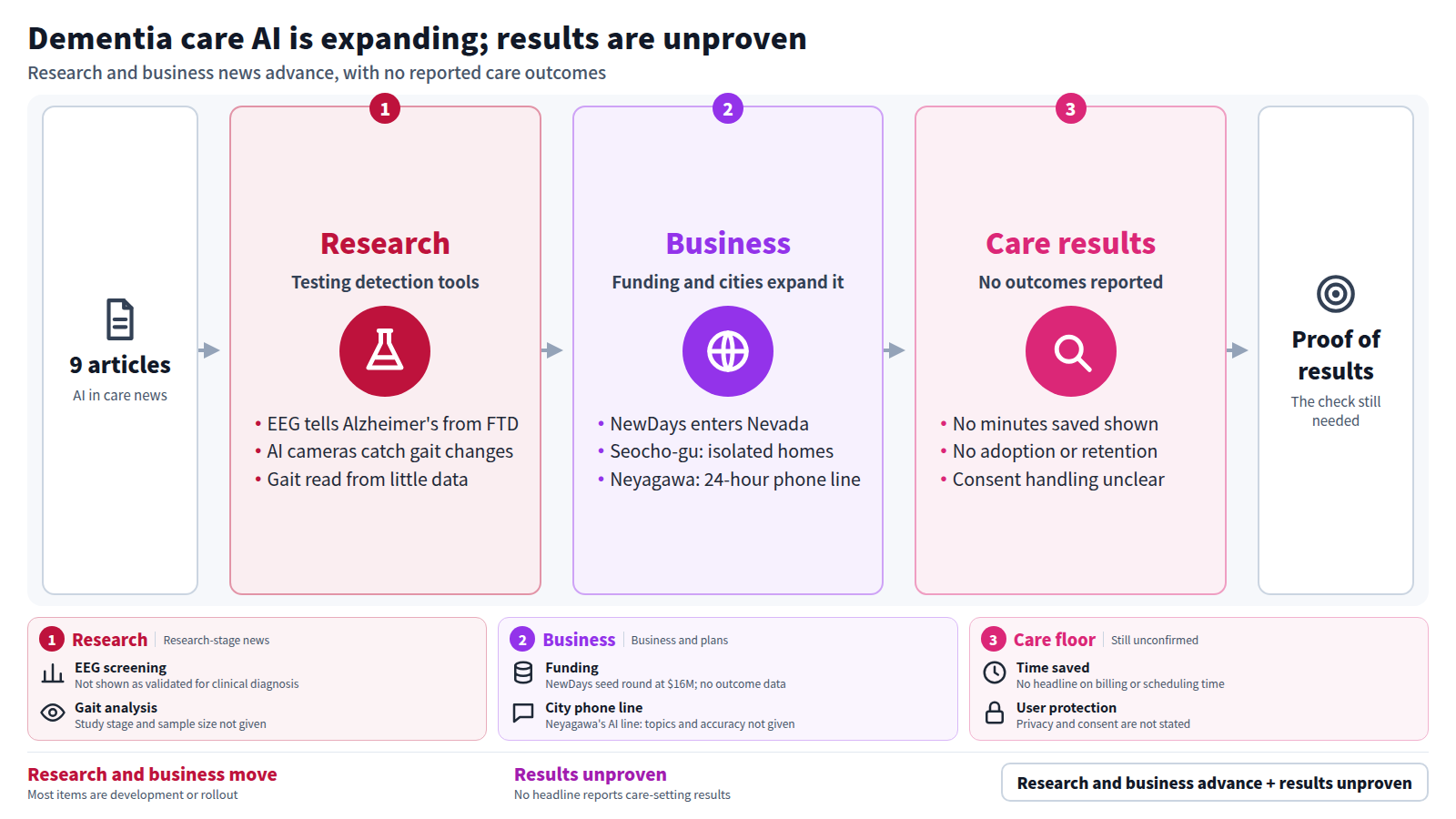
Most items this period concern dementia care and tools for people living at home, and most are research or product news rather than reports of results from care settings (Bioengineer.org, Healthcare IT Today, Focus Taiwan). On the staffing side, a Japanese city, Neyagawa, is moving phone consultations to generative AI around the clock, aiming to ease a labor shortage (Sankei Shimbun via Yahoo! News Japan). None of the headlines reports minutes saved, adoption rates or retention.
AI in care settings
- A Business Insider story says AI found a caregiver for a man as "His Body Shut Down" (Business Insider). The headline does not say how the match was made, how many people were helped, or how personal data was handled. - A research report says AI cameras catch "Parkinson-Like Gait Changes When Dementia Drugs Are Cut" (Bioengineer.org). The headline does not give the study stage or sample size, and does not say how consent or privacy was handled for camera use. - No headline reports time savings in documentation, billing, scheduling or care planning.
Staffing and the workforce
- Seocho-gu is rolling out AI companion robots and smart urinalysis as part of an integrated care program for isolated households (Herald Economy). The headline gives no staffing figures, so it does not show which tasks the tools take over or which remain with people. - No headline covers staffing standards, turnover or foreign workers.
Dementia care
- NewDays is bringing its AI-driven dementia care platform to Nevada and has expanded its seed round to $16M (Healthcare IT Today). This is a business expansion. The headline reports no outcome data. - A study reports that brain waves and machine learning can tell Alzheimer's and FTD apart (Bioengineer.org). This is research on discriminating between two conditions. The headline does not say it has been validated for clinical diagnosis or used in care settings. - III has developed AI-powered audiovisual technology for dementia care (Focus Taiwan). The headline describes development only, with no trial results and no mention of family burden. - The gait-camera study in section 2 is also relevant here (Bioengineer.org). It is the only item that touches on changes after dementia medication is reduced.
Home care and monitoring
- An article titled "Navigating Medicaid & the AI Audit Bomb" suggests AI-related audit risk for home care providers (HomeCare). The headline does not say what the risk is. - No headline reports false alarms or missed events for sensors, fall detection or remote monitoring. Seocho-gu's program for isolated households (section 3) is the nearest item, and its headline gives no accuracy or consent information.
Care robots and devices
- A study reports that AI can read stroke patients' strides from "Just Minutes of Labeled Data" (Bioengineer.org). This is research. The headline gives no deployment numbers or continued-use rate. - Seocho-gu's AI companion robots (section 3) are rolled out, but no unit count or continued-use rate is given (Herald Economy). - No headline mentions a program that was dropped or not sustained.
Policy and insurance
- A Japanese promotional guide offers AI training that uses subsidies, with a discount of "up to 60%" and an effective monthly cost starting at 2,800 yen (Dream News). It concerns AI workforce training. It is not a change to long-term care insurance, care fees or community-based care. - The Medicaid audit article (section 5) is the only other policy-related item (HomeCare).
Developments in Japan
- Neyagawa has created a section called "聞きましょ課" and will use generative AI to handle phone consultations 24 hours a day, aiming to ease the labor shortage (Sankei Shimbun via Yahoo! News Japan). The headline does not say what topics are covered, how accurate it is, or how callers' privacy and consent are handled. - The training guide in section 7 is also Japanese (Dream News).
Statements by key figures
No notable developments.
- He Needed a Caregiver As His Body Shut Down. AI Found Him the One. — Business Insider10/10 08:30 UTC 🔗 Share link
- AI Cameras Catch Parkinson-Like Gait Changes When Dementia Drugs Are Cut — Bioengineer.org 🔗 Share link10/17 08:10 UTC 🔗 Share link
- NewDays Brings Its AI-Driven Dementia Care Platform to Nevada, Expands Seed Round to $16M — Healthcare IT Today 🔗 Share link10/09 16:56 UTC 🔗 Share link
- Brain Waves and Machine Learning Join Forces to Tell Alzheimer's and FTD Apart — Bioengineer.org 🔗 Share link10/06 07:00 UTC 🔗 Share link
- III develops AI-powered audiovisual technology for dementia care — Focus Taiwan 🔗 Share link10/04 07:00 UTC 🔗 Share link
- Navigating Medicaid & the AI Audit Bomb — HomeCare 🔗 Share link10/17 12:00 UTC 🔗 Share link
- AI Learns to Read Stroke Patients’ Strides with Just Minutes of Labeled Data — Bioengineer.org 🔗 Share link10/17 09:26 UTC 🔗 Share link