AI and Cancer Research ── Cancer biology ── 2026-10-18
Cancer molecular biology and AI
- Abstract
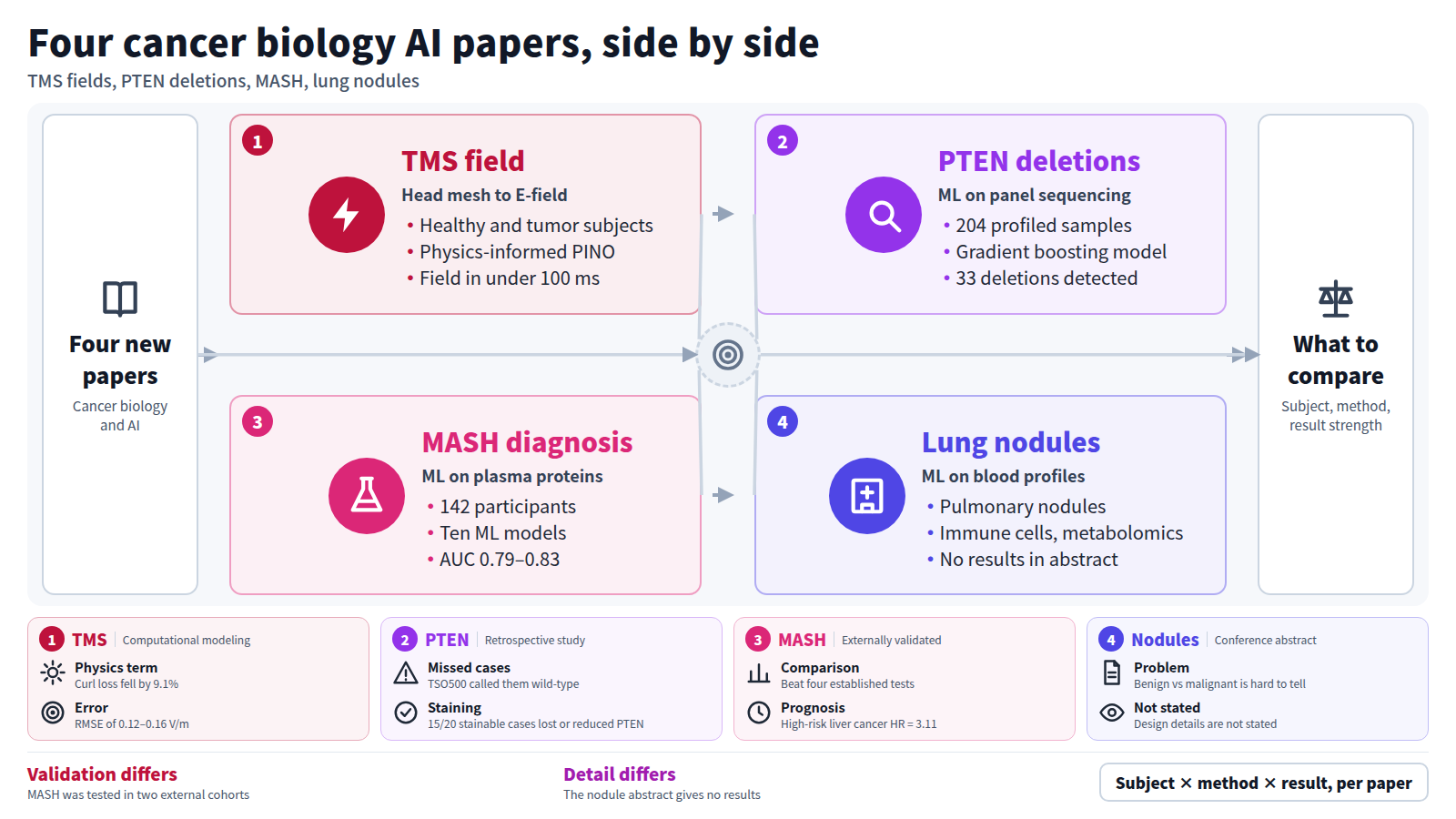
Accurate and rapid prediction of transcranial magnetic stimulation (TMS)-induced electric fields is essential for personalized clinical applications, from individualized therapy in major depressive disorder to presurgical functional mapping in neuro-oncology. Yet conventional finite element methods are often too computationally expensive for interactive use. Existing deep learning surrogate models partly address this limitation but are largely constrained to fixed voxel-grid representations that cannot naturally accommodate the irregular geometry of subject-specific head meshes. We present the first physics-informed neural operator (PINO) for subject-specific prediction of vector TMS electric fields, built on a mesh-native dual-encoder architecture that jointly encodes head anatomy and coil configuration. By incorporating a curl-based regularization term aligned with the curl-free nature of the TMS secondary field, the PINO model promotes physical consistency as a soft regularizer alongside data-driven supervision. Trained on 75 subjects from the IXI dataset, the framework was evaluated across four independent held-out test datasets, including healthy subjects from two additional MRI cohorts and, for the first time in learning-based TMS electric-field prediction, tumor patients. The resolution-agnostic formulation generalizes across subjects, coil types, and spatial resolutions without retraining, predicting vector electric fields on approximately 300,000 gray matter volume nodes in under 100 ms on a consumer-grade GPU. Across all test datasets within the focality-50% region, the PINO model achieved median center-of-gravity errors of 0.39–0.43 mm, RMSE of 0.12–0.16 V/m, and mean angular deviations of 6.7°–7.3°, with performance within or below the error ranges reported by recent deep-learning approaches. At the selected 5% physics-loss weighting, curl loss decreased by 9.1% relative to the data-only model, while RMSE and MAD increased by only 1.6% and 1.3%, respectively. These results suggest that physics-informed neural operators provide a scalable technical foundation for rapid gray-matter electric-field approximation, supporting future studies on real-time electric-field-guided TMS workflows
Journal IF-equivalent: 5.2 (OpenAlex 2-year mean citedness, value as of 2026-10-04, retrieved 2026-10-05; not the official Clarivate IF)Reference: Moser P, Greifeneder F, Freinberger D, Reishofer G, Ritter P, Frank L, et al. Physics-informed neural operators for rapid electric field prediction in transcranial magnetic stimulation of healthy and tumor subjects. Sci Rep. 2026 Oct 16 [Epub ahead of print]. doi:10.1038/s41598-026-74936-z.Checked: Abstract only - Abstract
Missed genetic deletions can prevent cancer patients from receiving effective targeted therapy. Standard pipelines, such as TSO500, use bin count averaging for copy number variation detection but often overlook focal events. To address this, we developed a machine learning (ML) pipeline for deletion detection and zygosity evaluation within the MASTERsg precision oncology program. We focused on the tumor suppressor gene PTEN, whose loss confers sensitivity to mTOR/Akt inhibition. An Extreme Gradient Boosting model trained on PTEN-deleted and wild-type tumor samples identified focal deletions missed by the TSO500 pipeline and CNVkit that were associated with concordant PTEN protein loss by immunohistochemistry. Importantly, the model detected PTEN deletions in 33/204 profiled samples that were classified as PTEN wild-type by TSO500; 75% (15/20) of stainable cases showed absent or reduced PTEN protein expression. These findings demonstrate the potential of ML to enhance panel sequencing, uncovering therapeutically relevant alterations missed by established diagnostic methods.
Journal IF-equivalent: 8.9 (OpenAlex 2-year mean citedness, value as of 2026-10-04, retrieved 2026-10-05; not the official Clarivate IF)Reference: Kerle IA, Husak O, Gross T, Hartig A, Prause R, Richter D, et al. Machine learning uncovers previously undetectable genetic deletions in cancer panel sequencing. npj Precis Onc. 2026 Oct 16;10(1):397. doi:10.1038/s41698-026-01756-9.Checked: Abstract only - Abstract
Background: Metabolic dysfunction-associated steatohepatitis (MASH) can progress to cirrhosis and hepatocellular carcinoma, yet the invasiveness of liver biopsy limits its clinical utility. Accurate noninvasive diagnostic tools are essential for improved patient risk stratification.
Methods: A machine learning study was conducted using plasma proteomics from 142 participants (83 MASH cases, 59 controls) recruited from a Chinese hospital, randomly divided into training and validation cohorts (7:3 ratio). Key proteins were identified via feature selection using Least Absolute Shrinkage and Selection Operator regression and the Boruta algorithm. Ten machine learning models were developed to create the MASHPredict score, with external validation in two test cohorts. Prognostic evaluation focused on liver-related events, atherosclerotic cardiovascular disease (ASCVD)-related mortality, and all-cause mortality.
Results: MASHPredict demonstrated robust diagnostic performance, with Area Under the Curve (AUC) values of 0.83 (95% CI: 0.74–0.92) in the training cohort, 0.80 (0.66–0.94) in the validation cohort, 0.79 (0.67–0.91) in test cohort 1, and 0.79 (0.76–0.83) in test cohort 2. It outperformed established noninvasive tests, including the Fibrosis-4 Index, AST to Platelet Ratio Index, AST/ALT Ratio, and NAFLD Fibrosis Score. High-risk individuals exhibited significantly increased hazards for liver-related mortality (HR = 8.18), MASH (HR = 12.07), cirrhosis (HR = 3.37), liver cancer (HR = 3.11), ASCVD-related mortality (HR = 1.64), and all-cause mortality (HR = 1.42) (all p < 0.001).
Conclusion: The MASHPredict score is a validated, noninvasive diagnostic tool with broad applicability. Its superior performance in diagnosing MASH and prognosticating liver-related outcomes supports its potential role in early detection, risk stratification, and clinical decision-making.
Journal IF-equivalent: 5.5 (OpenAlex 2-year mean citedness, value as of 2026-10-02, retrieved 2026-10-03; not the official Clarivate IF)Reference: Hu X, Meng F, Zhou W, Li S, Gao Y, Zhang Y, et al. A multicohort proteomics-based machine learning score (MASHPredict) for noninvasive diagnosis and long-term prognostication of metabolic dysfunction-associated steatohepatitis. Front Immunol. 2026 Oct 15;17:1849699. doi:10.3389/fimmu.2026.1849699.Checked: Abstract only - Abstract
Accurate differentiation between benign and malignant pulmonary nodules remains a clinical challenge. We investigated the diagnostic value of peripheral blood immune cell profiling combined with untargeted metabolomics and machine learning in pulmonary nodule risk stratification.
Journal IF-equivalent: 1.0 (OpenAlex 2-year mean citedness, value as of 2026-10-16, retrieved 2026-10-17; not the official Clarivate IF)Reference: Liu X, Song W, Lu J, Li Y, Lu G, Du N, et al. P1.068: Integrated Peripheral Blood Immune-Metabolic Profiling for Pulmonary Nodule Risk Stratification Using Machine Learning. Journal of Thoracic Oncology. 2026 Oct;21(10):104472. doi:10.1016/j.jtho.2026.104472.Checked: Abstract only