AI & Economy News — 2026-10-17 (Sat) Evening News
Source links point to the original outlet. The AI Integrated Analysis is auto-generated from the headlines below only and is not intended to add facts beyond them. Not investment advice.
Overview
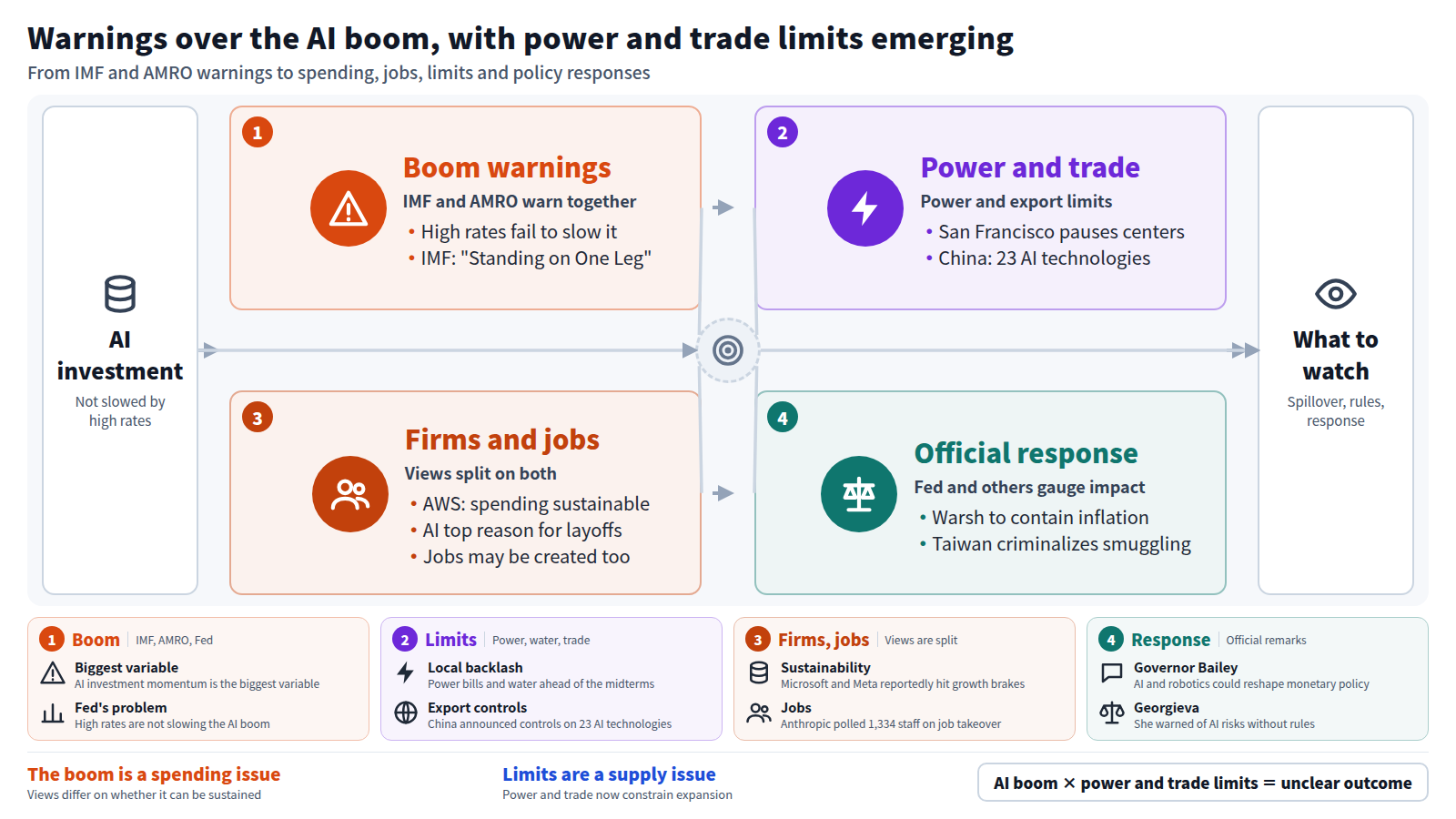
Warnings about the AI boom's macroeconomic effects dominated the past 12 hours. Fed Chair Kevin Warsh warned of an AI shock to the economy while pledging to contain inflation (Rural Radio Network), and the IMF said the global economy is "Standing on One Leg" as the AI boom masks cracks (Nation Thailand). At the same time, China announced export controls on 23 AI technologies (Pasquale Pillitteri, RTTNews) and San Francisco paused data centers amid a backlash over power bills and water (Benzinga).
Macro and growth
High interest rates are not slowing the AI boom, which is a problem for the Fed (Inquirer.com). Fed Chair Kevin Warsh warned of an AI shock to the economy and pledged to contain inflation (Rural Radio Network). The IMF and AMRO issued simultaneous warnings that AI investment momentum is the biggest variable for the global economy (BigGo Finance). South Korea's AI-driven economy is growing but faces rising vulnerabilities (Chosun Ilbo).
Productivity
No notable developments. 【Employment and the labor market】 AI is now the top reason for layoffs, though for some workers it is also a path to starting a business (Entrepreneur). Anthropic polled 1,334 of its employees, who are more sure than most people that AI will take over jobs (Business Insider). A local economist said AI could create jobs as well as eliminate them (KTNV Las Vegas). One outlet argued that small AI can create more and better jobs by reaching everyone (Techsauce).
Energy and power demand
San Francisco paused data centers as the AI boom fuels a backlash over power bills and water ahead of the midterms (Benzinga). Data centers are outpacing power grids, and the question is whether storage and on-site power can close the gap (Reccessary). 【Central banks, international organizations and key figures】 - Kristalina Georgieva (IMF Managing Director) warned of AI risks without rules in Bangkok (NewsBytes). - Andrew Bailey (Bank of England Governor) said AI and robotics could reshape monetary policy (Breakingthenews.net). - Kevin Warsh (Fed Chair) warned of a "bumpy" AI ride as the job impact is unclear (China Daily Global Edition), and also warned of an AI shock while pledging to contain inflation (Rural Radio Network). - The IMF said Singapore is among the Asian winners of the AI boom (Bloomberg.com). - Thailand aims to strengthen relations with the IMF's 191 member countries, using AI, investment and soft power for its growth strategy (newsclip.be).
Corporate capital spending
The Amazon Web Services CFO said AI spending is sustainable (Axios). A Chinese outlet reported that cash burning no longer works as Microsoft and Meta hit AI growth brakes, with Apple emerging as 2024's top AI winner (36Kr). Another outlet asked whether SpaceX winning AI data centers can overcome losing its model (NextBigFuture.com).
Trade and industrial policy
China announced export controls on 23 AI technologies (Pasquale Pillitteri). The measure is described as a proposal made amid U.S. tech rivalry (RTTNews) and as Beijing seeking a tighter grip on AI exports (The China-Global South Project). Taiwan moved to criminalize AI chip smuggling to China under its Foreign Trade Act (forkast.news). 【Integrated analysis: what is happening】 The headlines suggest the AI boom is now the main driver of macro risk, not only a growth story. The IMF and AMRO call it the biggest variable (BigGo Finance), and the Fed faces an investment surge that high rates have not slowed (Inquirer.com). This may complicate inflation control, which Warsh has pledged to pursue (Rural Radio Network). On the supply side, data center growth appears to be running into physical and political limits. Grid capacity is lagging (Reccessary), and San Francisco's pause points to local resistance over power bills and water (Benzinga). Meanwhile, Amazon Web Services says spending is sustainable (Axios), while another report says Microsoft and Meta face growth brakes (36Kr). Corporate confidence is therefore likely uneven. Labor-market evidence is mixed. AI is cited as the top reason for layoffs (Entrepreneur), yet economists also point to job creation (KTNV Las Vegas), and Warsh calls the job impact unclear (China Daily Global Edition). Export controls in China and chip-smuggling enforcement in Taiwan suggest AI hardware and technology are increasingly treated as strategic goods, which may fragment supply chains.
What to watch
- Whether the Fed and other central banks (including the Bank of England, where Bailey sees monetary policy being reshaped) factor AI investment into their inflation and rate assessments. - Whether more local governments follow San Francisco in restricting data centers, and whether storage and on-site power can ease grid constraints. - Whether China's AI export controls move from announcement or proposal to implementation, and how the U.S. and Taiwan respond.
- High interest rates aren’t slowing the AI boom. That’s a problem for the Fed. — Inquirer.com10/17 09:01 UTC 🔗 Share link
- Anthropic polled 1,334 of its employees. They're more sure than most of us that AI will take over jobs. — Business Insider 🔗 Share link10/16 22:48 UTC 🔗 Share link
- IMF Warns Global Economy is 'Standing on One Leg' as AI Boom Masks Cracks — Nation Thailand 🔗 Share link10/17 08:29 UTC 🔗 Share link
- AI Is Now the Top Reason for Layoffs. For Some Workers, It’s Also a Path to Starting a Business. — Entrepreneur 🔗 Share link10/17 00:02 UTC 🔗 Share link
- IMF and AMRO Issue Simultaneous Warnings: AI Investment Momentum Becomes the Biggest Variable for the Global Economy — BigGo Finance 🔗 Share link10/17 08:05 UTC 🔗 Share link
- Fed chief warns of 'bumpy' AI ride as job impact unclear — China Daily Global Edition 🔗 Share link10/17 00:31 UTC 🔗 Share link
- Local economist says AI could create jobs as well as eliminate them — KTNV Las Vegas 🔗 Share link10/17 00:10 UTC 🔗 Share link
- San Francisco Pauses Data Centers as AI Boom Fuels Backlash Over Power Bills, Water Ahead of Midterms — Benzinga 🔗 Share link10/17 07:58 UTC 🔗 Share link
- Can SpaceX Winning AI Data Centers Overcome Losing Model and Tesla Beyond the Roadster — NextBigFuture.com 🔗 Share link10/17 03:31 UTC 🔗 Share link
- The AI infrastructure race: As data centers outpace power grids, can storage and on-site power close the gap? — Reccessary 🔗 Share link10/16 21:57 UTC 🔗 Share link
- China announces export controls on 23 AI technologies — Pasquale Pillitteri 🔗 Share link10/17 06:44 UTC 🔗 Share link
- Beijing Seeks Tighter Grip on AI Exports Amid U.S. Rivalry — The China-Global South Project 🔗 Share link10/17 02:38 UTC 🔗 Share link
- Taiwan Moves to Criminalize AI Chip Smuggling to China Under Foreign Trade Act — forkast.news 🔗 Share link10/17 08:32 UTC 🔗 Share link
- IMF Says Singapore Is Among Asian Winners of the AI Boom — Bloomberg.com 🔗 Share link10/17 08:31 UTC 🔗 Share link
- Bailey: AI, robotics could reshape monetary policy — Breakingthenews.net 🔗 Share link10/17 08:32 UTC 🔗 Share link
- South Korea's AI-Driven Economy Grows but Faces Rising Vulnerabilities — 조선일보 🔗 Share link10/16 23:33 UTC 🔗 Share link
- Small AI Can Create More and Better Jobs by Reaching Everyone — Techsauce 🔗 Share link10/17 07:07 UTC 🔗 Share link
- IMF and AMRO Issue Simultaneous Warnings: AI Investment Momentum Becomes the Biggest Variable for the Global Economy — Japanese media 🔗 Share link10/17 08:05 UTC 🔗 Share link
- Thailand to strengthen ties with 191 IMF member countries, further growth strategy by leveraging AI, investment, and soft power — newsclip.be 🔗 Share link10/17 05:15 UTC 🔗 Share link
- IMF's Kristalina Georgieva warns AI risks without rules in Bangkok — NewsBytes 🔗 Share link10/17 05:37 UTC 🔗 Share linkKristalina Georgieva / IMF Managing Director 🔗 Share link