AI & Healthcare News — 2026-10-17 (Sat) Evening News
Source links point to the original outlet. The AI Integrated Analysis is auto-generated from the headlines below only and is not intended to add facts beyond them. Not investment advice.
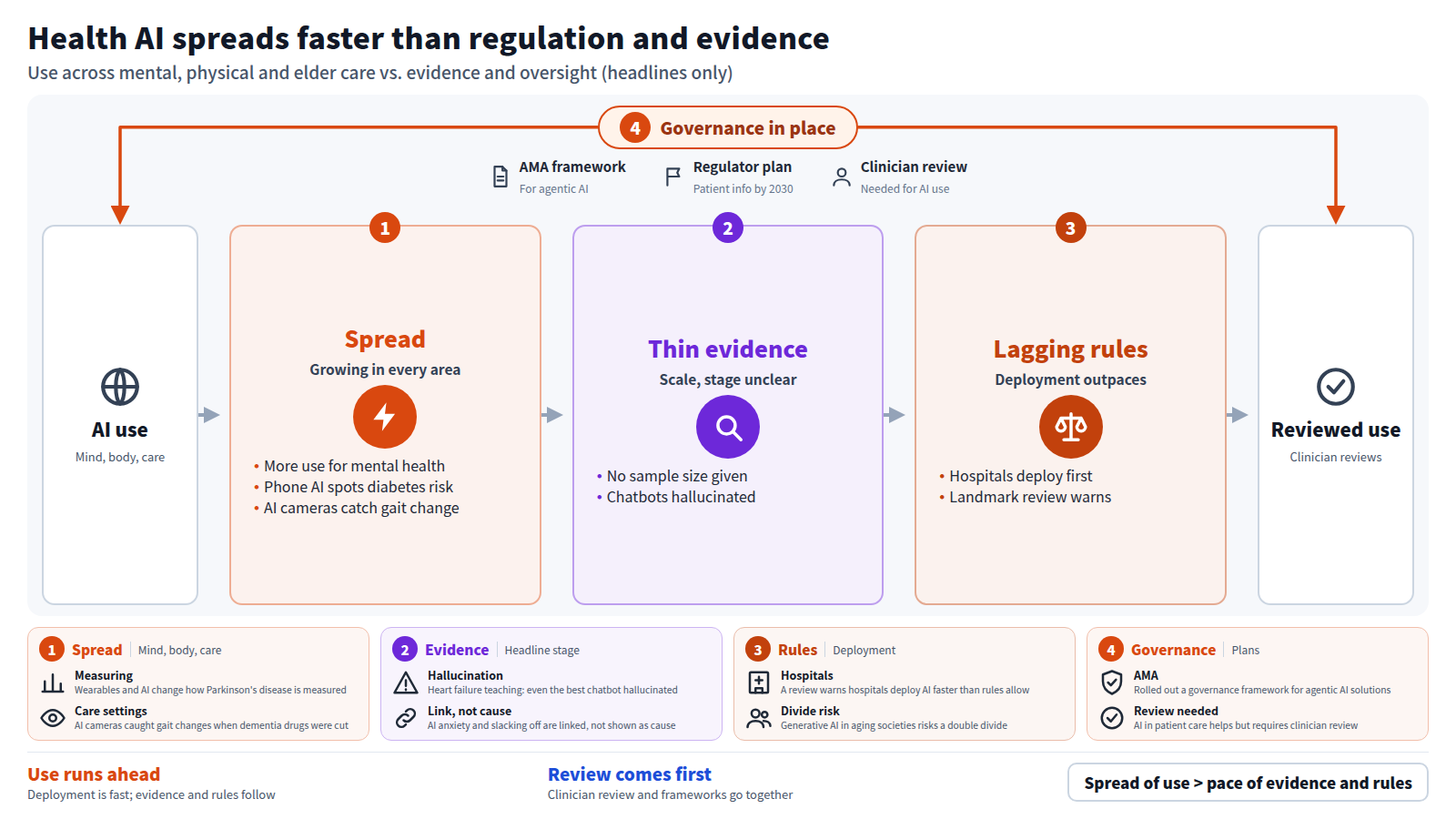
Overview
Mental health: the items cover AI use for mental health and AI-based depression detection, with a separate item on AI anxiety at work (KFYR-TV, Bioengineer.org, Labroots). Physical health: headlines on wearables, early-risk prediction and screening tools dominate, mostly without a stated evidence stage (Bioengineer.org, CNBC, Medical Product Outsourcing). Systems: regulation and governance drew attention, including an AMA framework for agentic AI and a review warning that hospitals deploy AI faster than regulators can keep up (Fierce Healthcare, Bioengineer.org).
Mental health
- Rise in people using AI for mental health. The headline gives no measure or scale (KFYR-TV). - "AI Role-Play Interviews Boost Depression Detection in Machine Learning Breakthrough." The headline does not say what was measured, the sample size or the evidence stage (Bioengineer.org). - "AI Anxiety Linked to Slacking Off and Bad Work Habits." This is an association, not a demonstrated cause. The headline gives no sample size or study design (Labroots).
Exercise and physical activity
- Amazon launched new Bee "personal AI" devices that listen to conversations. Other outlets describe them as wearable AI that can recall things for the wearer, and a next-gen Bee Frontier and an Eclipse MagSafe edition were also reported. The headlines do not describe any exercise or health function (CNBC, The Register, 9to5Toys). - A study reported that wearable sensors and AI are changing how Parkinson's disease is measured. The headline does not give the study size or the evidence stage (Bioengineer.org). - Singapore's Catalyst Performance, a personal training studio, was reported as the first fitness brand to win the National SME AI Impact Awards. The headline does not describe health outcomes (Business Insider Markets).
Sleep
- Syncra and Neumetry are partnering to build an AI-powered readiness platform for teenage athletes and their coaches. The headline does not mention sleep or any measured improvement (FinancialContent).
Nutrition and diet
- AI and multi-omics are being combined to decode the human microbiome. The headline gives no outcome or evidence stage (Bioengineer.org). - "AI in Patient Care Helps but Requires Clinician Review." The headline does not specify the setting or the evidence (Specialty Pharmacy Continuum).
Prevention and screening
- Lung cancer screening tools: Median Technologies and Olea Medical will market an AI-powered tool, and Eyonis will present clinical evidence for its AI-powered tool at CHEST 2026. The headlines do not give detection rates or the target population (Medical Product Outsourcing, The Manila Times). - A government plans AI-based cancer screening at upazila level. This is a plan, not a result (Dhaka Tribune). - A Hong Kong student built an AI tool as a companion between appointments for cancer patients. No results are given in the headline (South China Morning Post). 【Chronic disease self-management】 - A smartphone AI was reported to spot early diabetes risk by reading movement and glucose together. The headline gives no accuracy figures or evidence stage (Bioengineer.org). - A heart failure patient education study found AI chatbots failed the test: "Even the Best Hallucinated." This is a cautionary finding about patient-facing use (Bioengineer.org). - A transformer AI reads the first 24 ICU hours to predict heart failure deaths. This is a hospital prediction tool rather than self-management. The headline does not give performance figures (Bioengineer.org). - Eswatini and Taiwan are strengthening healthcare cooperation through AI and smart medical technologies. No specifics appear in the headline (Trendsnafrica).
Older adults and caregiving
- AI cameras caught Parkinson-like gait changes when dementia drugs were cut. The headline does not give the study size or the evidence stage (Bioengineer.org). - An EEG ensemble approach with interpretable AI was reported for differential diagnosis in dementia. The headline gives no performance figures (Bioengineer.org). - A paper on generative AI in aging societies points to the risk of a double divide. The headline does not say what the two divides are (Bioengineer.org).
Digital health and regulation
- "Hospitals Are Deploying AI Faster Than Regulators Can Keep Up, Landmark Review Warns" (Bioengineer.org). - The American Medical Association rolled out a governance framework for agentic AI solutions in the United States (Fierce Healthcare). - A regulator plans to use AI for earlier safety signals and to overhaul patient information by 2030. The headline does not name the regulator or country (The Pharmaceutical Journal). - A weekly roundup covers European HealthTech, MedTech and Health AI for October 16, 2026 (Nelson Advisors, healthcare.digital).
Workplace health
- AI anxiety is linked to slacking off and bad work habits. The headline does not describe any workplace policy (Labroots). - Sirona Medical secured $40M. The headline says nothing about workers' health (Modern Healthcare).
Developments in Japan
- Rehab Cloud launched an AI support chat that answers questions about operation and the system on the spot (Niconico News). - The AI shift function, which automates shift scheduling, was added to MentCare, an AI mentor for care providers, in a post dated October 16, 2026. This targets the administrative workload of care operators. The headline gives no figures on its effect (Livedoor News).
Statements by key figures
No notable developments.
AI videos and explainers
No notable developments.
- Rise in people using AI for mental health — KFYR-TV10/17 00:42 UTC 🔗 Share link
- Wall Street Anxiety Spreads as AI Rout Meets $110 Oil Shock — Bloomberg.com 🔗 Share link10/16 20:31 UTC 🔗 Share link
- AI Role-Play Interviews Boost Depression Detection in Machine Learning Breakthrough — Bioengineer.org 🔗 Share link10/17 07:41 UTC 🔗 Share link
- AI Anxiety Linked to Slacking Off and Bad Work Habits — Labroots 🔗 Share link10/16 23:15 UTC 🔗 Share link
- CoreWeave Slump Stokes AI Investment Anxiety as Rates, Midterms Threaten Year-End Rally — bloomingbit 🔗 Share link10/16 23:41 UTC 🔗 Share link
- Singapore Personal Training Studio Catalyst Performance Becomes the First Fitness Brand Ever to Win the National SME AI Impact Awards — markets.businessinsider.com 🔗 Share link10/16 21:08 UTC 🔗 Share link
- Wearable Sensors and AI Are Rewriting How Parkinson's Disease Is Measured, Landmark Study Finds — Bioengineer.org 🔗 Share link10/16 19:41 UTC 🔗 Share link
- Syncra and Neumetry Partner to Build AI-Powered Readiness Platform for Teenage Athletes and Their Coaches — FinancialContent 🔗 Share link10/17 00:53 UTC 🔗 Share link
- AI in Patient Care Helps but Requires Clinician Review — Specialty Pharmacy Continuum 🔗 Share link10/16 22:38 UTC 🔗 Share link
- AI and Multi-Omics Converge to Decode the Hidden Language of the Human Microbiome — Bioengineer.org 🔗 Share link10/16 19:51 UTC 🔗 Share link
- AI data centers are power hungry, and a startup wants to put them on a clean energy diet — Digital Trends 🔗 Share link10/16 17:46 UTC 🔗 Share link
- A companion between appointments: Hong Kong student's AI tool for cancer patients — South China Morning Post 🔗 Share link10/17 02:15 UTC 🔗 Share link
- Median Technologies, Olea Medical to Market AI-Powered Lung Cancer Screening Tool — Medical Product Outsourcing 🔗 Share link10/16 18:27 UTC 🔗 Share link
- Eyonis to Present Clinical Evidence for AI-Powered Lung Cancer Screening at CHEST 2026 — The Manila Times 🔗 Share link10/15 12:20 UTC 🔗 Share link
- Govt plans AI-based cancer screening at upazila level — Dhaka Tribune 🔗 Share link10/15 11:25 UTC 🔗 Share link
- Smartphone AI spots early diabetes risk by reading movement and glucose together — Bioengineer.org 🔗 Share link10/17 09:01 UTC 🔗 Share link
- 'Wonderfully Weird': Breztri's AI-Created Llama Ads Break Pharma Tropes 09/04/2026 — MediaPost 🔗 Share link10/16 18:56 UTC 🔗 Share link
- Eswatini And Taiwan Strengthen Healthcare Cooperation Through AI And Smart Medical Technologies — Trendsnafrica 🔗 Share link10/16 18:08 UTC 🔗 Share link
- AI Chatbots Flunk the Heart Failure Test: Even the Best Hallucinated in Landmark Patient Education Study — Bioengineer.org 🔗 Share link10/16 19:21 UTC 🔗 Share link
- Transformer AI Reads First 24 ICU Hours to Predict Heart Failure Deaths — Bioengineer.org 🔗 Share link10/16 19:51 UTC 🔗 Share link
- AI Cameras Catch Parkinson-Like Gait Changes When Dementia Drugs Are Cut — Bioengineer.org 🔗 Share link10/17 07:41 UTC 🔗 Share link
- Ophthalmic Imaging Equipment Market To 2035: Aging Demographics and AI Adoption Drive Expansion - News and Statistics — IndexBox 🔗 Share link10/16 19:01 UTC 🔗 Share link
- Interpretable AI for neural signal decoding in dementia: an EEG ensemble approach to differential diagnosis — Bioengineer.org 🔗 Share link10/17 04:36 UTC 🔗 Share link
- Generative AI in aging societies: the risk of a double divide — Bioengineer.org 🔗 Share link10/17 00:06 UTC 🔗 Share link
- Hospitals Are Deploying AI Faster Than Regulators Can Keep Up, Landmark Review Warns — Bioengineer.org 🔗 Share link10/17 05:41 UTC 🔗 Share link
- Nelson Advisors: This Week in European HealthTech, MedTech and Health AI: 16th October 2026 — https://www.healthcare.digital/ 🔗 Share link10/17 07:28 UTC 🔗 Share link
- American Medical Association rolls out governance framework for agentic AI solutions — Fierce Healthcare 🔗 Share link10/16 18:00 UTC 🔗 Share link
- AI Tracker: Teladoc launches new AI features — Modern Healthcare 🔗 Share link10/16 23:12 UTC 🔗 Share link
- Rehab Cloud launches AI support chat that answers operation and policy questions on the spot — Japanese media 🔗 Share link10/15 13:00 UTC 🔗 Share link
- MentCare adds AI shift function to automate shift scheduling for care providers — Japanese media 🔗 Share link10/17 01:21 UTC 🔗 Share link