AI Ethics News — 2026-10-17 (Sat)

Source links point to the original outlet. The AI Integrated Analysis is auto-generated from the headlines below only and is not intended to add facts beyond them. Not investment advice.
Overview
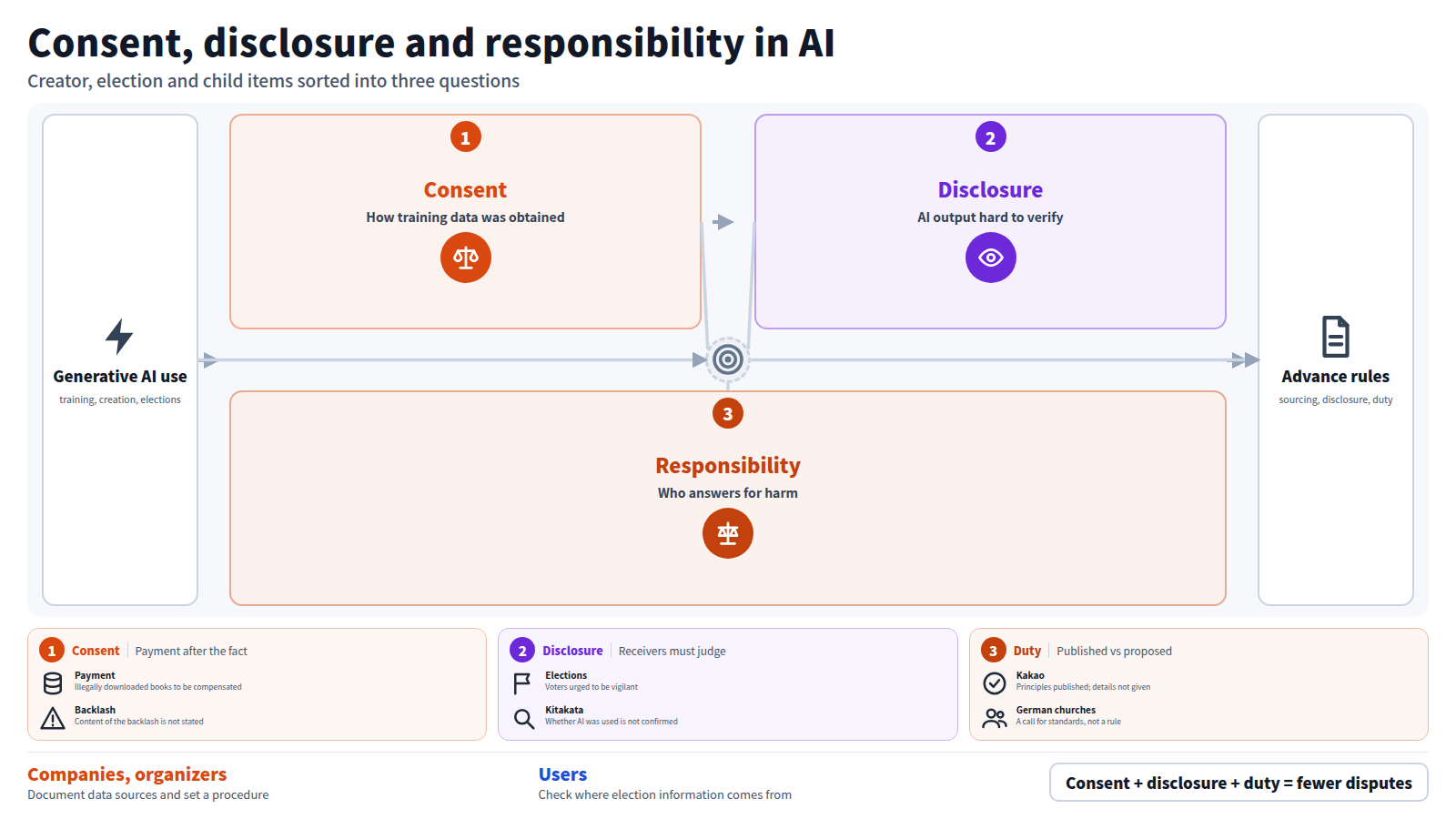
Questions of consent and compensation for creators surfaced in two items: the SoA position after backlash to its Ethical AI Charter (The Bookseller) and Anthropic's compensation for illegally downloaded Korean books (Chosun Ilbo). Election misinformation and child protection also came up (WAMC, nny360.com, House of Lords Library, Christian Daily). In Japan, a municipal children's poster dispute over suspected generative AI use drew attention (J-CAST News). 【Bias, discrimination and fairness】 No notable developments.
Privacy and surveillance
- The only item is a listing titled "talking ai chatbot nsfw characters for adults 18+ with privacy controls" (Universidad de Córdoba (UCO)). The headline does not say what data is collected, who consents, or how it is used, so no conclusion can be drawn from it. 【Transparency and accountability】 No notable developments. 【Creators, copyright and consent】 - SoA: its position on generative AI "remains unchanged" after backlash to its Ethical AI Charter (The Bookseller). The headline does not state the content of the backlash. - Anthropic is to compensate for illegally downloaded Korean books (Chosun Ilbo).
Disinformation and deepfakes
- Claim: WAMC's headline says "Voter vigilance key as AI election misinformation gets more realistic" (WAMC). - Warning: a State Attorney General, James, warned about AI-generated election misinformation (nny360.com). The headlines give no figures on actual harm, so confirmed damage cannot be stated.
Children and vulnerable groups
- House of Lords Library published material on the impact of screen use, artificial intelligence and social media on children and young people (House of Lords Library). - German churches launched an initiative calling for child-appropriate AI standards (Christian Daily). This is a call for standards, not an adopted rule. 【Ethical principles and guidelines】 - Proposal: German churches call for child-appropriate AI standards (Christian Daily). - Decided: Kakao set standards on "control and responsibility" for autonomous agents and published its AI ethics principles (Ajunews). The headline does not give the details. - Disputed: the SoA Ethical AI Charter drew backlash, and the SoA's position on generative AI is unchanged (The Bookseller).
AI ethics in Japan
- Posters by children in Kitakata City: after repeated claims that an award-winning work may have used generative AI, the city halted its display, citing defamation (J-CAST News). The headline does not confirm whether generative AI was used.
Statements by key figures
No notable developments. None of the tracked people (Timnit Gebru, Fei-Fei Li, Yoshua Bengio) appears in the headlines. 【Integrated analysis: how the ethical questions connect】 - Consent and compensation appear in the creator items, where the questions are whether source works were obtained with permission and who is paid (The Bookseller, Chosun Ilbo). The Anthropic headline describes the books as illegally downloaded, which suggests the payment follows a consent failure rather than a prior agreement. This is an inference. - Lack of verifiability runs through the election and Kitakata items. As AI output becomes more realistic, voters are urged to be vigilant (WAMC), and in Kitakata the claim of AI use led to a halt in display (J-CAST News). This suggests that individuals and local bodies are being left to judge authenticity without clear tools. This is an inference. - Standards are being drafted by different actors for different groups: churches for children (Christian Daily), a company for autonomous agents (Ajunews), and a writers' body for generative AI use (The Bookseller). Whether these converge is not shown in the headlines. - What may change decisions: companies may need to document where training data came from. Organizations that publish or judge public submissions may need a procedure for handling suspected AI use before it becomes a public dispute. Both points are inferences.
What to watch
Whether the SoA's unchanged position leads to further reaction from creators, and whether other compensation cases follow Anthropic's (The Bookseller, Chosun Ilbo). 2. Whether the detail of Kakao's "control and responsibility" standards for autonomous agents is disclosed, and how it compares with other companies' principles (Ajunews). 3. Whether authorities or organizations respond further to realistic AI election misinformation and to disputes over suspected AI use in public contests (WAMC, nny360.com, J-CAST News).
- SoA's position on generative AI 'remains unchanged' after backlash to Ethical AI Charter — The Bookseller10/16 11:14 UTC 🔗 Share link
- Anthropic to Compensate for Illegally Downloaded Korean Books — 조선일보 🔗 Share link10/16 15:55 UTC 🔗 Share link
- Voter vigilance key as AI election misinformation gets more realistic — WAMC10/16 16:16 UTC 🔗 Share link
- Screen use, artificial intelligence and social media: Impact on children and young people — House of Lords Library 🔗 Share link10/16 13:06 UTC 🔗 Share link
- German churches launch initiative calling for child-appropriate AI standards — www.christiandaily.com 🔗 Share link10/16 12:52 UTC 🔗 Share link