AI, Welfare & Long-term Care News — 2026-10-17 (Sat)

Source links point to the original outlet. The AI Integrated Analysis is auto-generated from the headlines below only and is not intended to add facts beyond them. Not investment advice.
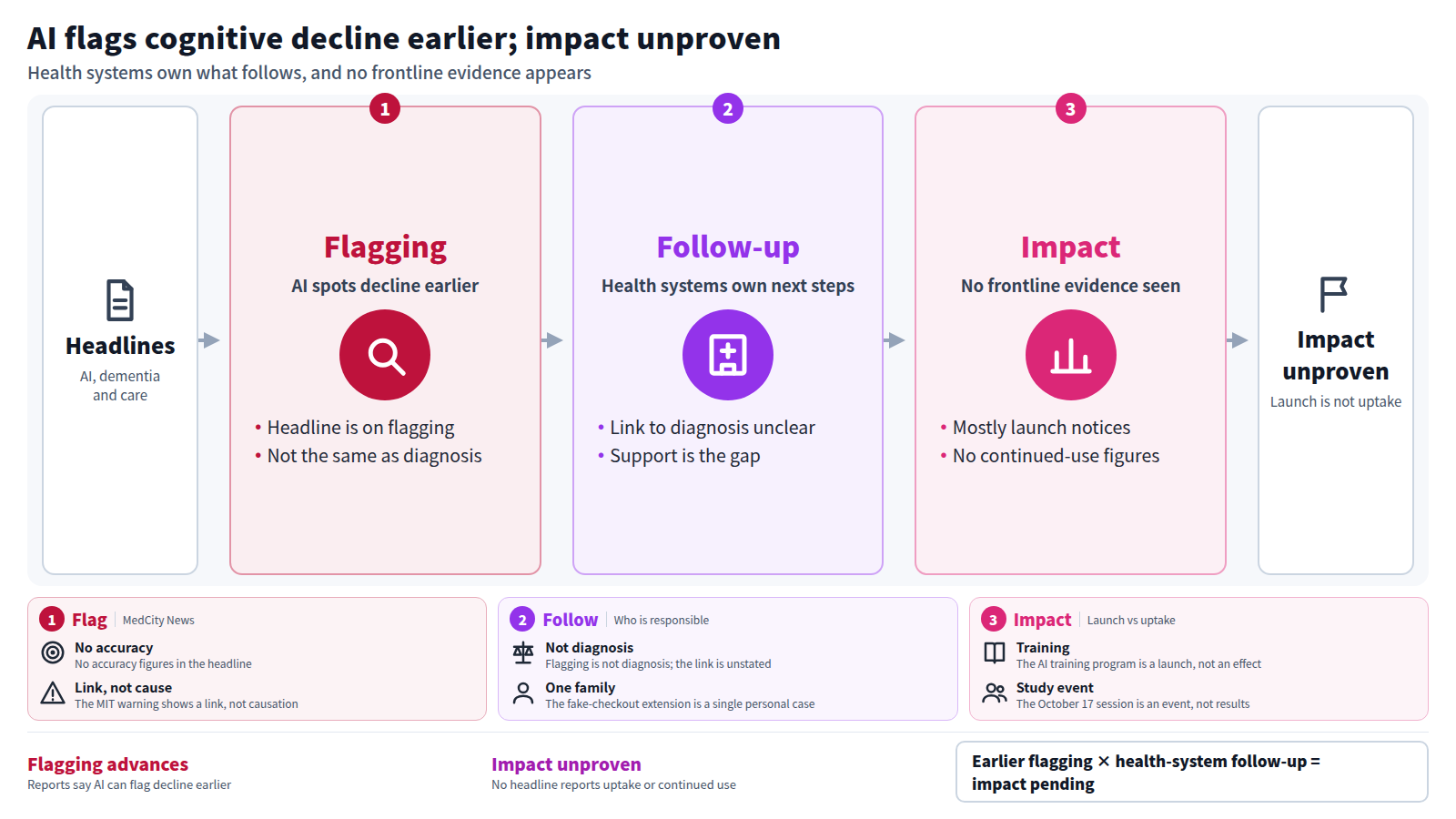
Overview
Care-work news in this period was thin, and no headline reports a change in Japan's care insurance system or staffing standards. Items cover AI in primary care, cognitive decline, and training and study events in Japan; most are overseas or general reports, and none reports a measured effect on frontline care work.
AI in care settings
No headline reports time saved on records, billing, shift scheduling or care plans in care facilities. The only related item is an Economics Observatory piece asking whether unemployment from AI disruption could solve the care crisis: "Unemployment from AI disruption: could it solve the care crisis?" (Economics Observatory). The headline alone shows a question, not a finding, and no evidence stage is given.
Labor shortages and workers
Beth Israel Deaconess Medical Center (BIDMC) researchers have run what is described as the first real-world study of the safety and quality of patient-facing AI in primary care (Newswise). This is a primary care setting, not a care facility, and the headline gives no results, sample size or study design. The Economics Observatory headline above also touches on the labor question, but no staffing standards, turnover or foreign-worker figures appear (Economics Observatory).
Dementia care
- A MedCity News headline says AI can flag cognitive decline earlier, but health systems still own what happens next (MedCity News). Flagging is not diagnosis, and the headline gives no accuracy figures or evidence stage. - Fox Business reports an MIT professor warning that heavy AI use is linked to cognitive decline (Fox Business). This concerns AI users in general, not people receiving care, and a link is not shown to be causal. - Business Insider carries a first-person account in which a person's relative's dementia led to endless online purchasing, and the author built an AI extension that made fake checkout pages (Business Insider). It is a single personal case, not a trial. The headline does not say whether the person with dementia agreed to the tool.
Home care and monitoring
No relevant headlines. No false-alarm or missed-detection data is available.
Care robots and devices
No notable developments. No installation counts or continued-use rates are reported.
Policy and insurance
No notable developments.
Developments in Japan
- A generative AI training program for medical and nursing care providers has launched, covering efficiency gains through to talent development, with hands-on support tailored to each organization's challenges (@Press). The headline gives no participant numbers or outcomes, so this reports a program launch, not an effect. - A study session on using AI and VR in nursing care and welfare is scheduled for October 17, with experts explaining uses and a demonstration of the latest VR rehabilitation (Weekly Osaka Nichinichi Shimbun). The headline reports an event, not results. - On disability and assistive technology, outside Japan: France 24 reports that AI helped a UK lawmaker find her voice in parliament (France 24). A Marketing Tech News piece argues that accessibility is the foundation of AI visibility, which concerns web content, not welfare services (Marketing Tech News).
Statements by key figures
No notable developments.
- Unemployment from AI disruption: could it solve the care crisis? — Economics Observatory10/08 14:03 UTC 🔗 Share link
- AI Can Flag Cognitive Decline Earlier — Health Systems Still Own What Happens Next — MedCity News 🔗 Share link10/08 13:56 UTC 🔗 Share link
- MIT Professor warns heavy AI use is linked to cognitive decline — Fox Business 🔗 Share link10/16 15:19 UTC 🔗 Share link
- His dementia led to endless online purchasing. So I built an AI extension that made fake checkout pages. — Business Insider10/11 09:00 UTC 🔗 Share link
- Generative AI training launched for medical and long-term care providers — Japanese media 🔗 Share link10/09 00:30 UTC 🔗 Share link
- DMWF Spotlight: AI can't cite what it can't read: why accessibility is the foundation of AI visibility — Marketing Tech News10/16 13:27 UTC 🔗 Share link
- Study Session on AI and VR in Care and Welfare to Be Held October 17 — Japanese media 🔗 Share link10/06 10:52 UTC 🔗 Share link