
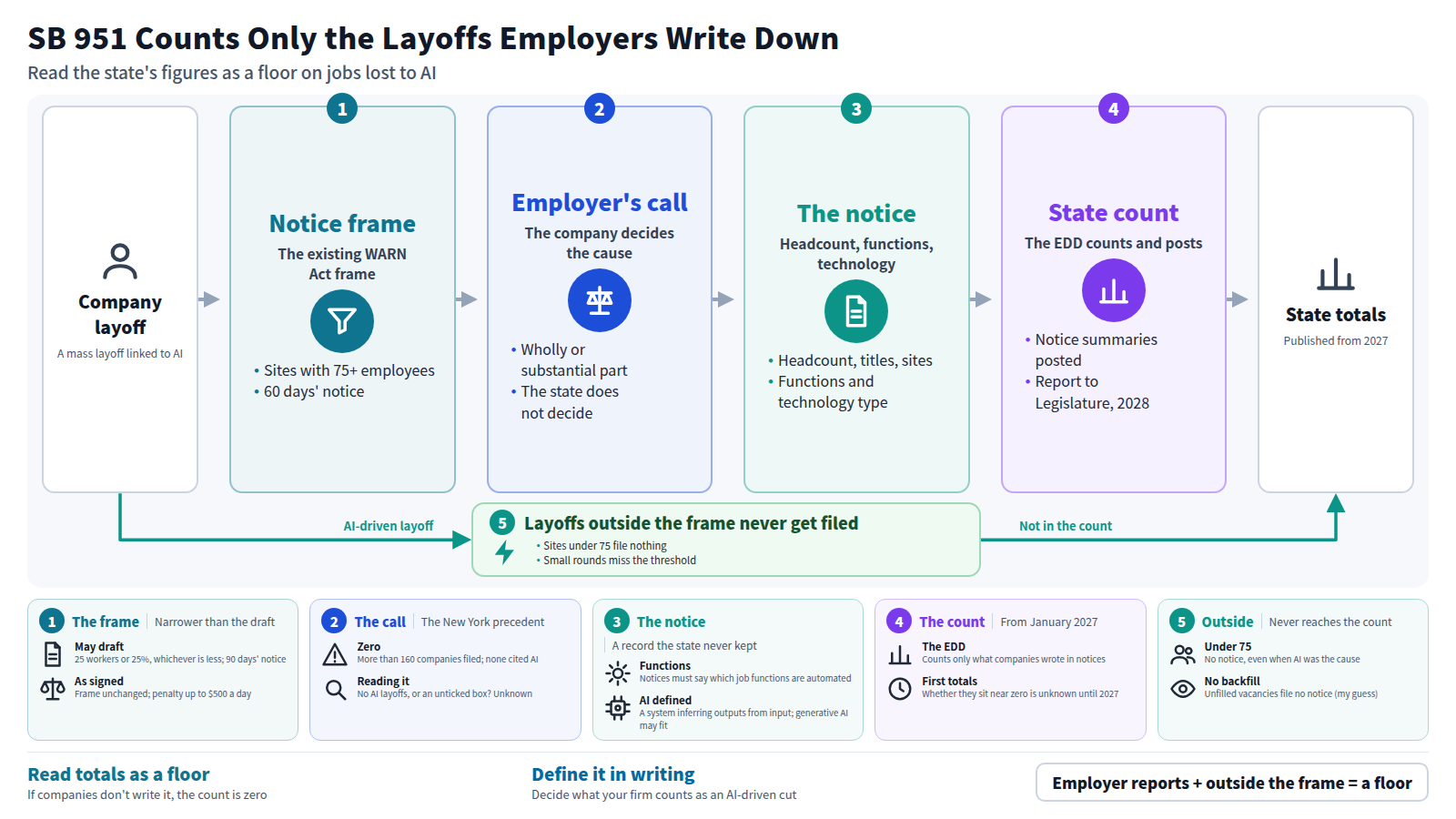
On 30 September 2026, California Governor Gavin Newsom signed SB 951, a law that makes employers say more when AI or automation drives a mass layoff. Their notices will have to state how many people are affected, which job functions go, and what kind of technology caused it. If employers must report AI-driven layoffs, will we learn how many jobs AI has cost? Only the cuts employers themselves attribute to AI will be counted. The state's figures from 2027 will not show how many jobs AI took. They should be read as a floor: the real number may be higher.
01SB 951 will count only the cuts employers attribute to AI
From January 2027, SB 951 requires employers planning a mass layoff caused wholly or in substantial part by AI to add the headcount, the job functions and the type of technology to their notice. The state does not decide whether AI was the cause. The company making the cuts decides, and writes it down.
New York had already added a box asking about this. More than 160 companies filed layoff notices there, and not one named AI as the reason.
California's count, too, will include only what companies write. Anyone who uses AI-and-jobs figures in their work should read the state's number as a minimum. Because the company is the one deciding the cause, HR and management teams would do well to decide in writing, before any notice is filed, what their own company will count as an AI-driven cut.
02Notices must now state the headcount, the job functions and the type of technology
Once a company decides AI is the cause, what goes into the notice? The law firm Littler's summary lists what SB 951 adds.
California already has a law requiring employers to give advance notice of mass layoffs: the state WARN Act. SB 951 amends it. The new items apply when AI or other technology causes the layoff wholly or in substantial part.
Headcount, job titles, locations
The number of workers being replaced by AI or automation, with their job titles and work sites.
Functions being automated
Which of the duties those workers performed will now be automated.
Type of technology
The kind of AI system or automated technology that caused the layoff.
An opening statement
The notice must say at the top that it concerns displacement by technology.
SB 951 also defines AI in the text. It is a machine-based system that infers from the input it receives how to generate outputs. On that definition, a generative model that writes text and a system that forecasts demand could both qualify.
Of the four items, the record of which job functions were automated is the one the state has never collected before. WARN notices have centred on how many people are being let go. Under SB 951, they will also say which work moved to machines.
03The final law dropped the draft's wider trigger and kept the existing 75-employee, 60-day frame
We now know what goes into the notice. The next question is which companies and which layoffs have to file one. That scope changed a great deal between the May draft and the signature.
| What to look at | May draft | SB 951 as signed |
|---|---|---|
| Who is covered | 25 workers or 25% of the workforce, whichever is less | The existing WARN frame (establishments with 75 or more employees) |
| Notice period | 90 days | 60 days, unchanged |
| Wording of the cause | Wholly or primarily AI | Wholly or in substantial part AI |
According to the law firm Ogletree, the May draft covered displacement of 25 workers or 25 percent of the workforce, whichever was less, and asked for 90 days' notice. The law as signed left the WARN frame alone. It still applies to establishments with 75 or more employees. Notice is still 60 days, and the penalty is still up to $500 a day.
SB 951 does not single out any industry. A manufacturing site, a retail chain and a pharmaceutical company's site fall under the same rules.
Because the frame did not move, some AI-driven cuts will never appear in a notice. A site with fewer than 75 employees does not file, even if AI was the cause. A company that splits a reduction into several small rounds may never cross the threshold in any one of them. In that case none of the rounds is reported.
My own guess is that AI may also shrink jobs by leaving vacancies unfilled rather than by cutting many people at once. If nobody is hired to replace a person who leaves, no layoff notice is ever filed. Jobs lost that way will not be in the state's count.
04In New York, not one company named AI as the reason
Even for layoffs inside the frame, it is the company that writes whether AI was the cause. New York is a precedent: it shows how many such notices that arrangement produced there.
From March 2025, New York added a box to its WARN notice form. If a layoff is due to technological innovation or automation, the employer ticks it. According to a May 2026 note from the law firm Hunton, more than 160 companies had filed notices since then. None attributed its layoffs to AI.
| What to look at | New York (from March 2025) | California SB 951 (from January 2027) |
|---|---|---|
| Legal basis | Law unchanged; a box added to the form | Amendment to the WARN Act |
| What is asked | Tick a box for technology or automation | Headcount, functions, technology type, and an opening statement |
| Who decides | The employer | The employer |
| Result | More than 160 companies filed; none cited AI | First totals due in 2027 |
Zero can be read in two ways. Perhaps New York truly had no mass layoffs caused by AI. Or perhaps there were such layoffs and companies did not tick the box. I have nothing that shows which reading is right.
Hunton offers two possible reasons the box stayed empty. One is that it is unclear whether answering is required. New York added the box to the form without changing the law. The other is that it is unclear what counts as an AI-related layoff.
Whichever reason holds, what reaches the state's count is only what employers write.
Companies may also have their own reasons not to name AI. A public record saying staff were cut because of AI could change how remaining employees and business partners see the firm. That is my speculation; Hunton does not list it.
05The state will publish notice summaries, quarterly totals and a 2028 report to legislators
The count depends on whether employers write it down. How, then, will the state tally the notices, and when will it publish? The bill summary compiled by CalMatters sets out the state's tasks.
Notice summaries
The Employment Development Department (EDD) posts summaries of the notices it receives on its website.
Quarterly statewide totals
The EDD posts the number of jobs displaced by technology across the state every three months.
Report to the Legislature
By 1 January 2028, a report on AI's effects on business hiring practices.
The EDD is the California agency that runs unemployment insurance and job services. From 1 January 2027, when SB 951 takes effect, the EDD collects and counts the notices.
California has also acted outside SB 951. On 21 May 2026, Governor Newsom signed Executive Order N-6-26. According to the law firm CDF, the order asks state agencies for recommended revisions to the California WARN Act within 180 days.
So the chain runs like this. Companies file, the EDD counts every quarter, and the Legislature receives a report in 2028. The EDD's quarterly numbers are built from what companies wrote in their notices.
06The totals are a floor, but which jobs moved to machines will be on record for the first time
California will count AI-driven layoffs through notices, totals and a report. I split what those numbers can and cannot tell us into three.
Read the totals as a floor
Only layoffs that companies attribute to AI enter the state's count. Whether or not that explains New York's zero, if companies do not write it, the number is zero. So a small total does not mean AI's effect is small. The cause of a small number may be a small effect, companies not writing it down, or cuts made outside the notice frame. The state's number alone cannot tell us which.
Which functions moved to machines will be recorded
SB 951 asks not only for headcount but for the functions automated and the type of technology. As notices accumulate, it will be possible to see in public state records which occupations AI has displaced in the layoffs companies reported. Even if the headcount is a floor, the record of functions becomes a concrete source, within what was reported, on where AI has entered human work.
Where "substantial part" begins may differ by company
The May draft covered layoffs caused "wholly or primarily" by AI. The final law says "wholly or in substantial part." I found no definition of "substantial part" in the passages quoted by Littler and CalMatters. I have not checked whether the statute defines it elsewhere. Without a definition, two companies making similar cuts may reach different answers on whether to report.
07Whether the first totals in 2027 come out near zero is unknown
What anyone reading the state's numbers should keep in mind is that they should be read as running low. How low will not be known until the first totals arrive in 2027.
California and New York differ in one respect. California made the disclosure a duty in the text of the law. New York only added a box to a form. With the duty spelled out, more California employers may write it down.
They are alike in another. In both states, the employer decides whether AI was the cause. Whether California's first totals will sit near zero, like New York's, cannot be known now. I will not predict a number.
Nor is it known whether the WARN revisions requested by the governor's order will set a test for when AI counts as the cause. If they spell out what "substantial part" means, differences between companies will narrow. If not, the differences remain.
Before the first totals appear, people who use AI-and-jobs figures can do two things. Read the state's number as a minimum. And decide, in writing, what their own company counts as an AI-driven layoff.
- From January 2027, SB 951 requires headcount, job functions and technology type for mass layoffs caused wholly or in substantial part by AI. Employers still decide the cause.
- In New York, more than 160 companies filed notices and none cited AI. A count built on self-reporting shows only what was reported.
- SB 951 kept the existing frame of 60 days' notice for establishments with 75 or more employees. Cuts at sites under 75 employees, and cuts split into rounds too small to cross the threshold, stay outside the state's count.
Making employers report AI-driven layoffs will not reveal how many jobs AI has cost. It reveals what employers write down.
Read California's numbers from 2027 as a floor, a count that may fall short of the real one. Decide in writing, ahead of time, where your own company draws the line on reporting. If I worked in HR, those are the two things I would hold to.
- Littler Mendelson. California Amends Its WARN Act Again. 2026-10-02.(Signature, new notice items, AI definition, effective date, 75 employees, 60 days, $500 a day)
- CalMatters Digital Democracy. SB 951 bill summary (2025–2026 Regular Session). 2026-09-30.(EDD summaries and quarterly totals; 2028 report to the Legislature)
- Hunton Andrews Kurth. New York WARN Act: No AI-Related Layoffs Reported in First Year of Adding AI-Related Disclosure to the System. 2026-05-18.(More than 160 companies, zero citing AI)
- Ogletree Deakins. California Legislature Proposes 90-Day Layoff Notice Requirement Due to Employers' AI Use. 2026-05-01.(The draft's 25-worker, 90-day trigger)
- Reed Smith (Employment Law Watch). What's new in California's response to AI workforce disruption. 2026.(The draft as amended)
- CDF Labor Law. Governor Newsom Signs Executive Order to Confront Economic Impacts of AI. 2026-05-29.(Executive Order N-6-26)
- Bloomberg Law (Daily Labor Report). California Passes Bill Requiring Notices of AI-Related Layoffs. 2026-08-31.(Passage by the Legislature)