AI and Cancer Research ── Cancer biology ── 2026-10-07
Cancer molecular biology and AI
- Abstract
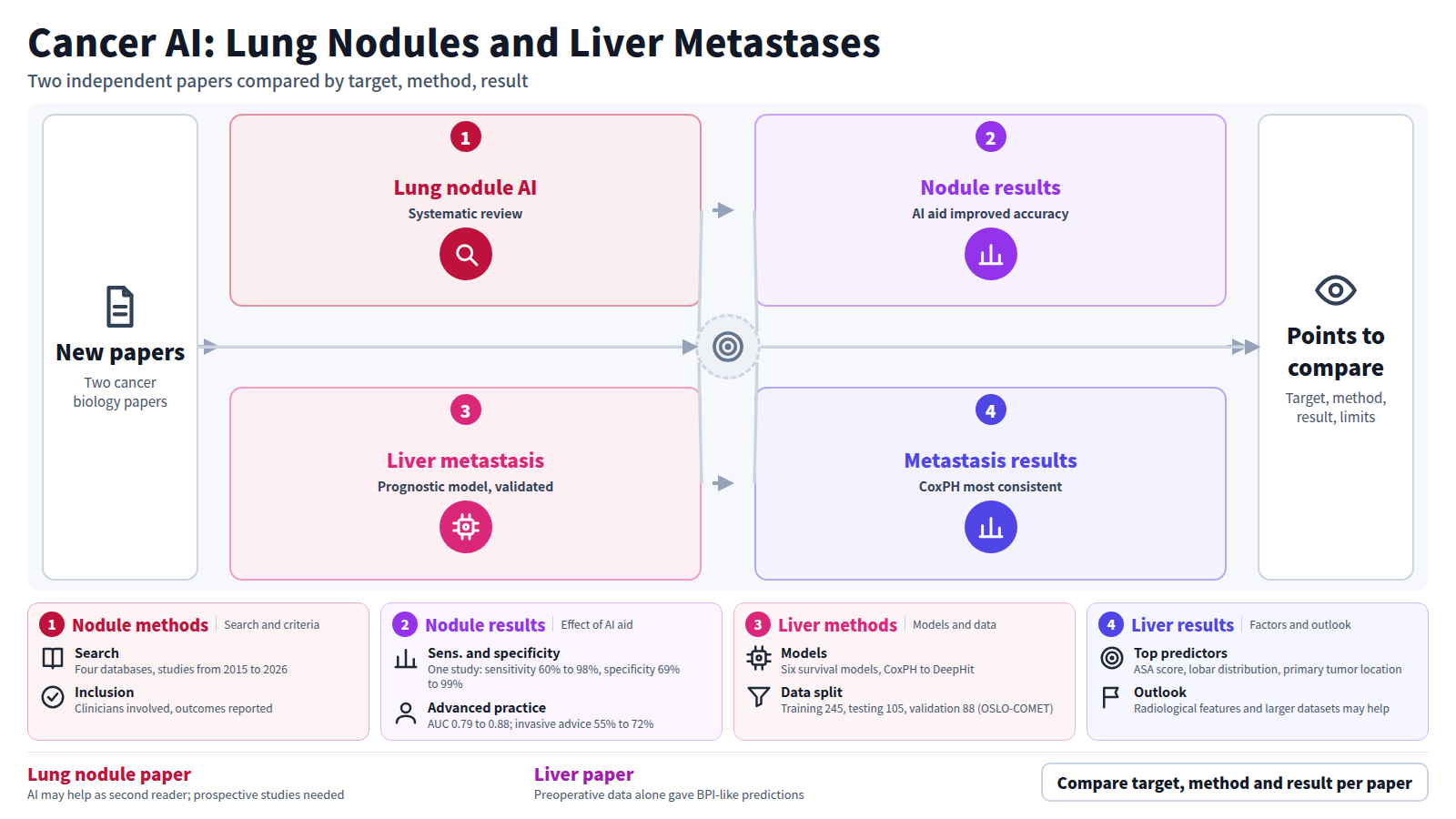
Indeterminate pulmonary nodules (IPNs) detected on computed tomography (CT) pose challenges because malignancy risk assessment is essential to balance early cancer detection with unnecessary invasive procedures. Artificial intelligence (AI) is increasingly used as a decision-support tool for pulmonary nodule assessment, but its impact on clinicians’ diagnostic and management decisions remains less established than the performance of AI algorithms. This systematic review evaluated the effect of AI assistance on clinicians’ diagnostic and management decisions for CT-detected IPNs. The review followed Preferred Reporting Items for Systematic Reviews and Meta-Analyses (PRISMA) guidelines. PubMed, ScienceDirect, Scopus, and Cochrane Library were searched for studies published from 2015 to 2026. Eligible studies assessed AI-assisted evaluation of indeterminate or suspicious pulmonary nodules on CT, involved clinicians, and reported diagnostic or management outcomes. Five retrospective reader-study or multireader multicase studies were included. AI assistance improved diagnostic performance and malignancy risk stratification. One study reported an AUC increase from 0.82 to 0.89 (P<0.001), with higher sensitivity, specificity, and interobserver agreement (Fleiss κ, 0.35 to 0.58; P<0.001). Another found sensitivity increased from 60% to 98% and specificity from 69% to 99%. Among advanced practice providers, AUC increased from 0.79 to 0.88, while invasive procedure recommendations for malignant nodules increased from 55% to 72%. AI detection also benefited radiologists across experience levels. Standalone AI performed worse than experienced radiologists. AI may improve clinician performance and management decisions, especially as a second-reader tool. Evidence remains limited by retrospective designs, heterogeneous systems and outcomes, and lack of randomized trials; prospective studies are needed.
Journal IF-equivalent: 0.1 (OpenAlex 2-year mean citedness, value as of 2026-10-06, retrieved 2026-10-07; not the official Clarivate IF)Reference: Fauziana Ulfa, Atika Amaliah. Impact of Artificial Intelligence Assistance on Clinicians’ Diagnostic and Management Decisions for Indeterminate Pulmonary Nodules on CT. Vitamin. 2026 Oct 6;4(4):255-77. doi:10.61132/vitamin.v4i4.2660.Checked: Abstract only - Abstract
BACKGROUND: Prognostication for patients undergoing liver resection for colorectal liver metastases (CRLM) remains challenging. Artificial intelligence-based survival models may improve individualized risk estimation. METHODS: We developed and compared classical machine learning and deep learning survival models using exclusively preoperative clinical variables from 350 patients undergoing first-time liver resection for CRLM. Models included Cox proportional hazards (CoxPH), random survival forest (RSF), support vector machine for survival (SVM), XGBoost survival, DeepSurv, and DeepHit. Model performance was evaluated using the concordance index (C-index) and the Integrated Brier Score (IBS) on a training set of 245 patients, testing set of 105 patients, and an independent internal validation set of 88 patients from the OSLO-COMET trial. Model interpretability was assessed using SHapley Additive explanation (SHAP) analysis. The results of the developed models were compared to well established Basingstoke Predictive Index (BPI). RESULTS: On internal validation cohort, CoxPH demonstrated the most consistent performance on the internal validation set (C-index 0.59), and on the test set patients (C-index 0.65), comparable to more complex machine learning and deep learning models. Although RSF achieved the highest training performance, this did not translate into superior performance both on the test and the internal validation datasets. CoxPH and DeepSurv models showed comparable 1-, 3-, and 5-year individual prediction to BPI. SHAP analysis consistently identified ASA score, lobar distribution, primary tumor location and number of metastases as the most influential predictors across models. CONCLUSIONS: Using structured preoperative clinical data, we developed machine-and deep-learning models to predict overall survival in patients with CRLM. Given that the models were based exclusively on preoperative clinical variables, their performance is encouraging. Predictive accuracy may be further improved by incorporating additional data modalities, particularly radiological features as well as by training on larger datasets.
Journal IF-equivalent: 2.7 (OpenAlex 2-year mean citedness, value as of 2026-10-02, retrieved 2026-10-03; not the official Clarivate IF)Reference: Kumar NP, Drejian S, Akhavi MS, Qadir HA, Fretland ÅA, Kazaryan AM, et al. Explainable AI–based prognostication of patients with resectable colorectal liver metastases using preoperative clinical parameters: is it comparable to traditional clinical scoring systems?. Front Oncol. 2026 Sep 21;16:1890766. doi:10.3389/fonc.2026.1890766.Checked: Abstract only