AI and Cancer Research ── Brain ── 2026-10-06
Brain tumours: treatment, trials and AI
- Abstract
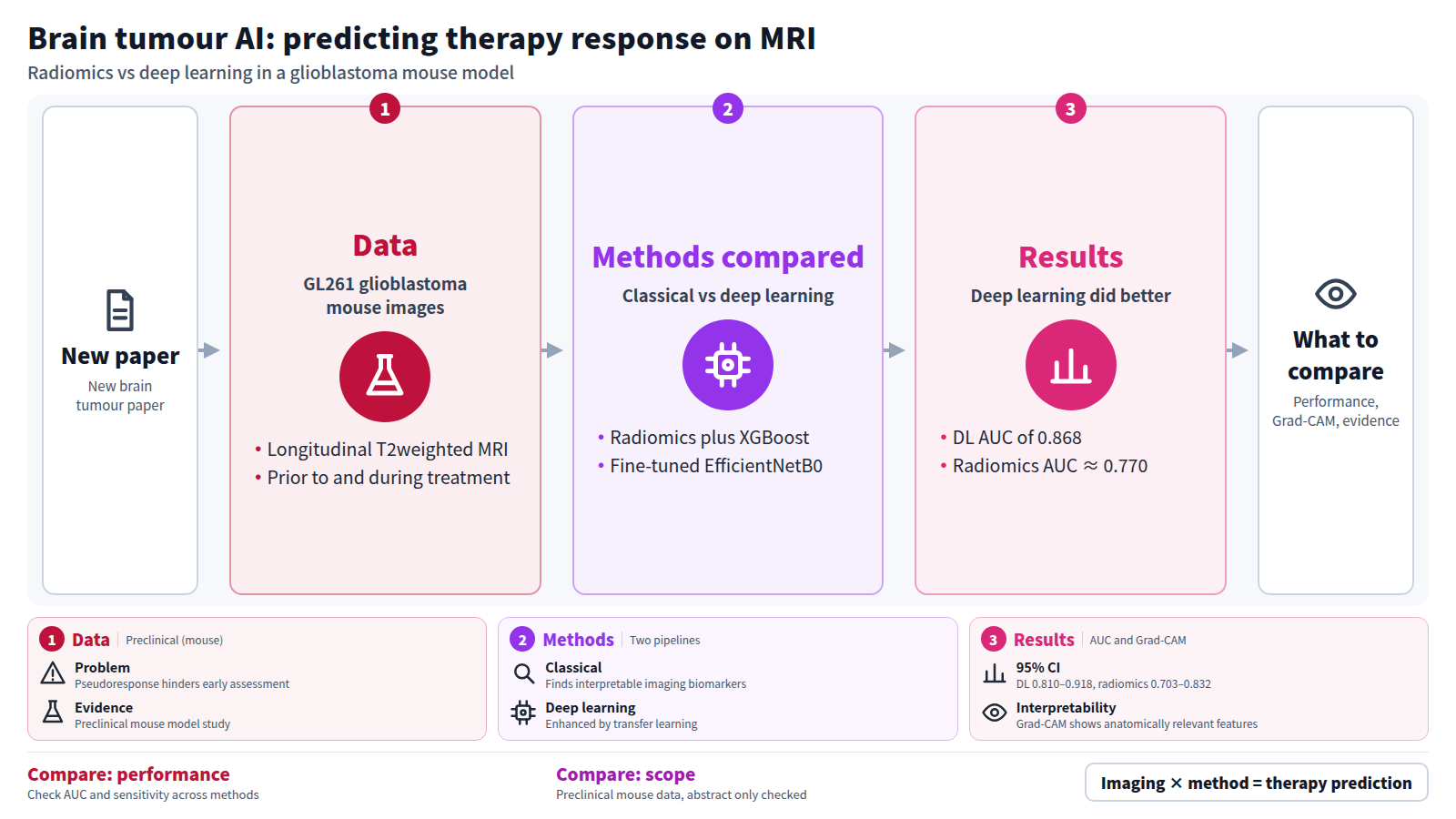
Glioblastoma (GB) is the most aggressive primary brain tumor, characterized by a poor prognosis, limited response to therapy, and high rates of recurrence. Early therapeutic response assessment is challenging due to phenomena such as pseudoresponse and pseudoprogression. This study explores the potential of advanced machine learning (ML) strategies to predict long-term therapy outcomes using longitudinal T2weighted Magnetic Resonance Imaging (MRI) data from a preclinical GL261 glioblastoma mouse model, acquired prior and during treatment. We compare two distinct approaches: a classical pipeline based on radiomic features coupled with an XGBoost classifier, and a deep learning (DL) pipeline using a fine-tuned EfficientNetB0 model. Our results demonstrate that while the radiomics approach identifies interpretable imaging biomarkers and achieves good predictive performance (AUC ≈ 0.770, 95% CI 0.703–0.832), the DL-based model outperforms it across most evaluation metrics, reaching an AUC of 0.868 (95% CI 0.810– 0.918) and a sensitivity of 0.818. The DL model shows better generalization across individual subjects, and the discriminative performance improves progressively throughout the follow-up period for both approaches. Interpretability analysis via Grad-CAM confirms that the DL model’s predictions are driven by anatomically relevant features. These findings suggest that DL, enhanced by transfer learning, has the potential to serve as a powerful non-invasive tool for the early prediction of treatment efficacy in glioblastoma, paving the way for more robust and personalized therapy monitoring.
Journal IF-equivalent: 5.2 (OpenAlex 2-year mean citedness, value as of 2026-10-04, retrieved 2026-10-05; not the official Clarivate IF)Reference: González J, Candiota AP, Vellido A. Advanced machine learning strategies for predicting therapy response in preclinical glioblastoma using longitudinal MRI. Sci Rep. 2026 Oct 4 [Epub ahead of print]. doi:10.1038/s41598-026-73929-2.Checked: Abstract only