AI, Welfare & Long-term Care News — 2026-10-06 (Tue) Evening News

Source links point to the original outlet. The AI Integrated Analysis is auto-generated from the headlines below only and is not intended to add facts beyond them. Not investment advice.
Overview
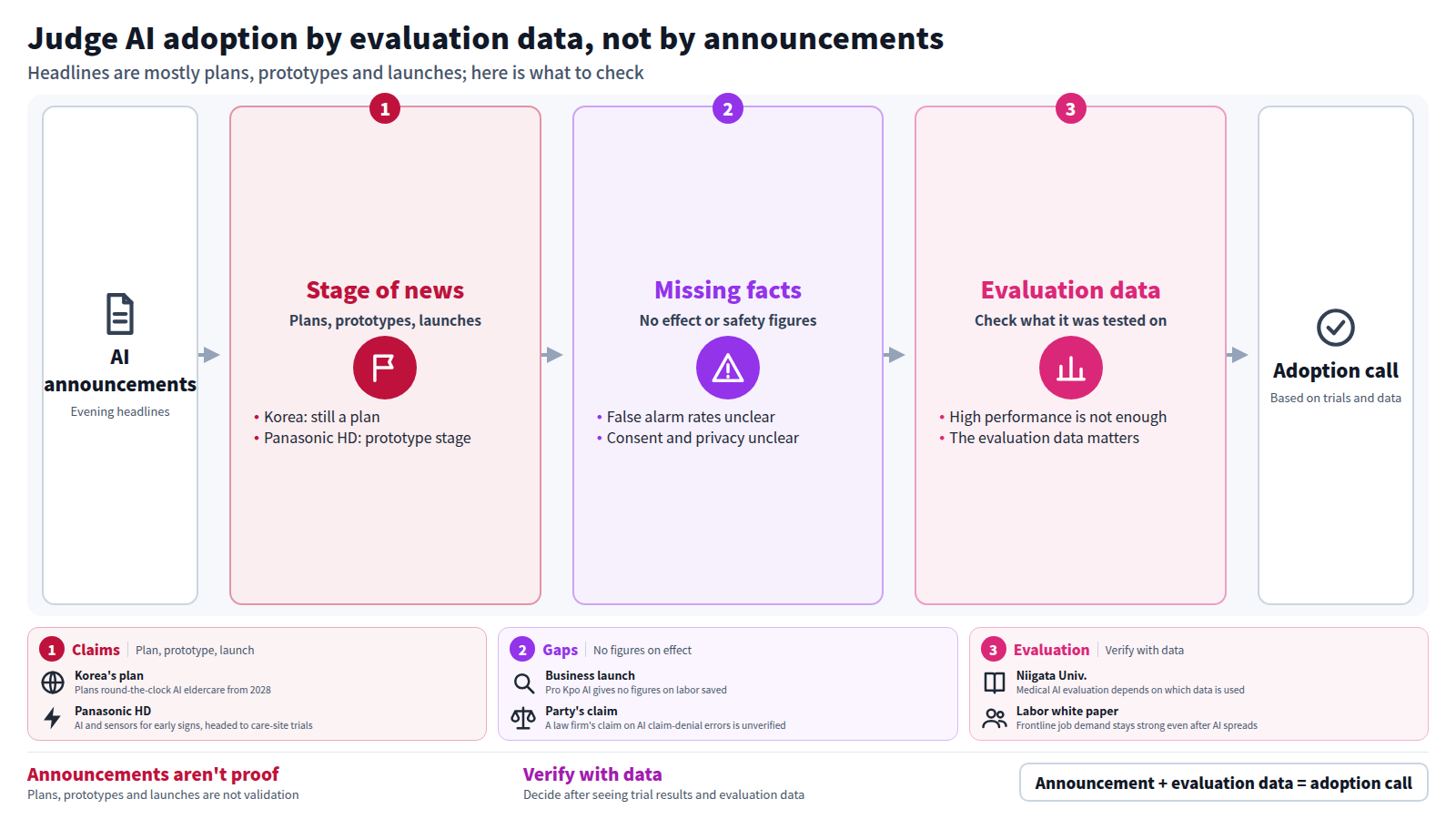
- The main movements were "on-the-spot technology development (monitoring signs and mobility support)" and "policy statement (Korea's 24-hour AI elderly care plan)," and movements regarding the domestic system (nursing care fees and placement standards) cannot be confirmed from the headlines. - Regarding the labor shortage, the White Paper on the Labor Economy is notable for stating that ``demand for front-line jobs will not decline even after the spread of AI.'' - In the field of disability welfare, while there are demonstrations of funding, subsidies, and support devices, there are also concerns about AI-based decisions on disability benefit non-payment.
AI in nursing care settings
- In a headline from the US, Pro Kpo AI launches business claiming to automate medical reservations and scheduling and reduce management costs (knoxnews.com). We are not talking about records, billing, and shifts at nursing care sites, but about medical reservation management, and there are no figures in the headlines that show how many minutes of labor has been saved. The evidence stage is the announcement of the start of the project, with no evidence of effectiveness verification. - There is no relevant information for headings that indicate time savings for recording, billing, and creating care plans.
Labor shortage and workers
- South Korean government plans 24-hour AI elderly care starting in 2028 (The Korea Herald). It is still in the planning stage, and the number of targets, impact on personnel, consent and privacy issues are unclear from the headline. - Labor Economic White Paper (Shinken Housing): It was shown that the demand for "on-site jobs" will not decline even after the spread of AI. It is not possible to tell from the headline whether the description is limited to nursing care workers. There is no specific breakdown of jobs that AI will replace and jobs that cannot be replaced in the headline. - There is no relevant information for headings regarding staffing standards, turnover, and foreign personnel.
Dementia care
- UCF researchers will work on using AI to help older adults thrive in a technology-driven society (University of Central Florida). It is unclear from the headline whether it deals with the detection and diagnosis of dementia. Research stage. - Annovis uses AI to speed up approval of Alzheimer's drug (Longevity.Technology). We are talking about drug discovery and application work, not detection and diagnosis at the point of care. The outcome or validity of the application is not in the headlines. - There is no relevant information in the heading regarding BPSD response and family burden.
Home care/monitoring
- Panasonic HD's "predictive solution" uses AI and sensors to detect signs of changes in the physical condition of the elderly, and will be demonstrated at nursing care sites (projectdesign.jp, Cloud Watch). The stage before the completion of development and the start of demonstration (prototype to future demonstration). False alarm/overlook rates, consent of individuals, and handling of privacy are not mentioned in the headlines and are unclear. - There is no relevant information for other headings of fall detection/remote monitoring.
Care robots/equipment
- Test of AI robot for visually impaired people released in Tokyo (The Japan Times). It is not a nursing care robot, but an assistive device, and is currently in the testing stage. The number of units introduced and the continuation rate are not in the headline. - There is no relevant information under the heading Transfer Support/Rehabilitation/Communication Robots. There is also no information regarding the number of units introduced and the continuation rate.
System/Insurance
- There is no relevant information for headings related to long-term care insurance, long-term care fees, and community comprehensive care. - Reference (outside the system): A law firm claims that AI is starting to influence decisions on the non-payment of disability benefits (insurance claims) in the United States, and errors are already appearing (EIN News). The message was sent by a representative for the parties involved, and it is not possible to verify the facts or confirm the number of cases from the headline. - As a local government demonstration, Mori Building and others conducted a demonstration experiment of an ``AI suitcase'' that supports the movement of visually impaired people at Toranomon Hills (Jutaku Shimpo). Demonstration stage in one location.
Japanese movements
- Panasonic HD: Developed an AI and sensor solution that detects signs of changes in physical condition, and will demonstrate it at nursing care sites (prototype → pre-demonstration). - A study session on “Nursing care x AI/VR” is scheduled to be held on October 17th (47NEWS). - Welmo (medical care AI) moves its headquarters to "Tenjin Business Center II" in Tenjin, Fukuoka (PR TIMES). Corporate relocation, not business results. - Mori Building, etc.: "AI suitcase" demonstration experiment at Toranomon Hills (above). - Niigata University of Health and Welfare: Announced that when evaluating the performance of medical AI, it is not only the high performance that is important, but also ``what data was used for the evaluation.'' This is a point regarding evaluation methodology, and does not indicate the effectiveness of a specific product. - Labor Economic White Paper: Points out that demand for front-line jobs will not decline even after the spread of AI. - There are no headlines indicating the desire of Japanese seniors to learn AI, and the survey of 95% of seniors who say they want to learn AI is from South Korea (The Hankyoreh Newspaper), so it is not included in Japan's trends.
Remarks from VIPs
- The list of important people to be tracked is empty and there is no relevant information. Supplement: Overseas/disability welfare field (other than Japan) Consideration stage. - Enable Ventures announces first closing of $50.31 million for disability-focused AI startup fund (Dealroom). We are talking about investment, but the effects on the ground are not shown. - Article discussing “Disabled Citizens and the Future of AI” (The Hindu). The content is unclear, just the headline.
- Pro Kpo AI Opens for Business to Automate Healthcare Scheduling and Reduce Administrative Costs — knoxnews.com10/04 07:00 UTC
- Korea plans round-the-clock AI eldercare from 2028 — The Korea Herald10/06 05:50 UTC
- UCF Researcher Harnesses AI to Help Older Adults Thrive in a Tech-Driven World — University of Central Florida09/24 07:00 UTC
- Annovis turns to AI to fast-track its Alzheimer’s filing — Longevity.Technology10/06 04:18 UTC
- Labor Economy White Paper: Demand for frontline workers stays strong even after AI spreads — 新建ハウジング10/05 10:56 UTC
- Nursing Care, AI and VR Study Session to Be Held October 17 — 47NEWS10/03 23:32 UTC
- 95% of seniors answered “I want to learn AI”…Behind this is a desire for “work and interpersonal relationships” = South Korea (The Hankyoreh Newspaper) — Yahoo!ニュース10/06 04:29 UTC
- Healthcare AI firm Welmo moves headquarters to Tenjin Business Center II in Fukuoka — PR TIMES10/06 01:00 UTC
- Durango nonprofit awarded $494,000 grant to explore AI for disability services — ColoradoBiz10/05 23:32 UTC
- Disabled citizens and the future of AI — The Hindu10/05 19:18 UTC
- Enable Ventures closes first fund at $50.31M to back disability-focused AI startups — Dealroom09/29 15:07 UTC
- Trial of AI robot for visually impaired people shown in Tokyo — The Japan Times09/29 07:33 UTC
- AI is starting to shape disability claim denials, and DeBofsky Law says the errors are already showing up — EIN News10/01 19:12 UTC