AI & Economy News — 2026-10-05 (Mon) Evening News
Source links point to the original outlet. The AI Integrated Analysis is auto-generated from the headlines below only and is not intended to add facts beyond them. Not investment advice.
Overview
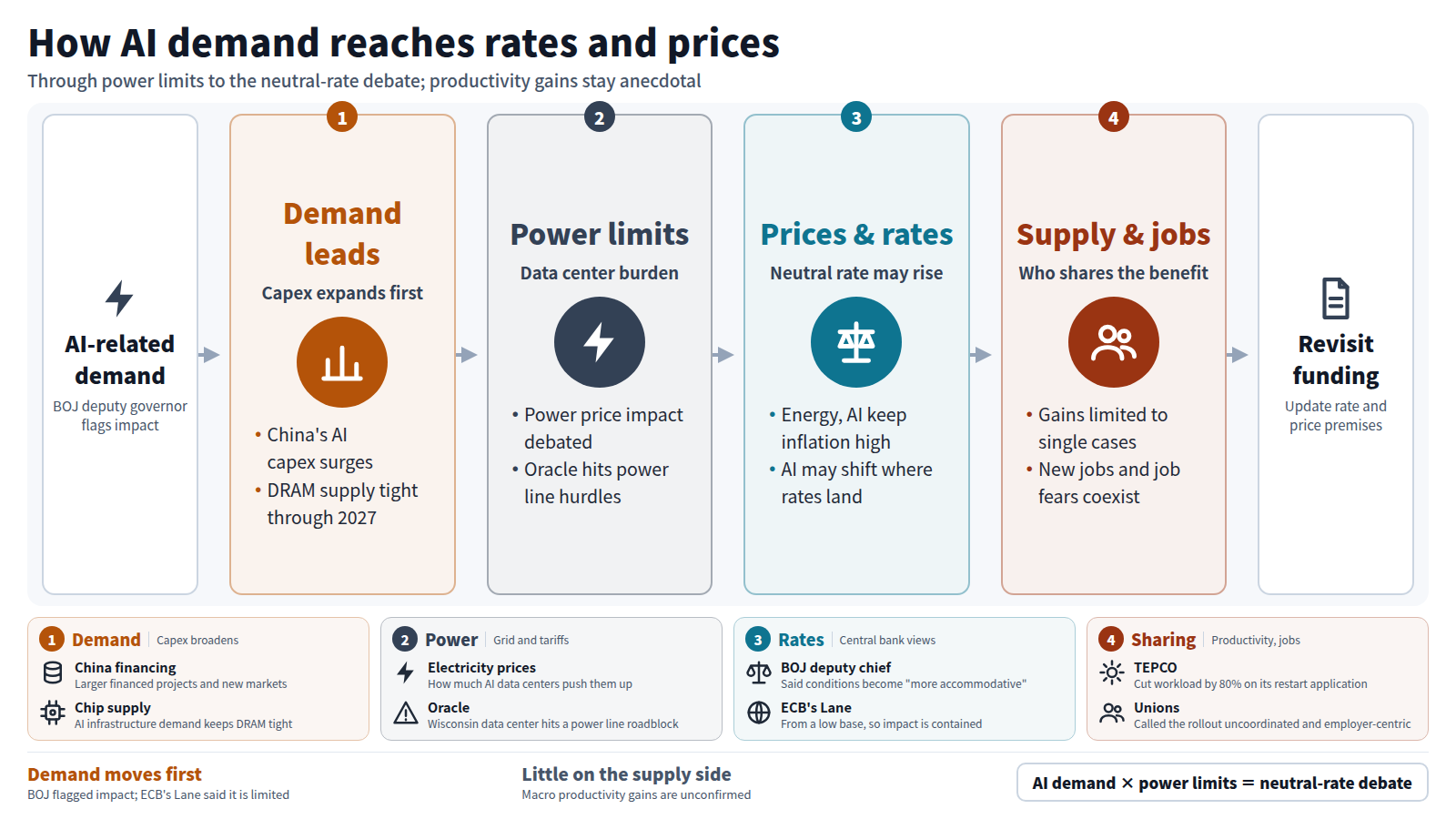
The Bank of Japan's deputy governor expressed the view that the growth in AI-related demand could affect prices, long-term interest rates, and the neutral interest rate, and said that financial conditions will become "more accommodative" (The Japan Times, Reuters, bloomingbit, Yahoo! News). ECB's Lane also said that AI-related spending will encourage investment in the euro area, but only from a low level and that the macroeconomic impact will be limited (TradingView). While central banks are increasingly arguing that AI will influence interest rates and price levels, the power burden on data centers has become an issue in various regions.
Macroeconomic/growth trends
Vanguard's Wang pointed out that energy and AI will help keep inflation high (Bloomberg.com). A major central banker said the AI boom could change where interest rates end up (businessinsider.com). The Deputy Governor of the Bank of Japan mentioned the possibility that the rapid increase in demand for AI could push up inflation, long-term interest rates, and the neutral interest rate (The Japan Times, bloomingbit). There are also reports that technology-related prices have soared, contrary to expectations that AI would bring prices down (theaustralian.com.au).
Productivity trends
Itoki and Matsuo Research Institute used AI to analyze behavioral data of 854 people and showed that "receiving chats" can reduce productivity (ZDNET Japan). Tokyo Electric Power Company reportedly used AI to apply for restarting nuclear power plants, reducing the amount of work by 80% (Nihon Keizai Shimbun). World Bank President Ajay Banga said AI can boost India's farmers (National Herald). There's also an article discussing what the AI boom is doing in the US (noahpinion.blog). Unions criticized the introduction of AI as "poorly coordinated and employer- and developer-centric" (hrleader.com.au).
Trends in employment and labor market
It was reported that 29,000 new AI-related jobs have been confirmed in the US, marking an "alarming change" in the country (teleSUR English). Mark Cuban warns of 750,000 new AI jobs (BeInCrypto). Sapiens chairman talks about company transformation including layoffs and AI (calcalistech.com). Cal State is moving ahead with the full implementation of AI, but students aiming to find jobs remain skeptical (EdSource). Questions have also been raised about whether AI will replace jobs or merely change the way we work (CBS News).
Trends in energy/power demand
The extent to which AI data centers are driving up electricity prices was discussed (NPR). Oracle's Wisconsin AI data center faces power line hurdles (Startup Fortune) Some argue that the manufacturing industry needs AI, data centers, and electricity (Montgomery Advertiser). The growing interest in AI data centers has also been reported in local newspapers (Lowell Sun).
Remarks by central banks, international organizations, and VIPs
・Bank of Japan Deputy Governor Uchida: Pointed out that the impact of AI demand will take precedence, and stated that the financial environment will be "more accommodative." He also mentioned that a surge in demand for AI could push up inflation, long-term interest rates, and neutral interest rates (Reuters, Yahoo! News, The Japan Times, bloomingbit). ・ECB・Mr. Lane: AI spending is encouraging investment in the euro area, but said that since it is coming from a low level, the impact on the macro economy will be limited (TradingView). ・World Bank President Ajay Banga: Said that AI can change the lives of farmers in India and other developing countries (National Herald, indica News). -No notable movements for Christine Lagarde, Kazuo Ueda, Andrew Bailey, Kristalina Georgieva, Mathias Cormann, Daron Acemoglu, and Erik Brynjolfsson.
Trends in corporate capital investment
China's AI infrastructure investment is expanding with large funding deals and the expansion of new markets (Global Sources). It is predicted that DRAM supply will remain tight until 2027 due to demand for AI infrastructure (EE Times Asia). There is also an article discussing the "Agentic AI Supercycle" (semiengineering.com).
Trade and industrial policy
It was reported that the difference in AI performance between the US and China has narrowed to 3%, with DeepSeek now matching Anthropic's performance (finance.biggo.com). There are no headlines regarding tariffs, export regulations, or subsidies, and there are no other notable developments. It has also been reported that AI will reduce labor and increase added value in the seafood processing field (intrafish.com).
Integrated analysis: What is happening now
What the central bank's statements indicate is that AI will be effective on the demand side first. The Deputy Governor of the Bank of Japan pointed out that demand is ahead, and Mr. Lane said that even if investment increases in Europe, the impact will be limited. There may be regional differences. Expanding capital investment (infrastructure investment in China, tightening of DRAM) is directly linked to power and transmission grid constraints (Oracle case, concerns about electricity rates), and this seems to be leading to inflationary pressures and a rise in the neutral interest rate. On the other hand, improvements in productivity are limited to individual cases such as analysis of TEPCO and companies, and there is little material that can be confirmed as a macro-level improvement in supply capacity. On the employment front, the creation of new jobs, concerns about replacements, and criticism from unions coexist, and the distribution of benefits may be becoming a point of contention.
Future points of interest
・How will major central banks, including the Bank of Japan, incorporate AI demand into their estimates of neutral interest rates? ・To what extent will data center power burdens and power grid constraints affect electricity rates and prices? ・Will productivity improvements due to AI be reflected in macro statistics from individual cases, and how will the reallocation of employment progress?
- Watch Vanguard's Wang: Energy, AI Keep Inflation High — Bloomberg.com10/05 00:00 UTC
- The AI boom could change where interest rates end up, a top central banker says — businessinsider.com10/05 05:11 UTC
- BOJ’s deputy chief flags AI’s possible impact on neutral rate — The Japan Times10/05 02:42 UTC
- BOJ Deputy Governor Says AI Demand Surge May Lift Inflation, Long-Term Yields and Neutral Rate — bloomingbit10/05 04:01 UTC
- AI promised lower costs, then tech prices exploded — theaustralian.com.au10/05 07:47 UTC
- What the AI boom is doing for Americans — noahpinion.blog10/05 08:12 UTC
- Worker union criticises ‘uncoordinated, employer and developer-centric’ AI rollout — hrleader.com.au10/05 07:38 UTC
- Cal State goes all in on AI, but some job-seeking students remain skeptical — EdSource10/05 07:16 UTC
- AI is being taught how to do your job. Will artificial intelligence replace us, or just change the way we work? — CBS News10/04 23:53 UTC
- Experts weigh in on AI in the workforce at panel hosted by Beth Macy | Elections | dnronline.com — dnronline.com10/05 09:00 UTC
- “The bad and the ugly was Sapiens itself”: Sapiens chairman on layoffs, AI and the company’s transformation — calcalistech.com10/05 08:07 UTC
- Manufacturing needs AI, data centers and power | PERRY O. HOOPER JR. — Montgomery Advertiser10/05 08:47 UTC
- Written in Granite: AI data centers are all the rage — Lowell Sun10/05 07:06 UTC
- Oracle's Wisconsin AI data center hits a Wisconsin power line roadblock — Startup Fortune10/05 01:32 UTC
- The changing face of processing: AI, fewer hands, higher value — intrafish.com10/05 04:42 UTC
- U.S.-China AI Gap Narrows to 3% as DeepSeek Matches Anthropic's Performance — finance.biggo.com10/05 06:35 UTC
- The Agentic AI Super Cycle — semiengineering.com10/05 07:33 UTC
- China’s AI infrastructure investments surge with larger financed projects and new markets on the horizon — Global Sources10/05 05:24 UTC
- AI Infrastructure Demand Keeps DRAM Supply Tight Through 2027 — EE Times Asia10/05 05:09 UTC
- Bank of Japan Deputy Governor Uchida AI “moves the financial environment more accommodatively” (TBS NEWS DIG Powered by JNN) — Yahoo!ニュース10/05 08:54 UTC
- TEPCO uses AI to apply for nuclear power plant restart, reduces workload by 80%, addresses shortage of specialized human resources — 日本経済新聞10/05 02:50 UTC
- Mark Cuban warns of 750,000 new AI jobs — BeInCrypto10/05 05:08 UTC