AI & Economy News — 2026-10-06 (Tue) Morning News
Source links point to the original outlet. The AI Integrated Analysis is auto-generated from the headlines below only and is not intended to add facts beyond them. Not investment advice.
Overview
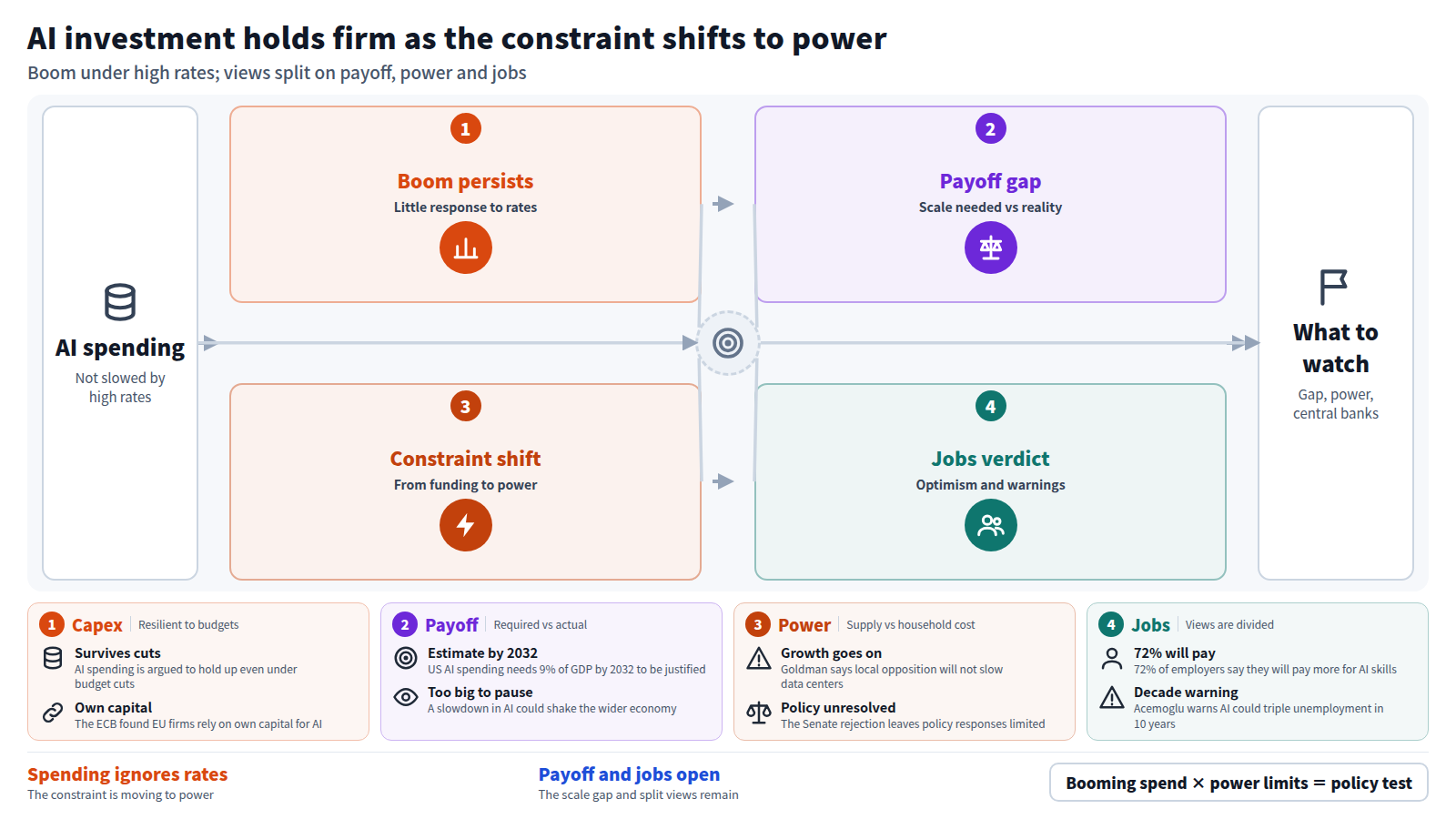
The main focus is on the sustainability of AI investment and the economic effects and power supply that underpin it. AI investment continues unabated even under high interest rates, and the impact on monetary policy is being debated (nytimes.com). On the other hand, it has been estimated that ``9% of GDP is needed to justify AI investment'' and that electricity is the ``most difficult bottleneck to solve'' (Harici, TradingView).
Macroeconomic/growth trends
The headline reads, "High Interest Rates Aren't Slowing the A.I. Boom. That's a Problem for the Fed," which suggests that AI investment has not slowed down even with high interest rates, posing a problem for the Fed's policy management (nytimes.com). Philip Jefferson reportedly discussed AI, inflation, and the credibility of the Fed (Darden Report). “US AI spending needs 9% of GDP by 2032 to justify capital boom,” indicating the scale needed to justify the capital investment boom (Harici). It is also being discussed that the slowdown in AI could shake up the economy, citing the possibility that it is "too big to pause" (TradingView). In Japan, it was reported that ``the hurdles remain high for unprecedented AI investment to realize commensurate economic effects'' (Reuters).
Productivity trends
There are no headlines about productivity statistics themselves. The argument is that AI should be linked to growth strategies rather than layoffs (AFR). It was also reported that Mark Cuban warned that the ability to utilize AI will determine an individual's competitiveness (Benzinga). Some analyzes ask what must happen before the “AI job apocalypse” arrives (Benefits and Pensions Monitor).
Trends in employment and labor market
"72% of employers say they'll pay more for AI skills" (Fortune). Japan's Labor Economy White Paper stated that the demand for "on-site jobs" will not decline even after the spread of AI (Shinken Housing). New York Governor Hochul expands free community college to address AI's impact on labor (nydailynews.com). Some people whose jobs were changed early on by AI are now trying to avoid it (CNN).
Trends in energy/power demand
Citi's Kaiser said power generation is AI's "hardest bottleneck to fix" (TradingView). Goldman Sachs said the expansion of AI data centers will not be stopped by opposition from local residents (Yahoo Finance). The U.S. Senate has rejected a bill that could protect Americans from soaring electricity costs caused by AI data centers. Opponents have criticized it as "toothless" (Tom's Hardware). There is also discussion of "AI Energy Parks" centered on electricity (Data Center Frontier).
Remarks by central banks, international organizations, and VIPs
- Daron Acemoglu (MIT economist / Nobel laureate): Warned that AI could triple the unemployment rate over the next 10 years (NDTV Profit). - Ajay Banga (World Bank President) said AI could empower Indian farmers (IndiaWest). - ECB: pointed out that EU companies rely on their own capital for AI transition (FStech). - Bank of Japan Deputy Governor Uchida said that AI will "make the financial environment more accommodative" (TBS NEWS DIG). The impact of AI on demand, interest rates, productivity, and employment was a major topic of discussion at the Bank of Japan's monetary policy meeting (Chiba Television Broadcasting). - Philip Jefferson: Discussed AI, inflation, and Fed credibility (Darden Report). - No notable movement in headlines regarding Christine Lagarde, Kazuo Ueda, Andrew Bailey, Kristalina Georgieva, Mathias Cormann, and Erik Brynjolfsson.
Trends in corporate capital investment
“AI Spending Is The Honey Badger Of Budgets” argued that AI spending is likely to be maintained even under budget cuts (The Next Platform). EU companies are financing AI transition with their own capital (FStech). In the industrial automation field, business is being repositioned to AI and software (controlglobal.com). Securing electricity is considered to be a constraint on investment (TradingView).
Trade and industrial policy
In China, there was a commentary (South China Morning Post) that AI microdramas could become a touchstone for the next wave of exports. In the United States, the Electricity Rate Protection Act was rejected, and policy responses related to data centers were limited (Tom's Hardware). There was no notable movement in the headlines regarding tariffs, export controls, and subsidies.
Integrated analysis: What is happening now
The headlines suggest that AI investment will grow as a self-sustaining demand that is not responsive to interest rates, and that there is a disconnect between the scale needed to justify it (9% of GDP) and the actual economic impact (Harici, Reuters, nytimes.com). Constraints appear to be shifting from funding to electricity, and Citi's points and the Senate's rejection of the bill show that the friction between supply and household burdens remains unresolved in policy (TradingView, Tom's Hardware). Deputy Governor Uchida's view that the Fed is headed for ``easing'' and the boom faced by the Fed amid high interest rates suggest that AI may be changing the assumptions of neutral interest rates and policy management. On the employment front, views are divided on the combination of optimistic factors such as wage premiums for AI skills and sustained demand for front-line jobs, as well as Acemoglu's warning that the unemployment rate will triple.
Future points of interest
Will the gap between AI investment as a percentage of GDP and actual productivity improvement narrow? 2. Will policy responses regarding electricity supply and rates limit the pace of data center expansion? 3. How will central banks factor AI into decisions on interest rates, prices, and employment (Bank of Japan and Fed discussions)?
- Philip Jefferson on AI, Inflation & Fed Credibility — Darden Report10/05 15:57 UTC
- High Interest Rates Aren’t Slowing the A.I. Boom. That’s a Problem for the Fed. — nytimes.com10/05 15:27 UTC
- AI Spending Is The Honey Badger Of Budgets — The Next Platform10/05 17:52 UTC
- What has to go wrong before the AI job apocalypse arrives? — Benefits and Pensions Monitor10/05 18:00 UTC
- Mark Cuban Drops a Blunt Warning for Workers: ‘Someone Who Knows How to Use AI Better Than You Will…' — Benzinga10/05 11:10 UTC
- Business needs a growth strategy, not a cost-cutting plan for AI — AFR10/05 18:00 UTC
- Wall Street Tackles Workforce’s AI Anxiety — Global Finance Magazine10/05 15:23 UTC
- Bank of America CEO highlights workforce development, AI - RBJ — Rochester Business Journal10/05 16:48 UTC
- Workers feared AI would kill jobs. Instead, 72% of employers say they’ll pay more for AI skills — Fortune10/05 14:58 UTC
- Their jobs were among the first to be changed by AI. Now some are trying to avoid it — CNN10/05 11:00 UTC
- Gov. Hochul expands NY free community college to address AI workforce impacts — nydailynews.com10/05 15:15 UTC
- AI Energy Parks: From Speed to Power to Power That Lasts — Data Center Frontier10/05 16:02 UTC
- AI data center growth won't be slowed down by angry neighbors: Goldman Sachs — Yahoo Finance10/05 16:14 UTC
- US Senate kills bill that could potentially shield Americans from skyrocketing power bills due to AI data centers — opponents say bill is 'toothless' and doesn't do enough to protect citizens — Tom's Hardware10/05 10:25 UTC
- Opinion | AI microdramas are a test case for China’s next big export wave — South China Morning Post10/05 12:30 UTC
- Year of the pivot: Repositioning around AI, software and other factors impacting industrial automation — controlglobal.com10/05 16:55 UTC
- EU businesses rely on own capital for AI transition, ECB finds — FStech10/05 14:56 UTC
- Citi’s Kaiser Says Power Generation Is AI’s ‘Hardest Bottleneck To Fix’ — TradingView10/05 16:45 UTC
- Focus: Unprecedented AI investment, still high hurdles to achieving commensurate economic effects | Reuters — Reuters10/05 09:10 UTC
- Labor Economy White Paper: Demand for frontline workers stays strong even after AI spreads — 新建ハウジング10/05 10:56 UTC
- AI Becomes Key Topic at Bank of Japan Policy Meetings, Affecting Demand, Rates, Productivity, Jobs — 千葉テレビ放送株式会社10/05 06:33 UTC
- AI Could Triple Unemployment In Next Decade, Warns Nobel Laureate Daron Acemoglu — NDTV Profit10/05 10:25 UTCDaron Acemoglu / MIT economist / Nobel laureate