AI and Cancer Research ── Lung ── 2026-10-05
Lung cancer: treatment, trials and AI
- Abstract
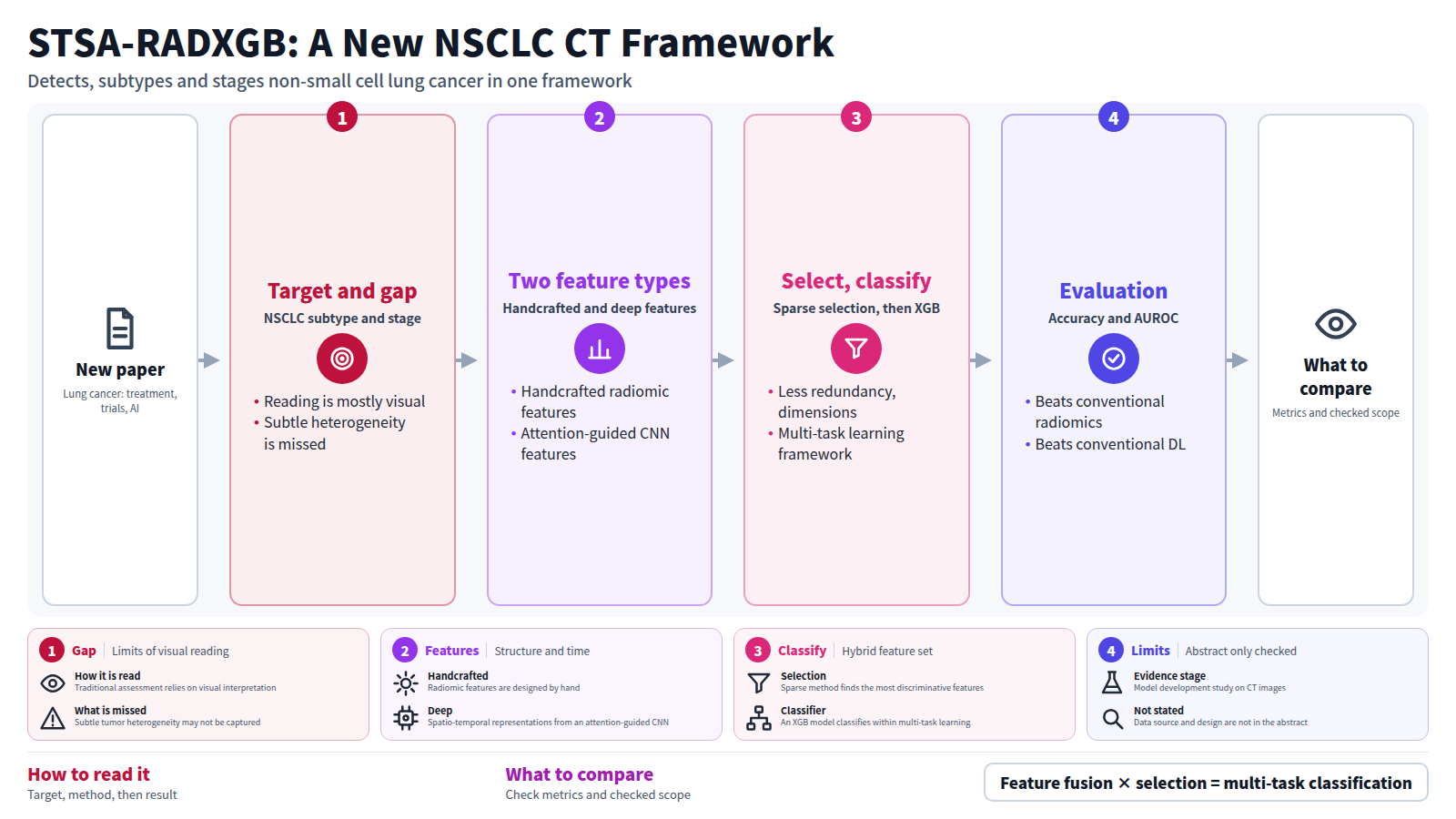
Accurate identification of Non-Small Cell Lung Cancer (NSCLC), including its histological subtypes and stages, is crucial for informed clinical decision-making and improved patient outcomes. Traditional radiological assessment largely depends on visual interpretation, which may fail to capture subtle tumor heterogeneity. To overcome this limitation, this study introduces Spatio-Temporal Sparse Attention Radiomics Extreme Gradient Boosting (STSA-RADXGB), an approach designed for automated NSCLC detection, subtype classification, and stage prediction using Computed Tomography (CT) images. The STSA-RADXGB approach combines handcrafted radiomic features with deep spatio-temporal representations derived from an attention-guided convolutional neural network, enabling comprehensive analysis of both structural and temporal tumor characteristics. A sparse feature selection method is applied to identify the most discriminative features while minimizing redundancy and dimensionality. The optimized hybrid feature set is then classified using an Extreme Gradient Boosting (XGB) model within a multi-task learning framework. Performance is evaluated using accuracy and AUROC. The results indicate better performance compared to conventional radiomics and Deep Learning (DL) approaches, supporting more reliable and interpretable clinical decision-making.
Journal IF-equivalent: 2.6 (OpenAlex 2-year mean citedness, value as of 2026-10-04, retrieved 2026-10-05; not the official Clarivate IF)Reference: Balekai R, Holi MS. A Spatio-Temporal Sparse Attention-Radiomics Framework for Automated Non-Small Cell Lung Cancer Detection, Histological Subtype Classification, and Stage Prediction. Eng Technol Appl Sci Res. 2026 Oct 2;16(5):39621-8. doi:10.48084/etasr.19919.Checked: Abstract only