AI and Cancer Research ── Pancreatic ── 2026-09-30

Pancreatic cancer: treatment, trials and AI
- Abstract
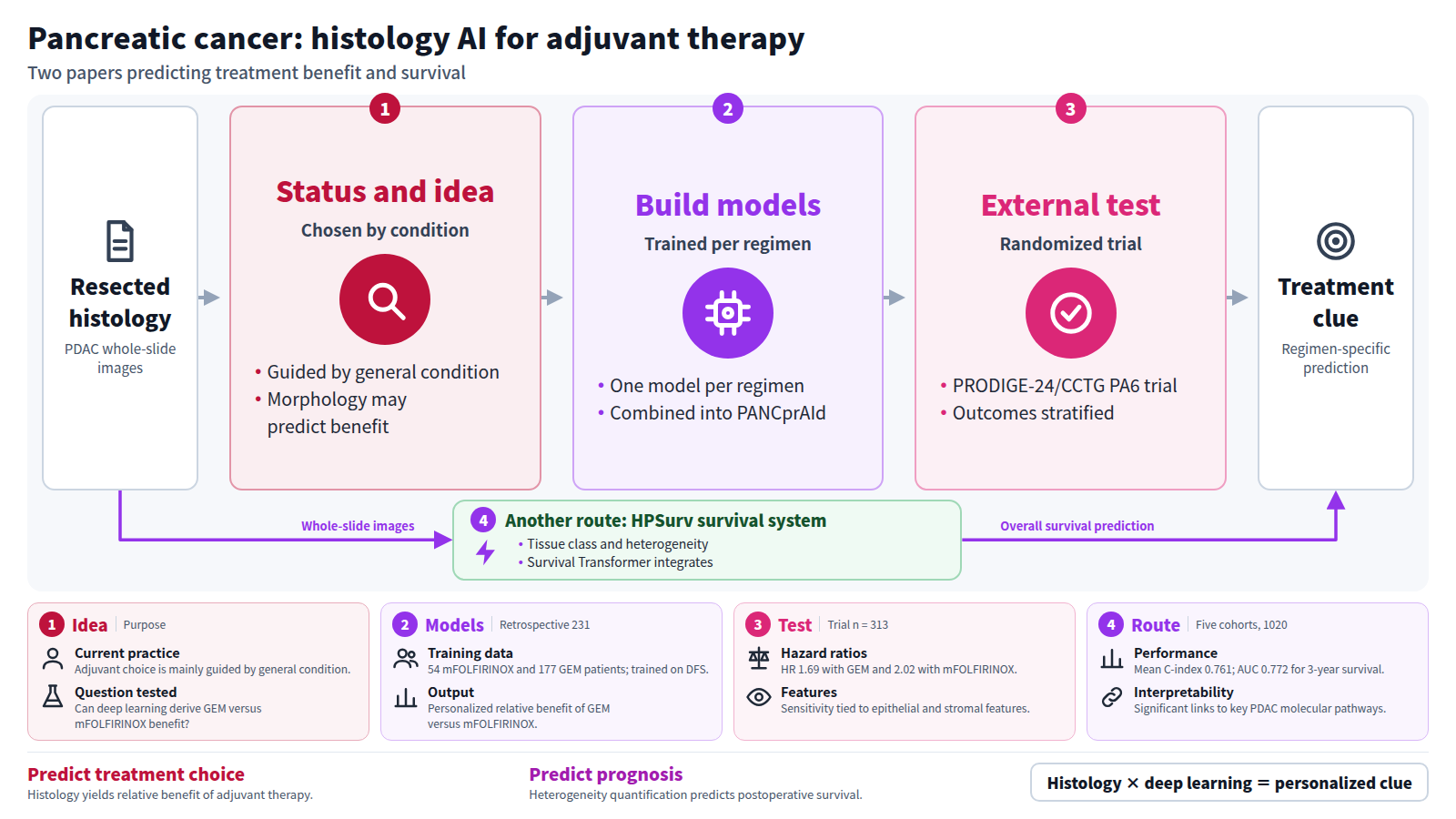
Purpose: The choice of adjuvant chemotherapy in pancreatic ductal adenocarcinoma (PDAC) is mainly guided by patients' general condition. We hypothesized that tumor morphology may predict differential treatment benefit and tested whether deep learning applied to histology images could derive a biomarker of relative benefit from gemcitabine (GEM) versus modified FOLFIRINOX (mFOLFIRINOX) in resected PDAC. Patients and methods Standard whole-slide images from a retrospective multicentric series of 231 patients who underwent curative-intent pancreatectomy and received adjuvant mFOLFIRINOX (n = 54) or GEM (n = 177) were used to train regimen-specific histology models on disease-free survival (DFS), which were then combined into PANCprAId, a biomarker estimating personalized relative benefit from adjuvant GEM versus mFOLFIRINOX. External validation was performed in the randomized PRODIGE-24/CCTG PA6 trial (n = 313).
Results: In PRODIGE-24/CCTG PA6, the treatment-specific histology scores used to construct PANCprAId stratified outcomes among patients treated with GEM (hazard ratio [HR], 1.69 [95% CI, 1.04 to 2.73]; P = .03) and mFOLFIRINOX (HR, 2.02 [95% CI, 1.4 to 3.0]; P < .001). When combined into PANCprAId, the biomarker identified subgroups with differential relative benefit from adjuvant GEM versus mFOLFIRINOX, with significant treatment interactions for DFS (interaction P = .003) and cancer-specific survival (interaction P = .001). Predicted sensitivity to each regimen was associated with distinct epithelial and stromal features.
Conclusion: Histology-based deep learning can derive a predictive biomarker of relative benefit from adjuvant GEM versus mFOLFIRINOX in resected PDAC.
Reference: Beaufils A, De Martino J, Jiang X, Blanchard T, Fraunhoffer N, Mendes D, et al. Developing a Histology-Based Artificial Intelligence Biomarker to Predict Adjuvant Chemotherapy Benefit in Pancreatic Cancer. J Clin Oncol. 2026 Sep 10;44(26):2507-16. doi:10.1200/jco-26-00327. PMID: 42507965; PMCID: PMC13557473.Checked: Full text checked - Abstract
Pancreatic ductal adenocarcinoma (PDAC) is one of the most lethal malignancies worldwide, and accurate prognostic prediction remains highly challenging due to its marked biological heterogeneity and complex tumor microenvironment. To address this challenge, a histopathomics-based survival prediction system (HPSurv) was developed using histopathological whole-slide images (WSIs) for individualized overall survival (OS) prediction. Within this framework, pathological tissue classification, quantitative characterization of tumor spatial heterogeneity, and a survival Transformer were integrated to enable multi-level representation learning from histopathological data. The system was developed and evaluated in 1020 patients across five independent cohorts. Compared with conventional clinicopathological indicators, significantly improved prognostic performance was achieved across multicenter cohorts (p < 0.05), with a mean C-index of 0.761 and time-dependent AUCs of 0.936, 0.877, and 0.772 for predicting 6-month, 2-year, and 3-year survival, respectively. Subgroup analyses further supported its role as an independent prognostic factor and suggested its potential utility in stratifying patients with respect to ACT-related outcomes. In addition, significant associations with key PDAC molecular pathways were observed, providing biological insights into the model predictions and supporting interpretability. In the study, an interpretable and high-performing artificial intelligence (AI) framework for quantitative modeling of PDAC was established. Objective characterization of tumor heterogeneity and accurate postoperative survival prediction are enabled, with potential value for personalized management in PDAC.
Reference: Shao L, Ke X, Wang Y, Li R, Yu K, Wu J, et al. AI-driven tumor heterogeneity quantification and survival prediction in pancreatic ductal adenocarcinoma. NPJ Digit Med. 2026 Jul 20 [Epub ahead of print]. doi:10.1038/s41746-026-02979-7. PMID: 42477155.Checked: Abstract only