AI and Cancer Research (Top Journals) ── 2026-09-30
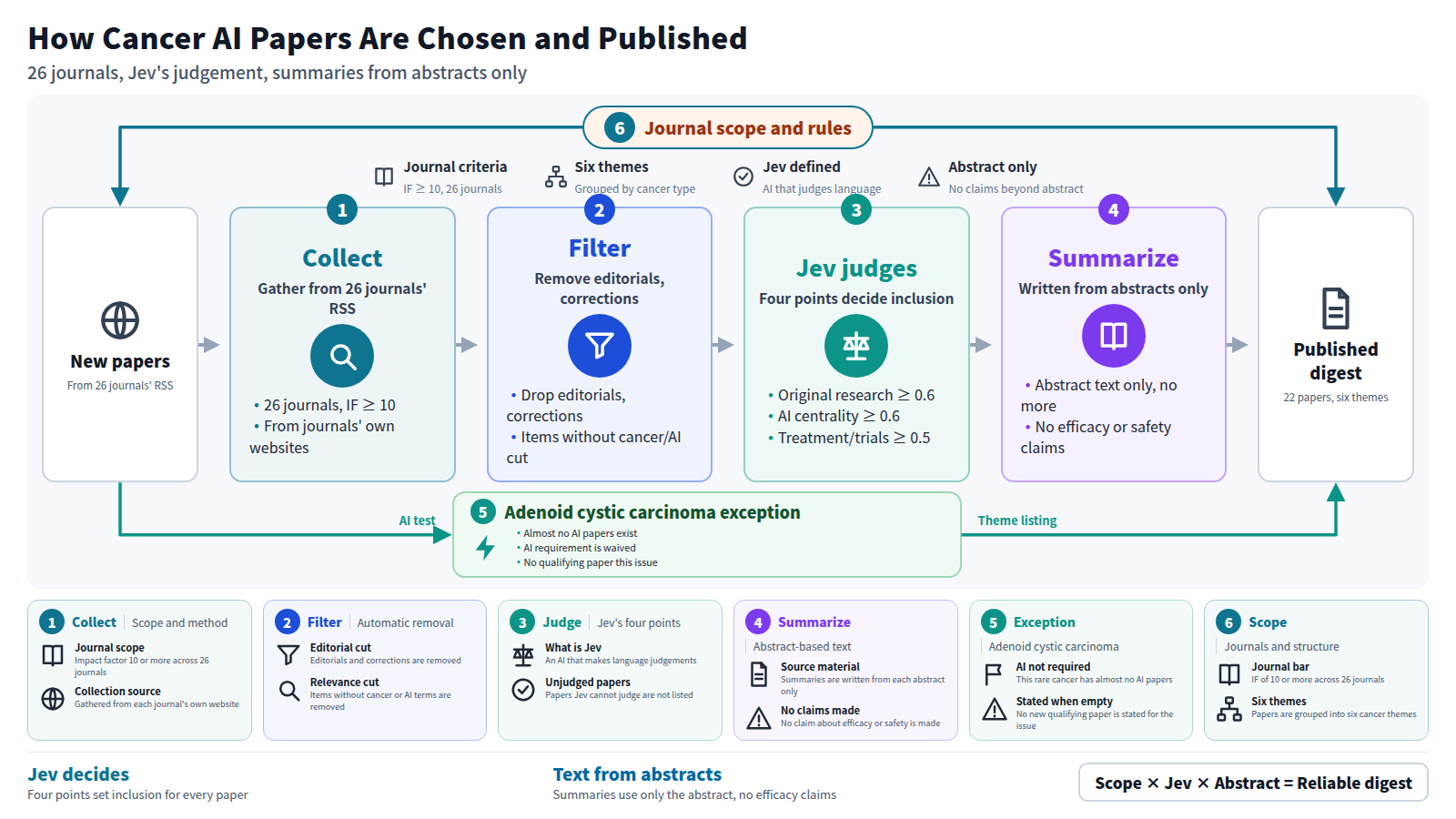
New papers on cancer and AI from 26 medical, oncology and general journals with an impact factor of 10 or more, collected from the journals' own websites and selected by Jev (an AI that makes language judgements): is it original research, is AI central, which of six themes, and does it concern treatment or trials. Summaries are written from each abstract only and make no claim about efficacy or safety.
Cancer molecular biology and AI
SpaCEy is an explainable graph neural network that models tissues as spatial graphs from marker expression, without predefined cell-type labels, to predict overall survival and disease progression. In a lung cancer spatial proteomic cohort it identified patterns associated with progression, and across breast cancer datasets it stratified patients by overall survival and highlighted contributing protein markers.
UniCure combines biological and chemical foundation models to predict drug-induced transcriptomic responses and rank drugs. Trained on 1.9 million perturbation profiles, it was fine-tuned on 345 patient-derived tumor-like cluster profiles and assessed on 396 real-world clinical profiles, with experimental checks in cell line and patient-derived models.
The authors generated over 38 million temporal protein-abundance measurements from systematically perturbed breast cancer cell lines and built ProteinTalks, a virtual cell model pretrained on these trajectories. It was applied to drug efficacy and synergy prediction, resistance-associated proteins and patient stratification, extending to organoids and clinical biopsies, generally exceeding the selected benchmarks under the evaluated protocols.
COMPASS is described as a pan-cancer foundation model that predicts immunotherapy outcomes from bulk transcriptomic data by routing input through human-readable concepts. The concept bottleneck architecture is reported to improve outcome prediction while providing biological interpretation. This item is a research-highlight summary of a primary study.
HisToSpatialCNV is a multiscale deep-learning framework that infers spatial copy number variations from H&E images using graph neural networks and multihead self-attention. On HER2+ breast, skin and brain cancer datasets it outperformed existing spatial gene expression inference methods, enabled subclone identification and phylogenetic reconstruction, and identified spatial-molecular subtypes with distinct survival in TCGA HER2+ data.
Thousands of AI-designed minibinders were screened by mammalian cell-surface display, yielding several high-affinity PD-L1 binders but far fewer against CD276 and VTCN1. Chai-1 ipTM scores with ESM embeddings correlated with binding success. Some binders trafficked poorly in chimeric antigen receptors; a genetic-algorithm redesign preserving the interface revealed an isoelectric point window improving CAR expression and target-selective killing.
stPainter is a conditional generative model with a latent diffusion architecture, pretrained on a pan-cancer scRNA-seq atlas, that reconstructs expanded expression profiles from sparse spatial transcriptomics without matched references or retraining. Across six cancer datasets it supported fine-grained subpopulation clustering and pathway enrichment, and comparison with CODEX proteomics indicated regional agreement.
VirTues is a foundation model for spatial proteomics that learns marker-aware, multi-scale representations of proteins, cells, niches and tissues from multiplex imaging. One pretrained backbone supports marker reconstruction, cell segmentation and typing, niche annotation, biomarker discovery and patient stratification. In triple-negative breast cancer its biomarkers predicted anti-PD-L1 chemo-immunotherapy response and stratified disease-free survival in an independent cohort.
Oncoformer, a multimodal transformer trained on the COMPASS cohort (3.67 million individuals, 17.7 million visits) and validated on external cohorts including UK Biobank, combines longitudinal EHR data with chest X-rays. Reported results include pan-cancer diagnosis (AUROC 0.956), cancer prediction up to one year before diagnosis (AUROC 0.869), stage inference (mean AUROC >0.90), and recurrence-free survival stratification.
CenSegNet is a deep learning framework for segmenting centrosomes and epithelial architecture. Applied to tissue microarrays of 911 breast cancer cores from 127 patients, it quantified numerical and structural centrosome abnormalities, which showed distinct spatial distributions and age-dependent dynamics and were associated with tumour grade, hormone receptor status, genomic alterations and nodal involvement.
GeneLLM is a transformer model that processes nucleotide sequences of plasma cfRNA reads directly, bypassing gene-level annotation. In a multi-centre cohort it reached ROC-AUC values of 0.9250 to 0.9962 across several cancers, with comparable performance at one-sixth of the typical sequencing depth. The work reports classification performance, not clinical outcomes.
COMPASS is a pan-cancer foundation model that predicts immune checkpoint inhibitor response from bulk tumour transcriptomes via a concept bottleneck of 44 immune concepts. Trained on 10,184 tumours across 33 cancer types, it outperformed 22 methods on average across 16 clinical cohorts covering seven cancers and six ICIs, and predicted responders had longer overall survival.
Breast cancer: treatment, trials and AI
CATALINA independently validated two locked AI pipelines producing computational TIL scores against pathologist-scored stromal TILs, using long-term outcome data pooled from seven randomised trials. Among 1,356 evaluable patients with early triple-negative breast cancer, correlation with pathologist scores was modest (r 0.375-0.473), and both score types were independently associated with disease-free and overall survival after adjustment.
This secondary analysis of the phase 3 APHINITY trial compared manual, automated digital and AI-based stromal TIL quantification, plus two AI spatial features, in 4,262 H&E images. Manual scoring showed high interobserver reproducibility (ICC 0.84) with modest concordance to automated methods, and higher TIL levels were associated with better invasive disease-free survival across methods (HRs 0.41-0.93).
The authors extend pre-training of histopathology foundation models on invasive tumour tissue, evaluate the biological concepts encoded in their representations, and identify recurrent tumour archetypes with consistent morphological and molecular identities across patients. RNA splicing-associated archetypes were consistently associated with poorer outcomes in the cohorts analysed, including HER2-positive and triple-negative breast cancer.
Lung cancer: treatment, trials and AI
I3LUNG (NCT05537922) enrolled 2,396 patients and combined real-world clinical and blood data, CT, digital pathology and genomics in early- and intermediate-fusion models. Clinical-blood models reached AUC up to 0.77 in the test set and 0.55-0.72 in external validation, exceeding PD-L1, ECOG PS, NLR, LDH and LIPI. Physicians' predictions improved with the explainable tool; prospective validation is ongoing.
A multi-task deep learning model using CT images was developed to predict EGFR mutation status in NSCLC (ChiCTR2400083082). The abstract reports accurate prediction and an association of the MTDL score with survival under EGFR-targeted treatment, gene expression patterns and the tumor microenvironment, without reporting performance values.
Across three institutions, 1303 brain metastases from 421 lung adenocarcinoma patients were modeled using 3435 radiomic features from T1, T2 and contrast-enhanced T1 to classify EGFR mutation status. Internal AUCs reached 0.95, and 94 pathologically confirmed lesions gave 83.0% accuracy. Sphericity was the leading feature and correlated negatively with RNF125 and SLC37A2.
Pancreatic cancer: treatment, trials and AI
Whole-slide images from a retrospective multicentric series of 231 resected PDAC patients were used to build PANCprAId, estimating relative benefit from adjuvant GEM versus mFOLFIRINOX. In the randomized PRODIGE-24/CCTG PA6 trial (n=313), regimen-specific histology scores stratified outcomes (HR 1.69 and 2.02), and an interaction with cancer-specific survival was reported (P=.001).
HPSurv combines tissue classification, quantification of spatial tumor heterogeneity and a survival Transformer applied to whole-slide images for individualized overall survival prediction in PDAC. Developed and evaluated in 1020 patients across five independent cohorts, it reported a mean C-index of 0.761 and time-dependent AUCs of 0.936, 0.877 and 0.772 at 6 months, 2 and 3 years.
Prostate cancer: treatment, trials and AI
A network-based machine learning framework integrating somatic copy-number, epigenomic and transcriptomic data in TCGA-PRAD (n=498) identified ZNF268, whose promoter hypermethylation marked a transition confined to low/intermediate-risk disease. A Rewiring Score from co-expression network changes was associated with progression-free survival (HR 2.79) and with biochemical recurrence in two external cohorts. Drug-sensitivity results are computational predictions.
This study evaluated a digital pathology multimodal artificial intelligence model, previously validated as a prognostic biomarker, for prediction of abiraterone benefit in nonmetastatic clinically very high-risk prostate cancer, using two STAMPEDE phase III trials. The abstract provided states only the rationale and objective; no results are reported in it.
Adenoid cystic carcinoma: treatment, trials and AI
No new qualifying paper in the covered journals for this issue.