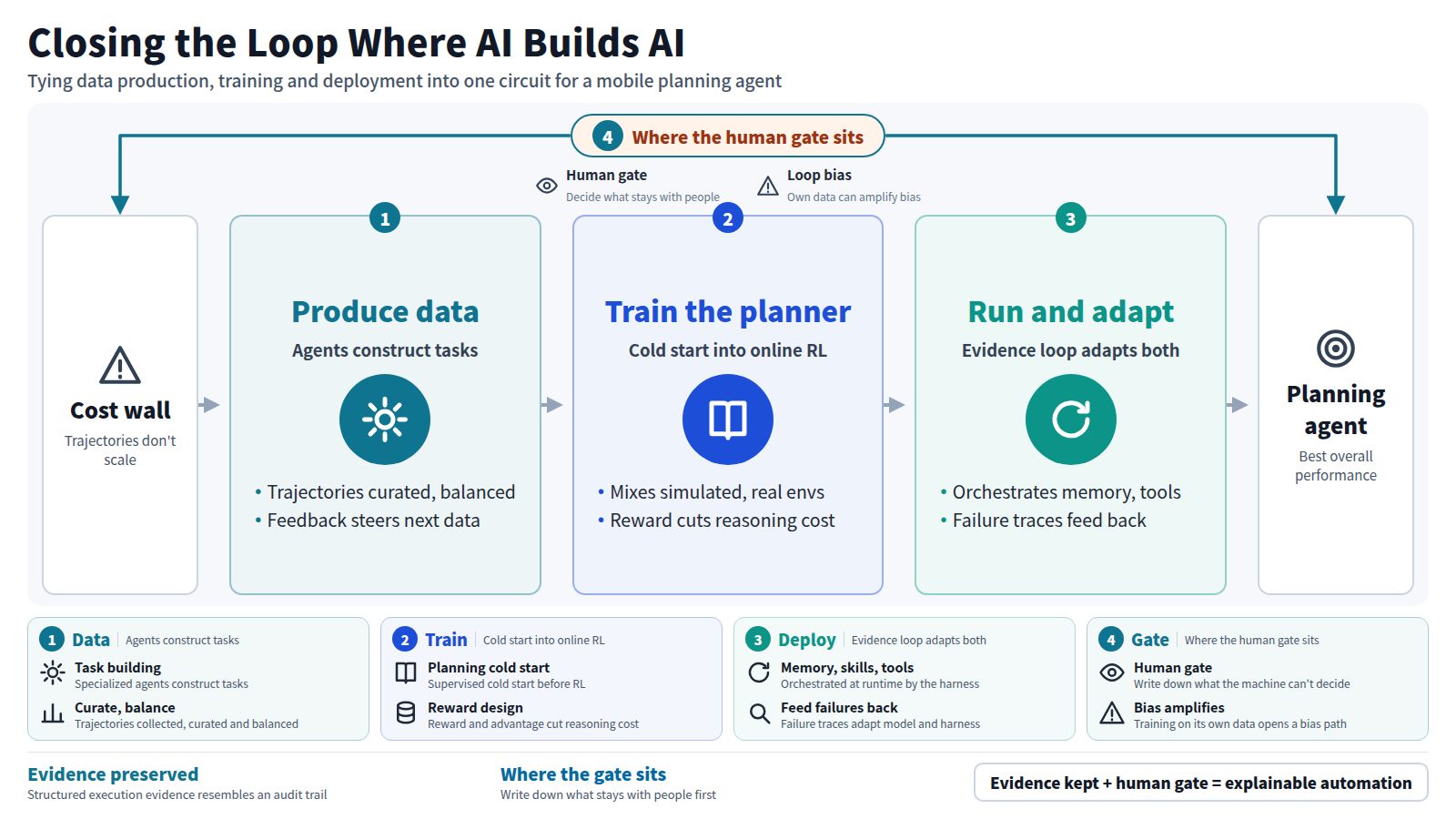
Building against real devices is where it jams
Building an agent that operates a mobile device runs into walls that never appear in desk exercises. Screen state shifts constantly, and a sequence that worked once carries no promise of working again. Sequences are long, and one wrong move partway through carries all the way to the end. Above all, each trial against a real device costs money and time. Collecting the volume of trajectories that training needs by having people tap through devices does not scale.
The authors start there. The abstract opens with the observation that the progression of large language models is pushing AI out of passive content generation and into the active workflows of engineering and scientific discovery. One question follows. Can AI be both the object of development and a participant in building the next system? Mobile planning is offered as a demanding place to test it: long-horizon tasks strain agent reliability, and the cost of real-device interaction limits how far development can scale.
The core: three stages under one contract
If the proposal has to be reduced to one thing, it is this: data production, model training and deployment are connected into a single loop through a shared action-feedback-verification contract. Three stages that normally run separately are rewired to pass the same shape of information.
The abstract describes the loop in three layers. The first is data: a human-gated agentic flywheel in which specialized agents construct tasks, collect interaction trajectories, curate and balance training data, with training feedback steering what gets generated next. The second is training: a supervised planning cold start, followed by online agentic reinforcement learning in a hybrid of simulated and real environments. Here the authors introduce a reward-and-advantage design aimed at cutting reasoning and tool-use cost while holding task performance. The third is co-evolution of the model and its surrounding harness: an execution-evidence-driven loop orchestrates memory, skills and tools at runtime, then feeds structured action feedback and preserved failure traces back so that model and harness are adapted together.
What the abstract states
The authors report the best overall performance among the models and systems they evaluated on a benchmark for mobile planning, improving over the base model across tool use, memory, skills and sub-agent coordination. They further report improvements on non-mobile agentic benchmarks while largely preserving general capabilities.
No figures are given in the abstract. The size of these differences therefore cannot be discussed here. "Best overall" also shifts in meaning depending on what was placed in the comparison. This is the authors' claim, not a settled conclusion. Being a preprint, the methodological detail and the handling of counter-evidence wait on the full text and on review.
What this looks like in actual work
Handing a long sequence of steps to a machine comes down to this difference in practice.
Instructing one move at a time
Person: "Open the submission screen."
Machine: (opens it)
Person: "Copy last time's entry."
Machine: (copies)
Person: "Change only the date, then save."
Handing over the goal
Person: "File this month's in the same format as last time."
Machine: (opens the screen, finds the prior entry, copies it, corrects the date, saves)
Person: "Where did the decision fork?"
Machine: (reports which move it hesitated on and what it decided from)
Whether the second column holds depends on recovery — what happens when a move partway through goes wrong. Looking only at whether the final answer was right cannot separate a run that drifted and accidentally recovered from a run that was sound throughout. Routing execution evidence back into the loop reads as an attempt to keep those apart. Preserving failure traces rather than discarding them is the visible sign of that intent.
What is not new, and what cannot be read
The loop itself — produce data, train, run, use the result to produce the next data — is not a new idea. Active learning is long-standing, and using a model's own output to build its next training set has become ordinary over the past few years. What this paper brings is closing that loop in the most expensive place available: work against real devices.
Much is unreadable from the abstract. Human gating is mentioned, but which decisions stayed with people is not stated. Nor is how the simulated and real environments were mixed, nor how failure traces were curated. None of these conditions is given within the abstract. A closed loop also carries a characteristic hazard. Training a system on data it generated itself opens a path for the initial bias to amplify. The human gate is presumably there to damp that, but how far it damped anything cannot be checked here.
Why this subject is arriving in a cluster
The paper drew 9 upvotes shortly after posting — a modest number. It was picked up in this site's selection not for vote volume but because another paper on the same question appeared in the same window; the cluster holds two papers. The other one carves out the executing side of mobile GUI agents and treats it separately.
Separating the planning side from the executing side is being tried by more than one group at once. That is the observable fact. But neither the votes nor the cluster is a measure of correctness or importance. They say that several hands reached for the same question at the same time, and nothing beyond it. Clusters in particular can form merely because a common toolkit spread.
Where this connects to pharmaceutical and regulatory practice
Handing long procedural work to a machine maps directly onto material review and submission drafting. But the connection is not about performance. What connects is the loop.
One point is preserving failure traces. Regulated practice asks less for records of what went well than for records of what went wrong and how it was recovered. A mechanism that returns structured execution evidence is close in shape to something auditable. Conversely, automation that leaves no evidence gets faster without becoming explainable.
The other is where the human gate is placed. In a closed loop, the position of the human sets the ceiling on quality. Not reviewing everything, not sampling at random, but writing down in advance which judgements the machine will not be allowed to make. Reverse that order and automation advances step by step from wherever cost falls fastest, leaving behind a judgement nobody decided. Decisions touching the appropriateness of material or the boundaries of approved indications are not candidates for entering the loop on cost grounds.