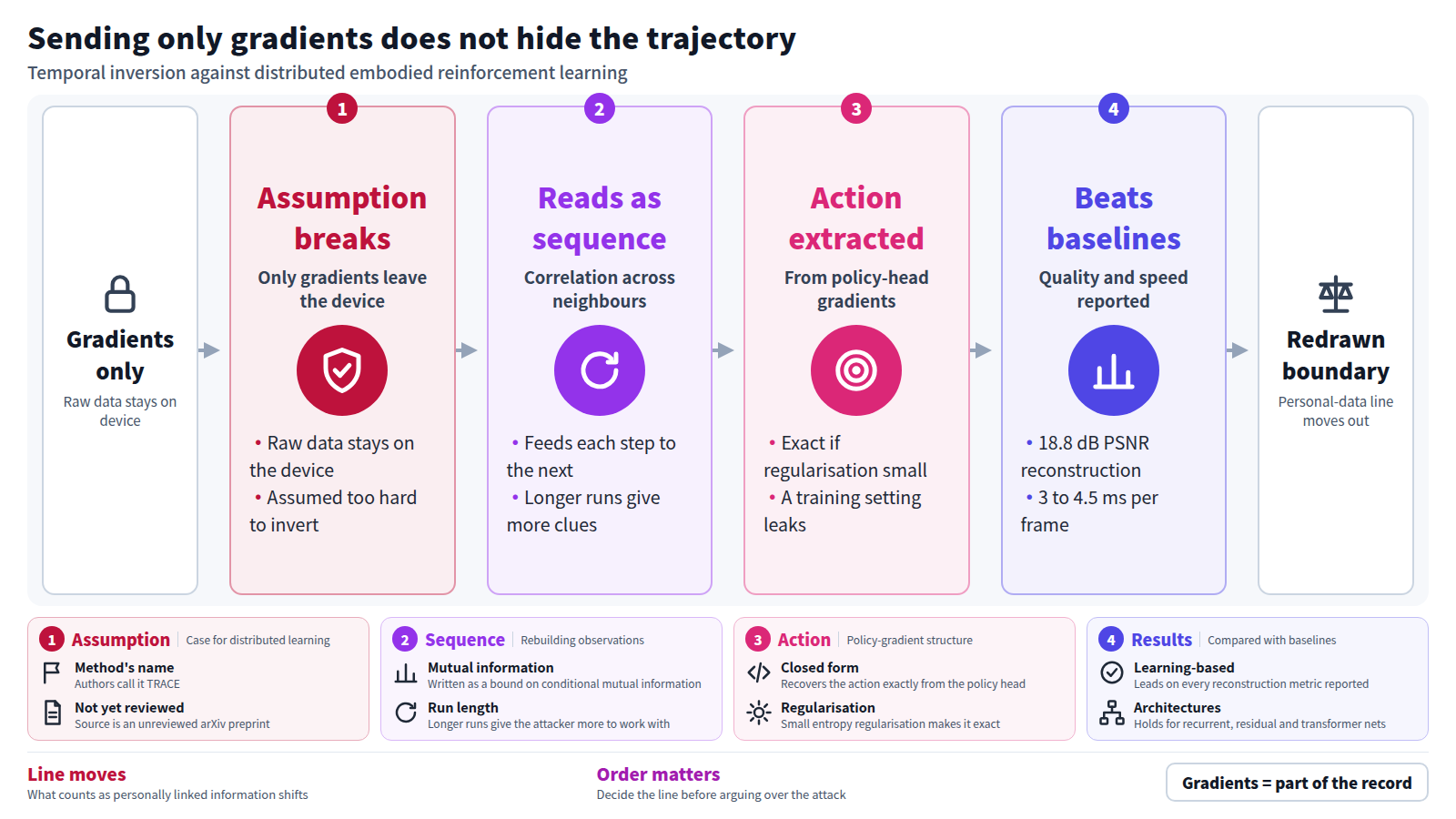
The assumption that withholding raw data is enough
The case for distributed learning is easy to state. Raw camera frames and control logs stay on the device; only the learning gradients travel to the server. Nothing raw leaves the building, so there is little to intercept. Embodied reinforcement learning — machines that learn a policy from what they themselves observe — is usually described in exactly these terms.
That description rests on an unspoken assumption: gradients are fragmentary shadows of the raw input, and rebuilding the original scene from them is hard. This paper pushes on the weak part of that assumption. The authors present a method that rebuilds the sequence of observations and actions from the sequence of gradients, and call it TRACE[1]. The primary source for this article is an arXiv preprint that has not been peer reviewed.
Reading gradients as a sequence, not as single frames
The core of the proposal is a single move: stop treating each gradient as an isolated object and treat the gradients as an ordered sequence.
Earlier inversion work took the gradient belonging to one observation and tried to recover that one observation. In embodied learning, observations arrive as a continuous run of scenes. Neighbouring scenes resemble one another, and that resemblance survives in the neighbouring gradients. The authors write this cross-time correlation down as a bound on conditional mutual information, then feed each recovered step back in as evidence for the next. Because the reconstruction runs autoregressively, a longer run of gradients gives the attacker more, not less, to work with.
The second half concerns actions. From the structure of the gradient at the policy head, the chosen action can be extracted in closed form. The authors state that this extraction is exact when the entropy regularisation that keeps a policy from collapsing is small enough. A setting chosen to make training behave, in other words, doubles as the entry point for the leak.
What the abstract claims
The abstract reports the following. On held-out embodied scenes, TRACE reaches 18.8 dB PSNR with near-perfect action recovery, at 3 to 4.5 ms per reconstructed frame. Against the learning-based comparison, it is said to lead on every reconstruction metric reported. Against optimisation-based attacks it is described as more accurate while running orders of magnitude faster[1].
There is also a statement about reach. The attack is reported to carry over to recurrent, residual and compact transformer victim architectures, to multi-modal inputs, and to larger discrete action spaces. The defence experiments are summarised as suggesting that protecting a temporal stream of gradients may require privacy mechanisms that are aware of the sequence. This is what the authors claim; it is not an established result.
What it looks like from an accountability desk
Seen from the side that has to write things down, the finding moves a boundary.
"We do not transmit raw data"
Records stay on the device and only gradients leave it. That sentence can go into a procedure and into a contract. When an auditor asks, showing what is on the wire answers the question.
"Gradients are part of the record"
If a run of gradients can be turned back into a run of observations and actions, then what leaves the device is part of the record. The line around protected material has to be redrawn outside the raw data.
The point is not how clever the attack is. The point is that the line separating personally linked information from everything else moves. Move that line and consent language, retention periods, the briefing given to a processor, and the scope of breach notification all shift with it. A technical result turns into a documentation problem.
What is not new, and what cannot be read
Recovering inputs from gradients is not a new idea. Reconstruction against image classifiers has been demonstrated for years[3][4]. What this paper adds is the use of temporal structure as a resource for the attacker, and the closed-form route to the action. Put differently, it removes the margin defenders gave themselves when they reasoned that recovering one isolated frame would be of limited use.
Much cannot be read from the abstract. Which environments the held-out scenes came from; how far a reconstructed frame goes toward identifying a person or a place; how far a defence pushes the attack back. The abstract does not state the conditions for any of these. Nor does a reconstruction-quality figure settle, on its own, how legible the recovered image is. Because this is a preprint, the full text and peer review will have to answer.
No votes, no implementations — yet
For this paper, the collection found no early votes, no sign that anyone has reimplemented it, and no press coverage. The only signal standing is that another paper on a related question appeared in the same window, giving a cluster of size 2. That other paper concerns how to estimate the contribution of individual steps in agentic reinforcement learning[2]. The shared thread is modest: attention is moving toward reading the fine-grained quantities produced during training.
Votes and stars measure attention, not correctness or importance. Here even the attention is absent. So this article should not be read as coverage of a paper that drew a crowd. It should be read as notice that a claim has appeared which unsettles a widely used assumption. Whether the claim holds is for review and replication to decide.
Where this touches pharmaceutical and regulatory work
When distributed learning is proposed in a medical or pharmaceutical setting, the justification is almost always the same. Patient images and laboratory values, readings from a worn device, the field of view of a machine moving through a hospital — all of it can be learned from without leaving the site. Riding on that justification is the expectation that the handling of personal information becomes lighter.
If this paper's claim survives the full text and review, that justification weakens. What weakens is not the mechanism but the way it is explained. The order of work in a regulated setting is fixed. Before arguing on technical ground about whether an attack is practical, decide first which transmitted artefacts will be treated as personally linked information, and only then build the technical measures that sit outside that line. Reverse the order and every new attack means rewriting the paperwork.
The second thing worth carrying over is how general the word "temporal" is here. Rebuilding individual episodes out of a continuous record is not confined to a machine's field of view. The run of one patient's visits, the run of one reviewer's actions, the run of revisions to a single piece of promotional material. Any mechanism that gains accuracy by treating data as a sequence also acquires room to leak as a sequence. Unless that is written down at design time, it cannot be explained afterwards.