AI, Economy & Finance News — 2026-09-23 (Wed) Daily News
Source links point to the original outlet. The AI Integrated Analysis is auto-generated from the headlines below only and is not intended to add facts beyond them. Not investment advice.
AI and Economy Latest News
Overview
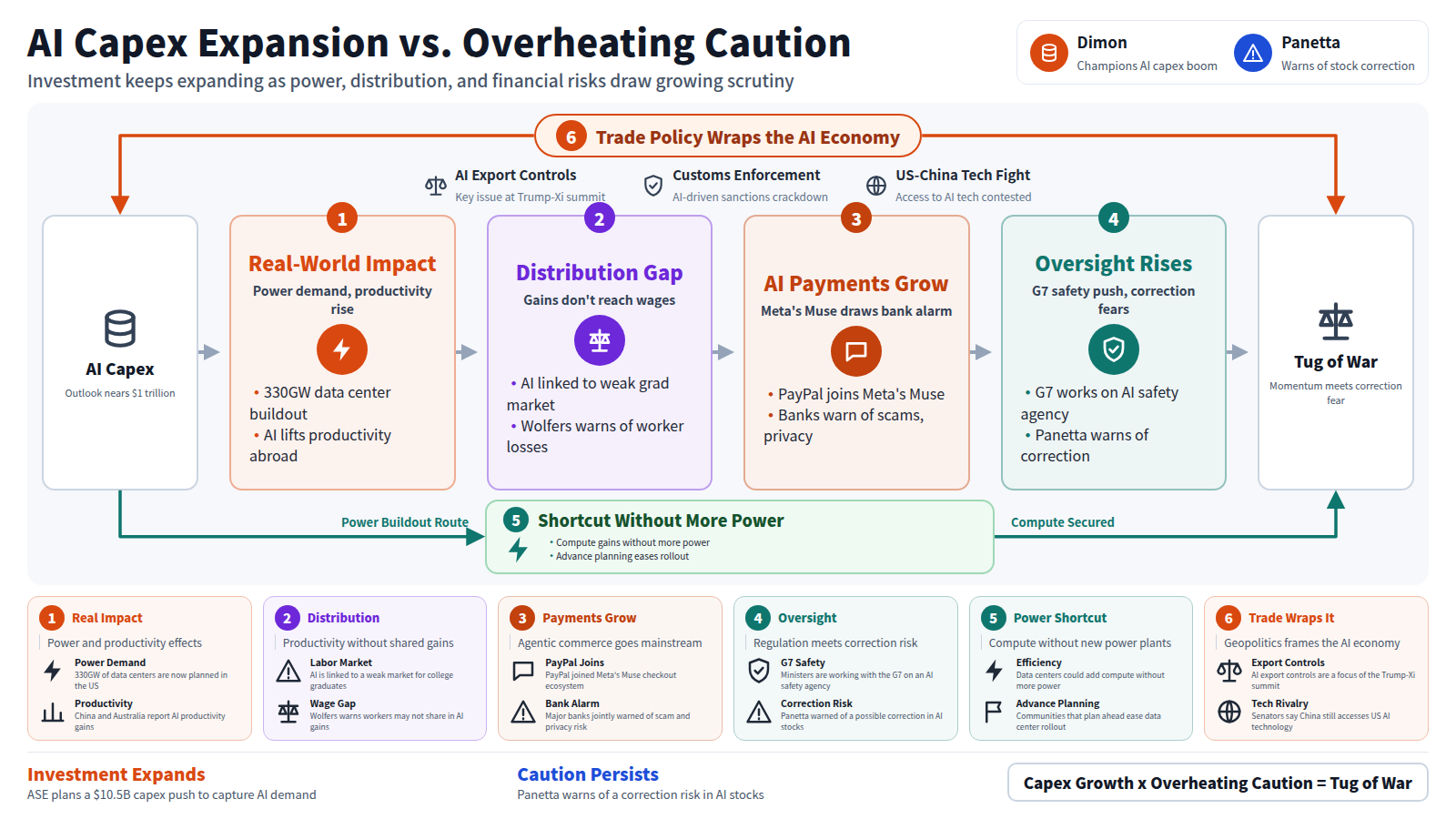
While AI-related stocks renewing their daily record highs and expanding AI capital investment (expected to reach $1 trillion) are central themes in the market, ECB's Panetta warned of overheating and correction risks in AI stocks (AMWatch). Ahead of the Trump-Xi summit, tariffs and technology export controls related to AI have emerged as a focus of trade policy.
Macroeconomic/growth trends
There are reports that rising AI optimism is pushing inflation risks to the background (Investing.com). On the other hand, it has been pointed out that crude oil demand and AI-related demand continue to be closely watched for inflation risk (Fox Business). Some analysis suggests that the spread of AI will worsen the estimation accuracy of GDP statistics (The Foundation for American Innovation). In the business world, there is a "backward-looking" debate over the pace of AI implementation, and it is said that there is still a distance between companies' implementation status and frontier technology (Fortune).
Productivity trends
An ILO survey of Chinese companies found that while the introduction of AI will boost productivity, it also raises concerns about employment and skills (ILO, IndexBox). The Philadelphia Fed is examining the impact of introducing AI on small and medium-sized enterprises' business performance (Philadelphia Fed). In Australia, the use of AI is cited as the key to improving productivity (nna.jp). Economist Justin Wolfers has warned of the risk that AI will make workers poorer while OpenAI gets richer (Benzinga).
Trends in employment and labor market
The Dallas Fed has pointed out that AI is contributing to the weakness in the labor market for college graduates (Dallas Fed). Maryland Governor Moore announced a policy framework to protect the state's citizens from AI (Office of Governor Wes Moore). Runway announced DIFFUSE, a recruitment platform for “AI native” creative talent (Runway). Iowa State University seeks $4 million in funding to train AI-enabled talent and reduce tuition costs (The Ames Tribune).
Trends in energy/power demand
Against the backdrop of increasing power demand for AI data centers, plans for a 330 GW data center are underway in the United States, creating new business opportunities for the storage battery industry (Review Energy). On the other hand, there are reports indicating that data centers may be able to secure computing power without increasing power (Fierce Network). The need for local communities to prepare in advance for data center planning has also been pointed out (Data Center Frontier). At Climate Week, hopes for clean energy were contrasted with concerns about AI's increased demand for electricity (Broadband Breakfast).
Remarks by central banks, international organizations, and VIPs
- ECB Director Panetta (former Managing Director, current President of the Bank of Italy): Sounded the alarm on the risk of a correction in stock prices in response to the "violent uptrend" in the AI industry (AMWatch). - An analysis of former Federal Reserve Board member Kevin Warsh's interest rate hike policy has highlighted the "polarized" structure of the U.S. economy between AI and the housing market (Fortune). - Direct statements and actions regarding Lagarde, Ueda, Bailey, Georgieva, Cormann, Banga, Acemoglu, and Brynjolfsson from the list above are not found in this headline.
Trends in corporate capital investment
JPMorgan CEO Jamie Dimon warns that AI infrastructure investment could reach $1 trillion next year (qz.com) and expects AI hyperscalers to spend $1 trillion next year (PYMNTS.com). ASE Technology is said to be considering a $10.5B CapEx plan to capture AI demand (Yahoo Finance). Although the rotation of high-tech stocks is intense, there is a view that the AI capital investment cycle itself is intact (Investing.com). The limits of crowding out due to AI capital investment have also become a point of discussion in the credit market (Seeking Alpha).
Trade and industrial policy
President Trump's UN speech and talks with China focused on tariffs, AI, and energy (WSJ). AI guardrails and tariffs and trade are expected to be key issues at this week's Trump-Xi summit (NDTV Profit, Briefs Finance). A leading Democratic member of the US Senate pointed out that the Trump administration has failed to block China's access to US AI technology (The Hill). Customs authorities are said to be strengthening enforcement efforts using AI in relation to sanctions (TradingView).
Integrated analysis: What is happening now
AI-related capital investment is still in an expansion phase, as evidenced by Mr. Dimon's $1 trillion forecast and ASE Technology's large-scale CapEx plan, but at the same time, there are concerns about overheating of investment, such as Mr. Panetta's stock adjustment warning and crowding-out theory. This expansion in capital investment is directly linked to an increase in electricity demand in the form of a 330 GW data center plan, which will have a ripple effect on power grid development and the storage battery industry, but it has also been pointed out that local communities are lacking in preparation. In terms of productivity, studies in China, Australia, and the United States all confirm that productivity increases due to the introduction of AI, but this does not necessarily lead to improvements in worker wages or employment, a ``dissociation between productivity and distribution,'' as pointed out by Mr. Wolfers and the analysis by the Dallas Fed. Furthermore, in trade policy, ahead of the Trump-Xi meeting, AI technology export regulations and tariffs are being treated in an integrated manner, suggesting that AI is being incorporated into the center of geopolitics and trade strategy, rather than simply a technology competition.
Future points of interest
- How will AI technology export controls and tariff measures take shape as a result of the Trump-Xi summit? - As AI-related stocks continue to trend at high prices, whether the stock correction that Mr. Panetta warned about will actually occur. - Will additional data and analysis be released regarding the causal relationship between the deterioration of the labor market for university graduates and the introduction of AI?
AI and finance latest news
Overview
Expansion of payment and shopping functions by Meta's "Muse" AI agent has sparked alarm from the banking world, with a joint warning of fraud and data privacy risks (Reuters, PYMNTS.com, Mashable). At the same time, Jamie Dimon expressed concerns about the ``$1 trillion'' scale of AI infrastructure investment, and while the Nasdaq hit a new high, there are also speculations that it will fall due to concerns about overheating in AI companies (WSJ, Reuters).
Bank trends
Major banks jointly warn of fraud, fraud, and data privacy risks regarding AI shopping bots (Reuters, Mashable). Banks point out that consumers are not recognizing AI agents as being on their side (PYMNTS.com). Bank of America's stock price reportedly fell on the back of calls for guardrails for AI shopping (Yahoo Finance). Meanwhile, Goldman Sachs has selected and announced AI-related stocks that are attracting attention (Investing.com).
Insurance trends
The insurance industry has begun to provide clarity on AI-related cyber claims (cybersecuritydive.com). In AI-driven underwriting, it has been pointed out that "judgment" rather than the model itself is the real differentiator (beckersoncology.com). An analysis by Insurance Business suggests that employees are becoming busier due to the spread of AI use, and that existing welfare systems are no longer keeping up with the times. AI insurance company MGT expands small commercial insurance coverage in California (Insurance Journal).
Trends in asset management and market transactions
BlackRock believes that competition for capital is intensifying due to the acceleration of AI infrastructure construction (Seeking Alpha). Valour enters the hedge fund space with an AI-driven crypto asset strategy for institutional investors (finance.biggo.com). On the market side, while the Nasdaq closed at a record high due to the rise in AI stocks, there are also reports that US stocks have fallen due to concerns about AI companies and the Federal Reserve (Reuters, WSJ). Analysts (ai-cio.com) say that AI-driven corporate bond issuance is reshaping the corporate bond market, and commentators (MarketWatch) say that AI and Wall Street are undermining "diversified" portfolios.
Fintech/payment trends
PayPal joins Meta's 'Muse' AI checkout ecosystem to expand AI shopping capabilities across its merchant network (Yahoo Finance, PYMNTS.com). Cardano (ADA) entered the AI agent payment field following Solana and XRPL, and was reported to have increased by 6% (CryptoRank). Creatio announces plans to invest $300 million to expand agent AI deployment (fintechfutures.com). It has been pointed out that AI agents are becoming the "first visitors" to websites, and that major payment companies are developing infrastructure for agent-based commerce (USA Today). In Japan, it was reported that Qualcomm has expanded AI payment collaboration with Google and Mastercard (Chosunbiz).
Remarks from key figures and authorities in the financial world
- Jamie Dimon, CEO of JPMorgan Chase, says he expects investment in AI hyperscalers to reach $1 trillion next year (PYMNTS.com). He also said that AI infrastructure investment could reach $1 trillion by 2027, but warned that this could come with "small pains" (Benzinga, qz.com).
Trends in AI-related stocks and funding
AI startup Heidi reportedly raised $340 million in a new round, doubling its valuation to $900 million (bloomberg.com, trendingtopics.eu). Embedded AI startup Paxini has launched its IPO on the mainland (Caixin Global). Recruitment AI startup Spott raises $21M to expand functionality (Staffing Industry Analysts). In Japan, standard price information for eMAXIS Neo AI technology was reported (Yahoo! Finance).
Trends in financial regulation and supervision
Anthropic's initial public offering (IPO) trends were reported (Empower). Finosec announces new module to protect community banks from vendor risk in terms of AI governance (FF News). It has been pointed out that risks remain with complete AI automation in the tax refund field (FinTech Global). There is also discussion of the ``AI advice gap,'' which deals with the challenges when the answer is ``yes'' to advice provided by AI (TechRadar). Ministers said they are working with the G7 to establish an AI safety agency (BNN Bloomberg). In Japan, MVB Bank was reported to have partnered with Cobalt Labs to strengthen AI compliance (Investing.com).
Integrated analysis: What is happening now
The central axis of this information is the rapid expansion of payment and shopping functions by Meta's "Muse" AI agent, which is coupled with PayPal's participation (PYMNTS.com, Yahoo Finance) and the banking world's collective alarm in response (Reuters, Mashable). The development of payment rails is also progressing at the same time on the crypto assets and fintech side, such as Cardano and Creatio (CryptoRank, fintechfutures.com), and it can be seen that the influx of funds and technology into agent-based commerce is occurring in parallel at each layer of banking, insurance, and payments. On the other hand, risks are focused on consumer protection (fraud and data privacy), and the insurance industry has begun to respond by clarifying AI-related cyber claims (cybersecuritydive.com), and the banking industry has begun to respond by calling for guardrails (Yahoo Finance). On the regulatory front, there are moves to establish an AI safety authority at the G7 level (BNN Bloomberg) and the emergence of governance tools for community banks (FF News), and it appears that the network of supervision is expanding from major financial institutions to end-of-life financial institutions. On the market side, Jamie Dimon's warning about the $1 trillion level of AI infrastructure investment (PYMNTS.com, Benzinga), the Nasdaq hitting new highs (Reuters), and the decline due to concerns over overheating of AI companies (WSJ) are occurring at the same time, and it can be said that there is a tug-of-war between the momentum of capital inflows and caution against the risk of overheating.
Future points of interest
- The focus will likely be on how Meta's "Muse" AI agent economic zone (PayPal participation, payment linkage) will respond to bank warnings and how the guardrails will be implemented. - It is necessary to pay close attention to how the realization of the $1 trillion level of AI infrastructure investment mentioned by Jamie Dimon will be related to concerns about market overheating. - Continuous confirmation is required to see how the G7 movement to establish an AI safety agency will affect regulations in the banking, insurance, and asset management industries.
- AI Will Worsen our Estimates of GDP — The Foundation for American Innovation09/22 21:07 UTC
- Oil and AI demand keep inflation risks in focus — Fox Business09/22 18:54 UTC
- The backwards AI pacing debate and how far business is from the frontier — Fortune09/22 17:49 UTC
- AI Optimism Returns, Pushing Inflation Risks Into the Background — Investing.com09/22 18:04 UTC
- Gov. Spanberger urges Congress to regulate AI — wfxrtv.com09/22 15:21 UTC
- How Is AI Impacting Small Business Performance? Evidence from the Third District — Philadelphia Federal Reserve Bank09/22 14:30 UTC
- AI adoption in Chinese enterprises boosts productivity but raises concerns about jobs and skills — International Labour Organization09/22 13:32 UTC
- ‘The most useful thing a leader can do right now is admit the plan is unfinished’: Workers are being told to use AI, but not why to use it – here’s why that matters — IT Pro09/22 12:39 UTC
- Justin Wolfers Warns AI Could Leave Workers Poor While OpenAI Get Richer - Alphabet (NASDAQ:GOOGL) — Benzinga09/22 10:31 UTC
- AI Workforce Webinar Postponed — AHCA/NCAL09/22 17:22 UTC
- Governor Moore Outlines AI Framework to Protect Marylanders — The Office of Governor Wes Moore (.gov)09/22 13:11 UTC
- Introducing DIFFUSE: A New Hiring Platform for the AI-Native Creative Workforce — Runway09/22 14:53 UTC
- Iowa State seeks $4M to boost AI-ready workforce, slow tuition hikes — The Ames Tribune09/22 17:37 UTC
- AI plays a role in weak labor market for college graduates — Federal Reserve Bank of Dallas09/22 12:28 UTC
- AI data centers could unlock more compute without more power — Fierce Network09/22 17:33 UTC
- Climate Week Talks Balance Hope For Clean Energy Against Uncertainty Over AI — Broadband Breakfast09/22 20:45 UTC
- Letters to the Editor: The only way to slow AI is to stop building power plants and data centers — Los Angeles Times09/22 14:30 UTC
- How Communities Can Plan for AI Data Centers Before the Projects Arrive — Data Center Frontier09/22 19:46 UTC
- AI boom drives 330 GW of planned data centers and opens new opportunities for battery storage in the US — Review Energy09/22 15:29 UTC
- Trump’s U.N. Speech and China Talks Put Tariffs, AI and Energy in Focus — WSJ09/22 10:01 UTC
- EXPD: Section 338 and Russian sanctions drive new tariffs and bans as Customs ramps up AI-driven enforcement — TradingView09/22 18:34 UTC
- Trump failing to block China’s access to American AI technology, say senior Senate Democrats — The Hill09/22 17:20 UTC
- How Kevin Warsh's rate hike exposed a 2-speed U.S. economy, with AI and housing at the poles — Fortune09/22 15:01 UTC
- Investing in Technology Is Not Enough: Closing the Talent Gap in AI, Quantum, and Cybersecurity — The ANSI Blog09/22 12:02 UTC
- Markets Can Price a Hawkish Fed. Cracks in AI Are Another Matter — The Dark Side Of The Boom09/22 12:00 UTC
- AI-Generated Deepfakes Fuel Political Misinformation in Uttar Pradesh Election Battle — OECD AI Policy Observatory09/22 10:26 UTC
- Is ASE Technology's $10.5B CapEx Plan Key to Capturing AI Demand? — Yahoo Finance09/22 14:44 UTC
- Tech’s Rotation Is Violent, but the AI Capex Cycle Still Looks Intact — Investing.com09/22 20:19 UTC
- The Credit Market Lens: AI Capex And The Limits Of Crowding Out — Seeking Alpha09/22 14:03 UTC
- Diversification of income sources to accommodate the AI economy — Forbes JAPAN09/22 13:49 UTC
- U.S. stock market = Nasdaq daily high; AI-related stocks soar; focus on U.S.-China summit — Reuters09/22 21:01 UTC
- Is AI a threat or a driver of the economy? Comprehensive reading of AI articles — 日本経済新聞09/22 15:00 UTC
- Goldman Sachs predicts AI will boost bank profits through fee income and efficiency gains Written by — Investing.com - FX | 株式市場 | ファイナンス | 金融ニュース09/22 17:19 UTC
- Utilization of AI is key to improving productivity in Australia — nna.jp09/22 15:00 UTC

- Banks warn AI shopping bots raise scam, fraud and data-privacy risks — Reuters09/22 15:20 UTC
- Banks Say Consumers Unsure AI Agents Are on Their Side — PYMNTS.com09/22 19:01 UTC
- Big banks warn that AI agents could lead to uptick in scams — Mashable09/22 21:10 UTC
- Bank of America Drops as AI Shopping Demands Guardrails — Yahoo Finance09/22 15:45 UTC
- Goldman Sachs Names Top AI Stock Pick — Investing.com09/22 18:10 UTC
- Insurance sector begins to offer clarity on AI-related cyber claims — cybersecuritydive.com09/22 16:37 UTC
- I Gave My Life Over to Meta’s A.I. Agent and Was Blown Away — The New York Times09/22 19:24 UTC
- The Real Differentiator in AI-Driven Underwriting Isn’t the Model — It’s the Judgment Behind It — beckersoncology.com09/22 16:25 UTC
- AI is making clients' employees busier. Their benefits were designed for a different era — Insurance Business09/22 16:29 UTC
- AI Insurer MGT Expands Its Small Commercial Coverage to California — Insurance Journal09/22 13:25 UTC
- Inside Open Future Forum: How Senior Executives, Founders and Private Equity Leaders Are Making AI Decisions — Technology Org09/22 12:40 UTC
- BlackRock sees AI buildout intensifying competition for capital (XT:NASDAQ) — Seeking Alpha09/22 10:06 UTC
- From AI Trading to AI Asset Management: Robinhood Has Paved the Way, What Do Startups Still Lack? — 深潮TechFlow09/22 11:06 UTC
- Efficiency Creator or 'Deal Killer'? David DeVoe Is Watching AI — ThinkAdvisor09/22 19:10 UTC
- U.S. Stocks Fall on Fears AI Companies, Fed Will Slam the Brakes — WSJ09/22 17:50 UTC
- Opinion: Wall Street and AI ruined your ‘diversified’ portfolio — MarketWatch09/22 12:24 UTC
- How AI Debt Issuance Is Reshaping the Corporate Bond Market — ai-cio.com09/22 19:33 UTC
- Intuit Stock Slides Amid Meta's AI Collaboration Uncertainty — Benzinga09/22 18:43 UTC
- PayPal Joins Meta’s Muse Checkout Ecosystem — Partnership Extends AI Shopping Across Its Merchant Network — Yahoo Finance09/22 16:22 UTC
- Exclusive: Creatio to invest $300m to scale agentic AI adoption — fintechfutures.com09/22 12:02 UTC
- AI Agents Are Becoming Websites' First Visitors, Says Webajans.com, as Payments Giants Develop the Rails for Agentic Commerce — USA Today09/22 16:01 UTC
- AI Startup Heidi Doubles Valuation to $900 Million in New Round — bloomberg.com09/22 12:00 UTC
- Embodied AI Startup Paxini Kicks Off Mainland IPO Bid Amid Sector Volatility — Caixin Global09/22 19:41 UTC
- Three AI Stocks Now Dwarf Decades of Tech IPOs — TradingView09/22 17:44 UTC
- Recruitment AI startup Spott raises $21M to expand capabilities — Staffing Industry Analysts09/22 11:55 UTC
- Why full AI automation in tax reclaims remains risky — FinTech Global09/22 10:22 UTC
- The AI advice gap: what happens when the machine says "yes"? — TechRadar09/22 10:07 UTC
- Minister says he's working with G7 to set up AI safety organization — BNN Bloomberg09/22 19:24 UTC
- eMAXIS Neo AI Technology [03311249]: Standard price/Investment trust information — Yahoo!ファイナンス09/22 18:58 UTC
- Qualcomm expands AI payment collaboration with Google and Mastercard — Chosunbiz09/22 20:08 UTC
- Transient receives investment from Nasdaq Ventures to advance bank-grade governance for enterprise AI — Business Wire09/22 14:27 UTC
- MVB Bank partners with Cobalt Labs to strengthen AI compliance Written by — Investing.com - FX | 株式市場 | ファイナンス | 金融ニュース09/22 20:36 UTC
- AI shopping assistant requests card information and guides vulnerable payments...Global banks issue joint warning — BigGo ファイナンス09/22 16:05 UTC