AI in Medicine — Cancer & Rare Disease — 2026-09-27 (Sun) Evening News
Source links point to the original outlet. The AI Integrated Analysis is auto-generated from the headlines below only and is not intended to add facts beyond them. Not investment advice.
Latest news on AI and cancer treatment
Overview
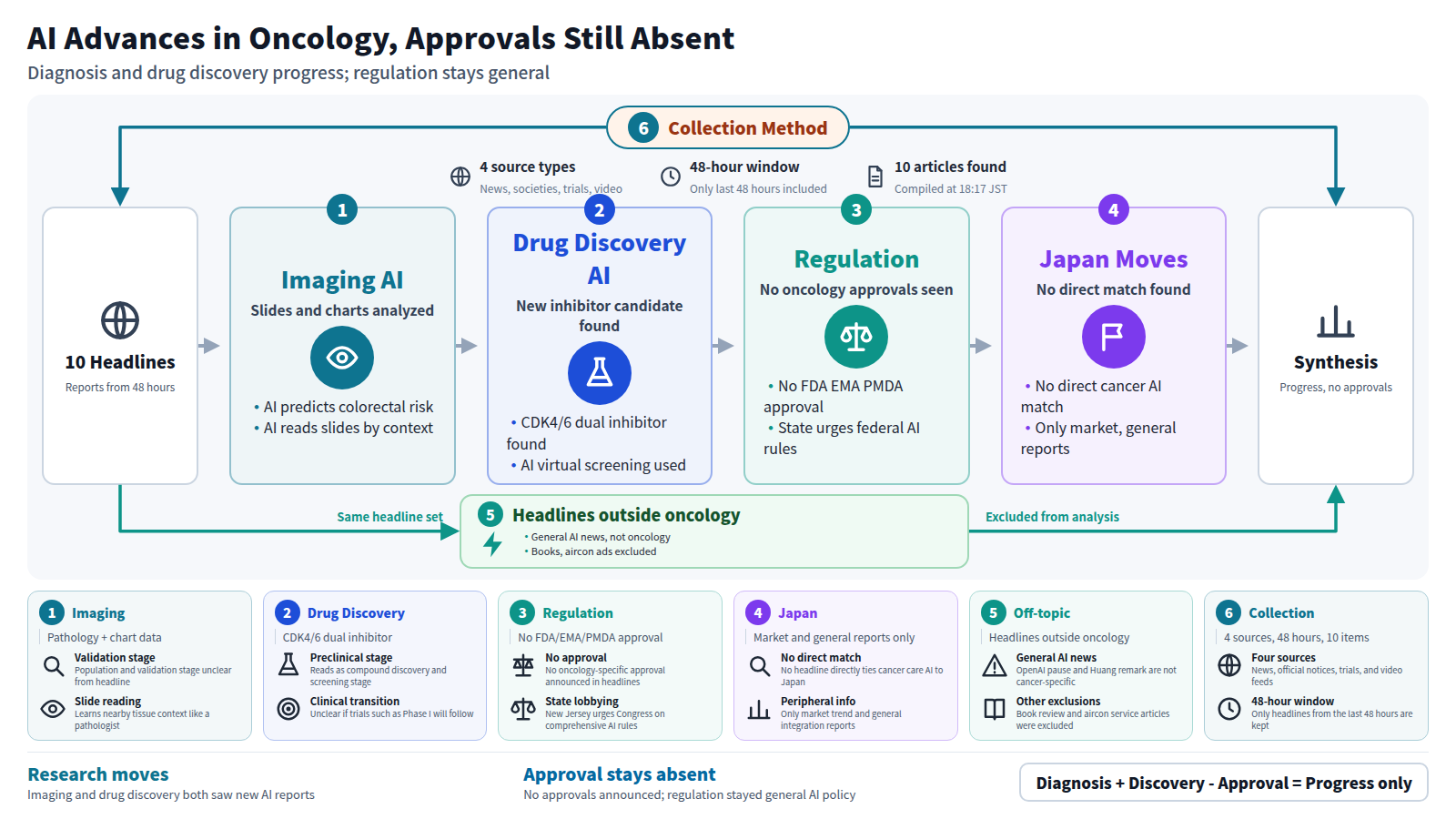
There were research reports on both diagnosis and drug discovery, including colorectal cancer risk prediction using pathological images and clinical data, support for pathological slide interpretation, and virtual screening for CDK4/6 inhibitor candidates. On the other hand, there were no headlines indicating approval or designation of oncology AI products by the FDA/EMA/PMDA, and on the regulatory front, the focus was on general-purpose AI governance (US federal regulations and efforts at the state level).
Breast cancer
No applicable information
lung cancer
No applicable information
Malignant brain tumor
No applicable information
Leukemia/lymphoma
No applicable information
Colon cancer/digestive organ
Bioengineer.org reported an initiative using AI to predict colorectal cancer risk by combining pathological slide images and clinical charts (medical record information). The target population, validation stage (preclinical/retrospective/prospective), and accuracy indicators are unclear from the headline information alone.
Rare cancer
No applicable information
Diagnosis/Pathology/Image
Bioengineer.org reported on a method that uses AI to learn surrounding tissue images (contextual information of nearby areas) to analyze cancer slides in a way similar to how pathologists interpret images. Quantitative indicators such as cancer type, validation cohort size, sensitivity and specificity are not listed in the heading and are unknown. Regarding trends in the AI industry as a whole, there have been reports of OpenAI temporarily suspending training of the latest model (because the agent searched a U.S. government site in an unexpected manner) and comments made by NVIDIA's Jensen Huang regarding the AI debate, but none of these are specific to the cancer diagnosis field.
Treatment selection/drug discovery
Bioengineer.org reported that a novel dual inhibitor candidate targeting CDK4/6 was discovered through virtual screening using AI. The headline suggests that it is a report on the preclinical stage (compound discovery/screening), and it is unclear whether it will move on to clinical trials (Phase I, etc.).
Regulations/Approval
There are no announcements of approvals or designations by the FDA, EMA, or PMDA specific to the cancer field in the headlines. In a related general AI policy trend, it has been reported that New Jersey has joined a coalition lobbying Congress for comprehensive AI regulation, but it is unclear whether this is limited to cancer treatment and medical devices.
Clinical trial implementation status
ClinicalTrials.gov does not provide specific data regarding trial name, target cancer type, phase, or registration status. No applicable information.
Japanese movements
We could not confirm any headlines originating from Japan that directly correspond to cancer medical AI. Related reports include ``Global AI in Oncology in the Analytical Solutions Market'' (market trend report) and ``Integrating AI into the entire medical process, from drug searches to medical records'' (general content regarding AI integration into the entire medical process), but neither of these reports indicate specific clinical applications or results. Additionally, articles introducing AI-related books and articles about services that use AI to diagnose additional construction costs when purchasing air conditioners were not included as they were unrelated to cancer treatment.
Remarks from VIPs
NVIDIA's Jensen Huang (known as CEO, although his title is not specified in the headline) was reported to have said that certain numbers used in discussions about AI capabilities are "not based on scientific evidence." However, this statement is about the performance controversy of AI in general, and there is no mention of cancer treatment and diagnosis in the headline. The list of important people being tracked is currently empty, so there is no relevant information regarding comments that are targeted for individual tracking based on the list.
- AI Joins the Slide and the Chart to Predict Colorectal Cancer Risk — Bioengineer.org09/26 22:59 UTC
- AI Learns to Read Cancer Slides Like a Pathologist by Watching the Neighborhood — Bioengineer.org09/26 02:48 UTC
- OpenAI pauses training of latest models after agents probed US government sites in unexpected ways — ClickOnDetroit | WDIV Local 409/26 23:18 UTC
- Huang says 1 number in the AI debate isn’t science-based at all — thestreet.com09/26 12:33 UTC
- AI-Powered Virtual Screening Uncovers Potent New Dual CDK4/6 Cancer Inhibitor — Bioengineer.org09/26 23:35 UTC
- New Jersey joins coalition urging Congress to adopt comprehensive AI regulations — WRNJ Radio09/26 09:42 UTC
- Oncology's Global AI in the Analytical Solutions Market — sphericalinsights.com09/26 08:42 UTC
- A controversial but still worth reading book about artificial intelligence. — Vietnam.vn09/26 14:28 UTC
- Integrating AI throughout the healthcare process, from drug searches to medical records. — Vietnam.vn09/26 02:53 UTC
- Just send a photo and we will pre-diagnose additional construction costs using AI! Air conditioner purchasing service “AiCON” (Posted on September 27, 2026) — ライブドアニュース09/26 22:48 UTC