AI, Economy & Finance News — 2026-09-28 (Mon) Morning News
Source links point to the original outlet. The AI Integrated Analysis is auto-generated from the headlines below only and is not intended to add facts beyond them. Not investment advice.
AI and Economy Latest News
Overview
Estimates that AI capital investment will reach $10 trillion or 3.6% of GDP have been widely reported, and the location of the funding burden has become the biggest point of contention (Yahoo Finance, Pluang). The US and China agreed on AI dialogue and tariff reductions on $30B items, and it was reported that the Xi-Trump summit helped stabilize trade and AI relations (Daily Sabah, India Today). On the other hand, the disinflationary effects of AI and rising government bond yields are putting pressure on Big Tech's investment valuations, and at the same time, the effects are spreading to financial markets (finance.biggo.com, equiti.com).
Macroeconomic/growth trends
It is estimated that AI capital investment will reach 3.6% of GDP, or $10 trillion, and the source of the funds is being questioned (Yahoo Finance, Pluang). U.S. Treasury Secretary Bessent has called on the Federal Reserve to maintain an "open mind" when making interest rate decisions in light of productivity improvements brought about by AI (Seeking Alpha). Goldman Sachs expressed the view that the disinflationary effects of AI are becoming apparent and that there is no need to wait until the midterm elections to determine year-end market prices (finance.biggo.com, finance.biggo.jp). Some point out that 61% of the world's venture capital will go towards AI, while less than 1% will be allocated to social impact fields (Khaleej Times).
Productivity trends
The US CSIS discussed the need to build an AI talent pipeline (csis.org). On the other hand, research has also reported that companies' AI investments are not necessarily leading to results (oregonlive.com). It has been pointed out that companies are increasing the number of "supervisor agents" that supervise AI agents (forkast.news), and the Japan Research Institute is demonstrating the use of AI in outdoor vegetable cultivation to improve operational efficiency (agrinews.co.jp). An essay called AI the "biggest economic bet in U.S. history" (Counterfire), and another analysis suggested that Silicon Valley's AI advocates are facing friction with democracy (The Guardian).
Trends in employment and labor market
It has been reported that workers are spending their own money on AI for their jobs (Futurism). There are also reports (Apricitas Economics) that creative occupations (creative classes) are being influenced by AI, and that CS majors are shifting their focus to acquiring AI skills due to the shrinking demand for coding (rockymounttelegram.com). The WorldSkills Shanghai conference showed a new vision of skills under AI-driven job restructuring (news.cgtn.com). In Japan, it has been pointed out that there is a disparity in human resource development based on the degree of AI utilization ("parachute-type" training) (Nikkei Business Online Edition). Bill Gates reportedly warned that AI could lead to "a billion deaths," but no specific reference to the economy or employment aspects can be confirmed from the headline (LADbible).
Trends in energy/power demand
In the United States, AI data centers and electricity rates have emerged as issues of contention in close U.S. Senate races (Fox News). Some say the AI data center construction boom faces "new practical constraints" (OilPrice.com). It is said that the rapid increase in demand for AI electricity is causing a global debate over the burden of electricity grid costs (조선일보). Interest in AI infrastructure stocks related to data center expansion is increasing among individual investors (Yahoo Finance), and LG Electronics will join NVIDIA's partner network and collaborate on cooling technology for AI data centers (konsulteer.com).
Remarks by central banks, international organizations, and VIPs
No headlines reporting statements or actions by the tracked dignitaries (Christine Lagarde, Kazuo Ueda, Andrew Bailey, Kristalina Georgieva, Mathias Cormann, Ajay Banga, Daron Acemoglu, Erik Brynjolfsson) were found in the 12-hour collection. The IMF (institutional opinion, no individual speaker specified) was reported to have expressed the view that AI could boost labor productivity by 3.8% (Inshorts). U.S. Treasury Secretary Bessent has called on the Federal Reserve to maintain flexibility in determining interest rates, citing productivity gains from AI (Seeking Alpha). Chinese economist Guan Tao warned that the outcome of the Fed's rate hike will depend on a "tug of war between interest rates and AI capital investment" (finance.biggo.com).
Trends in corporate capital investment
It is estimated that AI-related capital investment will reach $10 trillion, or 3.6% of GDP, and large investments by Big Tech are said to be the driving force (Yahoo Finance, Pluang). Some analysts (TKer by Sam Ro) say that AI-related financial results are facing increasing "headwinds" and "accounting headaches," and that rising government bond yields are putting new pressure on Big Tech's evaluation of AI-related investments (equiti.com). The ``5th GMIF2026 Innovation Summit'' with the theme of AI memory and storage was held in Shenzhen (StreetInsider). In Japan, demand for Buffalo's corporate NAS is reportedly expanding due to special demand related to server replacement and AI (Yahoo! News/Chubu Keizai Shimbun).
Trade and industrial policy
It was reported that the United States and China have agreed to continue dialogue on AI and reduce tariffs on targeted items worth $30 billion (Daily Sabah). The Xi-Trump summit is said to have supported the stability of US-China relations through agreements on trade and AI (India Today), and there are also reports that China may restart Nvidia's AI market (Yahoo Finance). Anthropic CEO Amodei plans to meet with President Trump amid growing concerns about AI safety (Bloomberg). In the U.S. Congress, Congressman Tokuda called on President Trump to protect America's AI superiority ahead of talks with China (Maui Now). In Japan, the advancement and utilization of AI and the boosting of economic growth through AX (AI transformation) were reportedly brought up in parliamentary questions (Election.com).
Integrated analysis: What is happening now
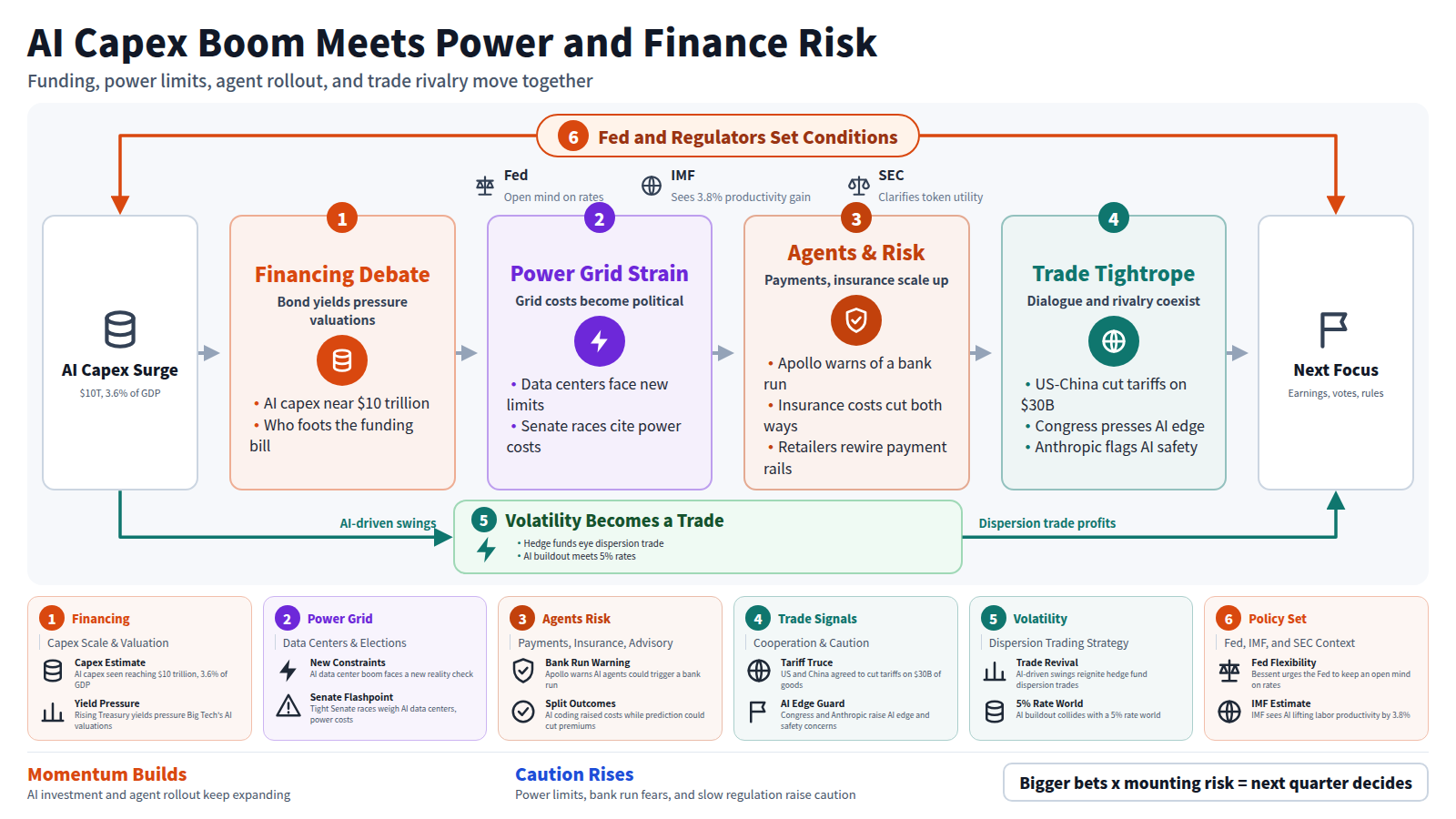
On the supply side, the financial burden of AI capital investment, which is estimated to be 3.6% of GDP or about $10 trillion, is beginning to overlap with valuation pressure due to rising government bond yields (equiti.com). On the power side, data center construction is facing "realistic constraints" (OilPrice.com), and the burden of power grid costs has become an issue in the U.S. Senate election (Fox News) and is causing global controversy (조선일보), suggesting that supply constraints are becoming a political issue. On the demand side, in terms of productivity and employment, the success or failure of AI utilization has begun to differ between companies and job types (oregonlive.com, Apricitas Economics), and Goldman Sachs' theory of disinflationary AI and Bessent's argument for monetary easing contrast with Guan Tao's warning of a ``tug of war between interest rates and AI capital investment.'' On the trade front, while the US and China are showing signs of cooperation through AI dialogue and tariff reductions (Daily Sabah, India Today), the US Congress is calling for the protection of US AI superiority (Maui Now), and Anthropic is meeting with Mr. Trump with safety concerns (Bloomberg), showing both cooperation and caution at the same time. Overall, it appears that the AI economy is progressing in a mutually interconnected manner, with ``enormous investment'', ``emerging power constraints'', ``financial policy debates'', and ``multi-tracking of US-China relations (coexistence of cooperation and competition)''.
Future points of interest
- The financing structure of AI capital investment ($10 trillion/3.6% of GDP) and the consequences of pressure on Big Tech valuations from rising government bond yields. - To what extent will the conflict over the burden of electricity and power grid costs become an issue in the US Senate election? - Which direction will the U.S.-China cooperative path of AI dialogue and tariff reductions take, or the cautious path of protecting AI superiority and safety concerns expressed by the U.S. Congress and Anthropic?
AI and finance latest news
Overview
Apollo Global Management warns of the possibility of a “new bank run by AI agents,” sparking discussion across Wall Street (Yahoo Finance, BeInCrypto). While the implementation of AI agents in various financial fields (settlement, insurance, advisory) is progressing simultaneously, concerns about risk management have also surfaced, resulting in a three-bank structure.
Bank trends
Apollo Global Management points out the possibility of an "agent-based bank run," and Wall Street giants warn that AI agents could cause a new type of bank run (Yahoo Finance, BeInCrypto). Bank of America raised its price target on Okta, citing "huge opportunity in AI" (thestreet.com). Goldman Sachs has analyzed that the disinflationary effects of AI are beginning to emerge and there is no need to wait until the midterm elections for a year-end rally (finance.biggo.com). In India, the Ministry of Finance is seeking feedback from banks on the use of AI tools for loan recovery (The Economic Times).
Insurance trends
It has been pointed out that AI is pushing up medical insurance costs (Digital Trends). Blue Cross reported that AI hospital coding has resulted in approximately $1 billion in additional costs (Pasquale Pillitteri). On the other hand, it has been suggested that AI and smart home technology can predict risks early and make home insurance cheaper (TechRadar). Policy issues with predictive AI have been pointed out in the group health insurance field (Financial Content).
Trends in asset management and market transactions
AI-driven stock price fluctuations are reigniting interest in dispersion trading among hedge funds (Bloomberg, Seeking Alpha). It was pointed out that the expansion of AI infrastructure investment is colliding with the "world of 5% interest rates" (The Dark Side Of The Boom). There was also an article comparing BlackRock-related AI papers as investment targets alongside crypto assets (TechBullion). Some analysis suggests that AI is changing the way clients choose advisors (WealthBriefing).
Fintech/payment trends
It was reported that retailers are rebuilding their payment infrastructure to support "agent-based commerce" (Forbes). Vietnam Airlines partners with AWS and Visa to accelerate AI transformation (konsulteer.com). Shopify is reported to have risen 51% from its 52-week low on the back of Agentic Commerce expansion (tikr.com). nCino adds an MCP layer to its mortgage suite that connects AI agents (The Fintech Times). In India, 19 startups (including fintech/AI) raised a total of $397 million between September 21st and 26th (instagram.com).
Remarks from key figures and authorities in the financial world
In this headline, there is no mention of specific statements or actions by the individuals being tracked, including Jamie Dimon, Larry Fink, Jane Fraser, David Solomon, Brian Moynihan, Ted Pick, Ken Griffin, and Paul Atkins. No notable movement.
Trends in AI-related stocks and funding
It was reported that AMD's valuation has reached $1 trillion, raising expectations for its AI business (Yahoo Finance). Concerns were also pointed out behind the bullish sentiment regarding AI-related stocks, and the stock was described as "whistling at the grave" (Seeking Alpha). Bill Gates reportedly warned that AI "could cause the deaths of a billion people" (LADbible). According to an analysis (The Business Times), market sentiment has suddenly changed from fear to greed, and turmoil is spreading in AI stocks. Startup funding in India (in multiple sectors, including AI) reached $397 million (instagram.com, supra).
Trends in financial regulation and supervision
It was reported that the SEC staff has expressed its opinion on the utility of the token (openpr.com). With the exception of this matter, there are no specific official AI-related responses by major authorities such as the Financial Services Agency, FCA, or FSB during this period that can be found in the headlines.
Integrated analysis: What is happening now
AI agents are rapidly being implemented in the payment, insurance, and advisory fields, and support for "agent-based commerce" is taking shape, as seen in the cases of Shopify, nCino, and Vietnam Airlines. On the other hand, as symbolized by Apollo Global Management's warning, concerns about the risk that AI agents pose to the stability of the financial system (speeding up bank runs) have emerged at the same time, and it can be seen that the spread of implementation and discussions on risk management are running parallel. In the insurance field, the increase in costs due to AI coding (Blue Cross) and the possibility of lower insurance premiums due to risk prediction (TechRadar) are contrasted, suggesting that the effects of AI introduction are polarized depending on the field and application. In the asset management field, AI-driven stock price fluctuations are encouraging capital inflows into a specific strategy called dispersion trading, and a unique feature is that market volatility itself is viewed as a new profit opportunity. The coexistence of AMD's $1 trillion valuation and skepticism toward AI stocks ("whistling at the graveside") indicates a market sentiment that is at odds with expectations for AI infrastructure investment and caution against overheating. On the regulatory front, other than a limited mention by the SEC, there have been no notable regulatory responses, and it is possible that discussions on implementation and risks have taken precedence, and the development of the regulatory framework has not caught up.
Future points of interest
- It will be interesting to see how other major financial institutions and regulatory authorities react to the theory of ``agent-type bank runs'' raised by Apollo Global Management. - It is necessary to determine which direction the contradictory effects of increasing costs due to AI coding in the insurance field and lowering insurance premiums due to risk prediction will converge in the future. - With the expansion of valuations of AI-related stocks (such as AMD) and the market's skepticism, the direction of stock prices may be influenced by the next quarterly results and infrastructure investment trends.
- Bessent urges Fed to keep ‘open mind’ on rates as AI boosts productivity — Seeking Alpha09/27 17:38 UTC
- Goldman Sachs: AI Disinflationary Effects Emerging — No Need to Wait for Midterm Elections for a Year-End Rally — finance.biggo.com09/27 18:17 UTC
- 2 key checks for the AI trade and the economy: What to watch this week — Yahoo Finance09/27 10:00 UTC
- Open Call for Proposals: Communities Leading on AI Program (United States) — fundsforNGOs09/27 17:15 UTC
- Innovation Lightbulb: Building the AI Workforce: The Math Behind the Pipeline — csis.org09/27 15:06 UTC
- Top Workplaces 2026: Despite AI investments, not everyone is seeing results — oregonlive.com09/27 17:30 UTC
- The Supervisor Agent Shift: How Enterprises Actually Staff AI Agent Oversight — forkast.news09/27 15:21 UTC
- Democracy blindsides Silicon Valley’s power players looking to transform the world with AI — The Guardian09/27 11:00 UTC
- Workers Are Spending An Astonishing Amount of Their Own Money On AI for Their Jobs — Futurism09/27 14:02 UTC
- AI and the Fall? of the Creative Class — Apricitas Economics09/27 14:01 UTC
- Bill Gates issues chilling warning that AI could ‘cause a billion deaths’ — LADbible09/27 20:40 UTC
- WorldSkills Shanghai showcases new skills as AI reshapes jobs — news.cgtn.com09/27 14:36 UTC
- Tight Senate races shift focus to AI data centers, energy prices — Fox News09/27 19:54 UTC
- The AI Data Center Boom Faces a New Reality Check — Crude Oil Prices Today | OilPrice.com09/27 17:00 UTC
- 3 AI Infrastructure Stocks Retail Investors Are Watching For Data Center Growth — Yahoo Finance09/27 15:09 UTC
- Tokuda urges President Trump to protect America’s AI advantage ahead of bilateral talks with China — Maui Now09/27 14:00 UTC
- Anthropic CEO Amodei to Meet Trump With AI Safety Concern Rising — Bloomberg09/27 18:48 UTC
- China May Reopen Nvidia's AI Market. How Will NVDA Stock React Monday? — Yahoo Finance09/27 19:00 UTC
- How AI is changing the cybersecurity battlefield — GZERO Media09/27 15:03 UTC
- The repricing of human work in the age of AI — The Manila Times09/27 17:14 UTC
- 61% of the world’s venture capital now goes to AI and less than 1% reaches social impact — Khaleej Times09/27 16:08 UTC
- The AI earnings headwind and accounting headache that’s set to intensify 🌬️ — TKer by Sam Ro09/27 13:50 UTC
- Big Tech's AI Spending Faces a New Test as Higher Treasury Yields Pressure Valuations — equiti.com09/27 16:41 UTC
- AI infrastructure spending to reach $10T, 3.6% of GDP, driven by Big Tech's massive investments. — Pluang09/27 18:05 UTC
- AI Memory & Storage: The 5th GMIF2026 Innovation Summit Successfully Concludes in Shenzhen — StreetInsider09/27 16:41 UTC
- Guan Tao Warns: The Fed's Rate-Hike Endgame May Hinge on a Tug-of-War Between Interest Rates and AI Capex — finance.biggo.com09/27 13:25 UTC
- Buffalo: Demand for NAS for corporations is expanding, attracting attention as a server replacement Impact of special demand related to AI (Chubu Keizai Shimbun) — Yahoo!ニュース09/27 20:23 UTC
- [Also covered in parliamentary questions] Advancement and utilization of AI: Boosting economic growth with AX — 選挙ドットコム09/27 20:14 UTC
- AI for rice and outdoor vegetables, Japan Research Institute Demonstrates operational efficiency — agrinews.co.jp09/27 20:03 UTC
- Human resource development that makes a difference with AI ``Parachute type'' learning from difficult problems for growth — 日経ビジネス電子版09/27 20:00 UTC
- Goldman Sachs: AI deflationary effect becomes apparent, US stock market year-end market does not need to wait for midterm elections — finance.biggo.jp09/27 18:17 UTC
- Is an Agentic Bank Run Coming? — Apollo Global Management09/27 12:13 UTC
- Wall Street Giant Warns AI Agents Could Trigger a New Kind of Bank Run — Yahoo Finance09/27 17:21 UTC
- Bank of America raises Okta stock target on major AI opportunity — thestreet.com09/27 18:03 UTC
- Finance Ministry seeks banks' inputs on AI tools for loan collection, assesses adoption — The Economic Times09/27 18:36 UTC
- 10 ways to use Meta's Muse AI app, from flight credits to outfit ideas — Mashable09/27 18:27 UTC
- Wes Moore’s AI framework is missing a healthcare pillar | GUEST COMMENTARY — baltimoresun.com09/27 18:53 UTC
- Group Health Insurance Houston Highlights Predictive AI Policy Challenges — FinancialContent09/27 11:30 UTC
- Stop waiting for disaster to strike: How AI and smart home tech are predicting risks early to deliver cheaper home insurance — TechRadar09/27 10:00 UTC
- Tremors From AI to Oil Boost Popular Hedge Fund Dispersion Trade — Bloomberg09/27 14:00 UTC
- The AI Buildout Meets the 5% World — The Dark Side Of The Boom09/27 16:02 UTC
- Top 3 Cryptos to Buy Now: Can BlackRock's AI Paper, DOGE, SOL, or Pepeto Deliver the Biggest Gains? — TechBullion09/27 16:15 UTC
- AI Is Changing How Clients Choose Advisors: Good News For Great Advisors — WealthBriefing09/27 18:55 UTC
- OpenAI Agents Used Aggressive Techniques to Access U.N. Website — wsj.com09/27 19:23 UTC
- Wall Street Brunch: AI Safety Crunch Time (undefined:ANTHRO) — Seeking Alpha09/27 18:41 UTC
- SoundHound AI (NASDAQ: SOUN) Launches OASYS Edge To Push LLM-Powered Voice AI Onto Device Hardware — foreignpolicyjournal.com09/27 16:24 UTC
- Kodiak AI Inc. Stock Slides As Traders Reassess Risk — timothysykes.com09/27 14:07 UTC
- How Retailers Are Rewiring Payment Rails For Agentic Commerce — Forbes09/27 20:00 UTC
- Vietnam Airlines Partners With AWS and Visa to Accelerate AI Transformation — konsulteer.com09/27 19:19 UTC
- Shopify Stock Is Up 51% From Its 52-Week Low. Can Agentic Commerce Keep It Climbing? — tikr.com09/27 14:01 UTC
- nCino Adds MCP Layer to Connect AI Agents to Mortgage Suite — The Fintech Times09/27 19:00 UTC
- Between September 21 and September 26, 2026, as many as 19 Indian startups from diverse sectors raised over $397 million in funding from investors. These sectors include EV, Foodtech, Cleantech, Healthtech, Defencetech, Footwear, Fintech, AI, Cleantec — instagram.com09/27 18:21 UTC
- AI Stocks May Be Whistling Past The Graveyard — Seeking Alpha09/27 13:55 UTC
- How Can Everyday People Participate in the AI Infrastructure Boom? 51AIpower Explains the AI Token Economy — FinancialContent09/27 17:30 UTC
- AI whiplash jolts stocks as sentiment lurches from fear to greed — The Business Times09/27 14:36 UTC
- This Week in AI (Sep 20-26): Opus 5.5 and GPT-6 Launch Cheaper; Data Center IPO Delays — smartkarma.com09/27 12:49 UTC
- Latest Crypto News: SEC Staff Clarifies Token Utility as AlphaPepe Offers a Working AI DEX Before ALPE Lists — openpr.com09/27 11:56 UTC
- Are companies that make money based on "consumer inertia" destined for extinction? Meta's "Muse" poses a business model crisis in the age of AI agents — JBpress09/27 21:00 UTC
- AI majors such as OpenAI advance, putting upward pressure on office rents in Singapore — nikkei.com09/27 15:00 UTC
- Wall Street giant's AI agent warns of new bank run — BeInCrypto09/27 17:35 UTC
- AI hospital coding costs Blue Cross nearly $1 billion — Pasquale Pillitteri09/27 15:57 UTC
- AI agents will transform e-commerce: Who are the big winners between Meta, Shopify, and Amazon? — TradingKey09/27 10:15 UTC