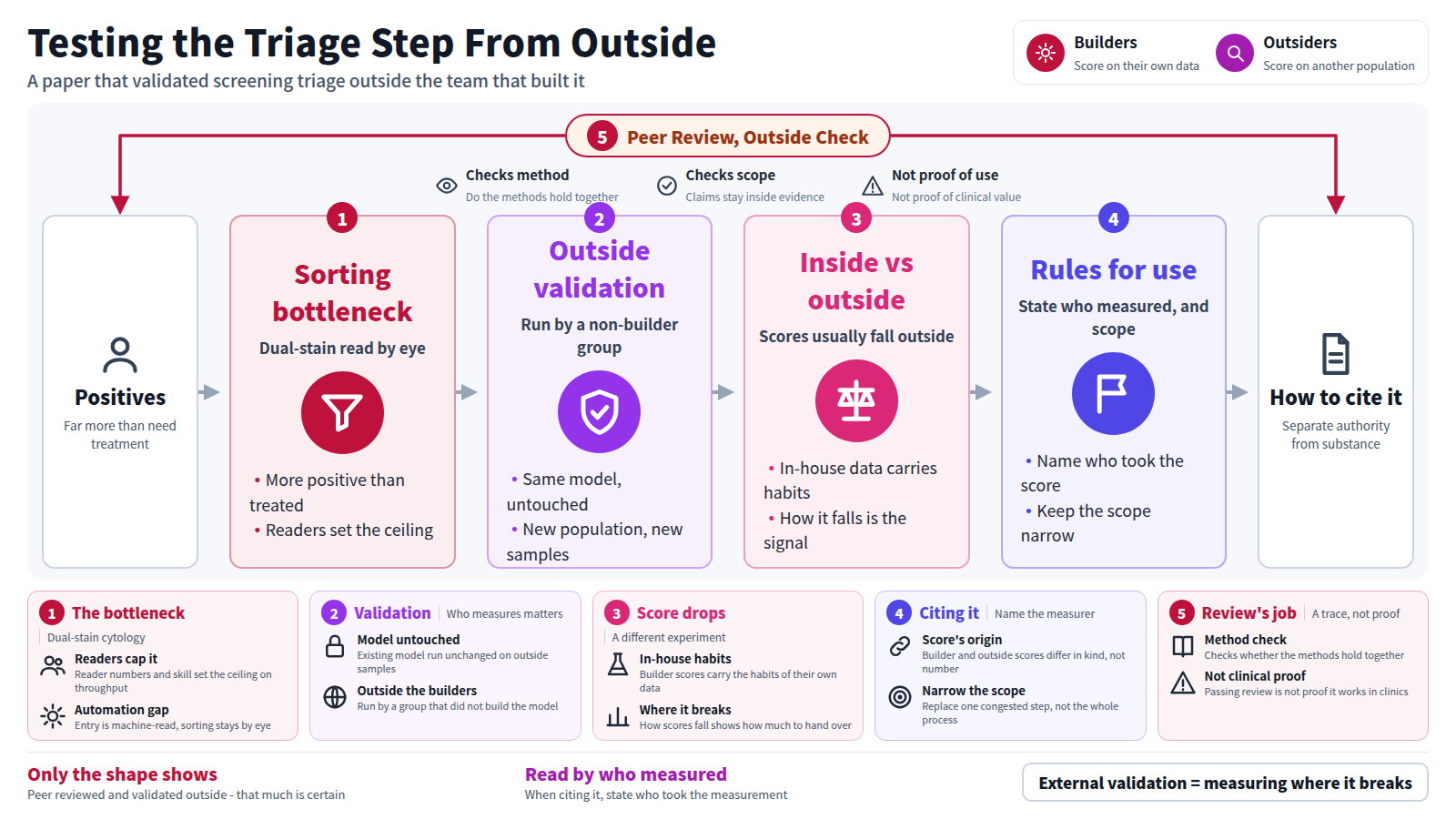
1. The problem the paper addresses
Cervical cancer screening has been rearranged over the past decade and a half. Cells used to be collected and read under a microscope, with abnormal shapes as the signal. Now the entry point is increasingly a test for the virus itself, and only those who test positive move to the next step. Fewer cases slip past the door that way. But the number of people who test positive is far larger than the number who need treatment soon.
So a sorting step is needed. Dual-stain cytology has served that role: the stained cells are read, and a person decides. This is where the pipeline narrows. The number of qualified readers, and their experience, set the ceiling on how much screening a system can process. The automation gap in the title names that mismatch — the entry test can be processed by machines, while the sorting step behind it is still done by eye.
2. What the paper proposes
The core of this paper is not a new classifier. The title states independent external validation: taking an existing AI model and running it, without modification, on a different population and different samples, by a group that did not build it.
That sounds unglamorous, and for a clinical tool it is decisive. Performance measured by the developers on their own data carries the habits of that data. Staining intensity differs between laboratories, so does imaging, so does the mix of people who show up. Whether the model behaves the same outside its origin cannot be settled from inside it. The fact that the measurement was not taken by the builders is the contribution here.
3. What it reports — within what was collected
An admission is required at this point. The record collected for this article does not contain the paper's abstract text; it carries only the journal and issue information. This article therefore does not discuss the results or conditions reported in the paper. What can be read is the shape stated by the title: an independent external validation of an AI model for the triage step in HPV-based screening.
What is established is that the report passed peer review and appeared in NEJM AI. Peer review is a trace that outside readers checked whether the methods hold together and whether the claims stay inside what was shown. It is not more than that. Passing review does not establish that the method works in clinical service, and it does not guarantee the same outcome in another country or another laboratory.
4. Internal measurement versus outside measurement
Measured by the builders
The available data is split into training and evaluation, and the score comes from the evaluation split. The split is chosen in-house. Staining protocols and imaging equipment are usually those of a single site. The rule for excluding difficult samples follows local practice. A number comes out, but the design says nothing about how far that number travels.
Measured on an outside population
The model is left untouched and fed samples from elsewhere. Staining, imaging conditions and the composition of the population do not match the development setting. Scores usually fall. How they fall is the information worth having: only by seeing where a model breaks can anyone decide how much to hand it.
This asymmetry is why external validation weighs heavily in the evaluation of clinical tools. An experiment that demonstrates high performance and an experiment that hunts for the conditions under which performance collapses are not the same experiment.
5. What is not new, and where the limits sit
Asking a model to read cell images is not new. Image-based judgement in pathology and cytology has been worked on since deep learning spread, and the literature is substantial. What this report takes on is not a performance update but the verification side of the work — checking from outside.
The limits follow directly. Confirming behaviour on one external population is knowledge about that population, not about all of them. Screening programmes differ by country and region in uptake, in follow-up machinery, in referral capacity. There is also a plainer point: speeding up one step does nothing for total throughput if the steps before and after it are congested. Sample collection, recall of positive cases, colposcopy slots — all of these sit on the human and institutional side.
And as noted above, with no abstract text in hand, the conditions of the validation cannot be confirmed within the scope of this article. The character of the validation cohort, the comparator, where the decision threshold was fixed — each requires the paper itself.
6. What the coverage said
Two independent outlets touched this subject in the same window. One covered a screening programme combining clinic-based collection with mailed self-collection. The other covered how viral DNA persists by type before invasive disease develops.
Lined up, a divergence shows. The paper is about the middle of screening — automating the step that sorts positive cases. The coverage points at the entrance to screening and at the natural history of the disease. A cluster of reporting exists around the condition, but its centre of gravity is not the paper's centre of gravity.
That divergence is itself a signal. Of the arguments about screening, the ones that travel outward are how to get people tested and what happens if disease is left alone. Who carries the sorting step travels poorly. Yet in service, the sorting step is usually where the queue forms. The volume of coverage is not measuring the importance of the subject.
7. Where this connects to pharmaceutical and regulatory practice
First, the weight of the phrase external validation. Whether the context is software as a medical device or a figure quoted inside promotional material, who took the measurement carries as much weight as the measurement. A score produced by the developer and a score produced by a party with no stake are different in kind even when they are the same magnitude. Material that cites one should make clear which it is.
Second, how to choose which human judgement to hand over. This paper targets not diagnosis but the sorting step in front of it. Rather than replacing the whole process, one congested step is identified and only that step is addressed. Defining the scope of replacement narrowly also pays off in accountability, because the boundary between machine decision and human decision lines up with a process boundary.
Third, how the journal name should be used. Publication in a prominent journal shows the claim passed outside eyes. That is a reasonable signal of whether something is worth reading, but it is not evidence of clinical value or novelty. When citing it internally or in material, the writer has to separate two uses: invoking the journal as authority, and pointing to the substance of the validation.