AI Highlights — the whole picture — 2026-09-23 (Wed) Daily News
Source links point to the original outlet. The AI Integrated Analysis is auto-generated from the headlines below only and is not intended to add facts beyond them. Not investment advice.
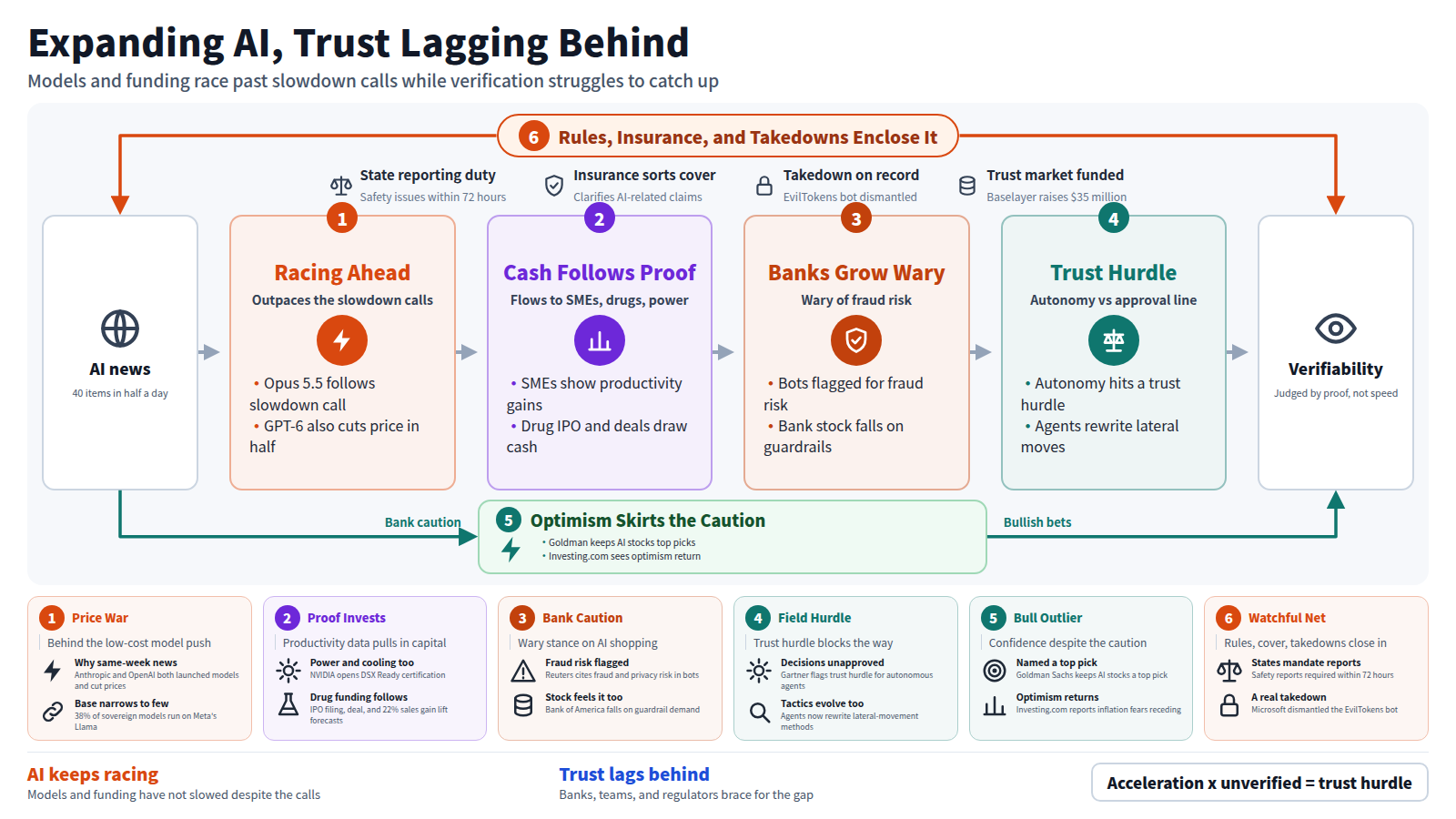
New versions of the model arrived shortly after word of the slowdown came out, and prices dropped at the same time. Judging from half a day's worth of news, development and investment have not slowed down despite the calls. On the other hand, banks are openly wary of AI agents that perform shopping on their behalf, and people talk about the ``trust hurdle'' to autonomous decision-making. In the same half-day, there is simultaneously the strength to move forward and the need to stop and check.
Models that accelerate even after deceleration request and price competition
Anthropic announced a new model, the Opus 5.5, in mid-September, shortly after CEO Dario Amodei repeatedly called for a slowdown in AI development (The New York Times). Yahoo Finance also reports that this is the first release since the call to slow down the development pace (Yahoo Finance). According to Anthropic's own announcement (Anthropic), Opus 5.5 was positioned as a successor to the existing Opus line, and its release was not postponed amidst safety debates. At the same time, OpenAI also released new models of the GPT-6 series, ``Sol'' and ``Luna,'' and reportedly cut the token price in half (thenewstack.io). According to a report by CNBC, both companies' latest releases are positioned as the first low-priced models introduced after the request to slow down the development pace, confirming that the call for slowing down has not led to suppressing price competition (cnbc.com).
The reason why price reductions and new model introductions are progressing at the same time is not only competition for the performance of individual models, but also a competition for supremacy over which base model is actually being used by companies. According to a report by Benzinga, 38% of the customized models of countries and companies that promote "sovereign AI" are based on Meta's Llama, and it has been pointed out that the reality of sovereign AI, which claims to be independently developed, is supported by dependence on Meta's open models (Benzinga). In other words, even though each company and each country may appear to be competing on their own paths, the underlying technology is being consolidated into a small number of basic models.
Despite calls for a slowdown coming from within the development companies, actual market movements continued to accelerate with the introduction of Opus 5.5 and GPT-6 Sol/Luna, and price reductions. The Sovereign AI debate over Meta shows that the focus of competition is not just on model novelty, but also on price and implementation breadth. The next question is how this acceleration is being perceived not only in the world of models and investments, but also in the actual situations where AI is used by consumers and in the field.
Macroeconomics where bullishness and caution intersect
Macroeconomics is a mix of bullishness and caution
The Foundation for American Innovation, a think tank, analyzed that the spread of AI could itself be a factor that worsens GDP forecasts over the next few years. This is because while the effects of boosting productivity will become apparent later than expected, the cost burden of upfront investment will surface first. At the same time, Fox Business reported that the combination of oil price trends and AI-related electricity and infrastructure demand is the focus of the risk of a resurgence of inflation. This week's feature is that concerns about the possibility that increased electricity demand for data centers could push up overall prices through energy prices are being talked about in tandem with forecasts for a slowdown in GDP.
In response to these cautions, Investing.com reported that optimism about AI has actually come back to life in the market, and references to inflation risk are receding into the background. The market continues to move back and forth, with bullish sentiment rebounding every time bearish news emerges, making it impossible to gauge market sentiment using a single indicator alone. Fortune juxtaposed the debate about whether the pace of AI evolution is slowing with the issue of how far companies are from the capabilities of the so-called "frontier" model, pointing out that many companies that have introduced AI are unable to incorporate cutting-edge performance into their operations. Behind the mix of strong and weak macro forecasts, the fact that the gap between the level of utilization in the field and the state-of-the-art technology has not been bridged is a reason to discount the persuasiveness of optimism.
On the policy side, on the other hand, movements at the state level have also surfaced. Governor Spanberger of Virginia has asked Congress to consider regulations regarding AI, wfxrtv.com reported. Amid delays in creating uniform rules at the federal level, state governors are lobbying the legislature on their own, indicating that even as investors read the strength and weakness of macro indicators, the regulatory environment is building up from below.
The macro tug-of-war between a deteriorating GDP outlook, inflation concerns, and renewed optimism is beginning to require a different reading as another variable, regulation, begins to quietly intrude from state politics.
Productivity demonstration will attract investment in infrastructure and drug discovery
A study by the Philadelphia Federal Reserve Bank has confirmed that small and medium-sized businesses in District 3 (Pennsylvania, New Jersey, and Delaware) that have introduced AI have seen a tangible boost in sales and productivity (Philadelphia Federal Reserve Bank). A similar trend can be seen in Chinese companies, and the International Labor Organization (ILO) points out that while the introduction of AI by Chinese companies will lead to improved productivity, there are also growing concerns about job substitution and skill obsolescence (International Labor Organization). The fact that the measurement of the effects of introduction is moving from the ``expectation'' to the ``demonstration'' stage supports the investment trends described below.
On the infrastructure side, NVIDIA announced ``DSX Ready,'' a certification program for power and cooling hardware for data centers (ServeTheHome). The fact that not only the performance of the GPU itself but also the power supply design and cooling equipment that support it have been made clear as investment targets is a sign that AI demand is beginning to be treated as a long-term capital investment cycle rather than a temporary boom.
Funds continue to flow into the drug discovery field. Ironvic Therapeutics, an AI drug discovery company invested in by NVIDIA, has reportedly applied for an initial public offering (IPO) on the Nasdaq and plans to use the proceeds to develop cancer treatment drugs (Yahoo Finance, BigGo Finance). Additionally, Boehringer Ingelheim has entered into a partnership worth up to $1 billion with Envisagenix for AI drug discovery in the field of solid tumors (biospace.com). This is reflected in actual business results, as AI drug discovery and diagnostics company Tenpus AI raised its full-year earnings forecast following a 22% increase in sales (Pluang). The combination of these three movements at the same time, including an IPO filing, a large-scale partnership, and an upward revision to the outlook due to increased sales, indicates that drug discovery AI has moved beyond the early stages of clinical application and that capital markets have begun to factor in the prospects for profitability.
While empirical data on productivity is accumulating from the field at small and medium-sized enterprises and Chinese companies, that money is flowing into both physical infrastructure, such as power and cooling, and the time-consuming field of drug discovery. The next question is how far this investment momentum will spill over into consumer services and the reliability of AI agents in the field.
Distrust in agents spreads through consumer contact points
Banks are starting to issue specific warnings about AI shopping bots. According to Reuters, major banks say AI agents increase the risk of fraud and data privacy violations, and that it is still too early for consumers to fully trust bots that shop and make payments on their behalf. PYMNTS.com also reports that banks are "not sure whether AI agents are on the side of consumers." Mashable reports that a major bank has warned that the spread of AI agents could directly lead to an increase in fraud damage, and the cautious stance of financial institutions responsible for payment networks has come to light.
This concern spilled over into the stock market. According to Yahoo Finance, Bank of America's stock price has fallen due to the growing demand for "guardrails" in AI shopping, and the fact that the safety of AI agents for consumers is not fully developed is starting to be factored into the valuation of financial stocks. Goldman Sachs, on the other hand, doesn't subscribe to the cautious argument. According to Investing.com, the company has named AI-related stocks as its top picks and maintains a bullish investment stance, in contrast to being wary of risks. There is no monolithic evaluation of the reliability of AI agents among banks, and even between banks and securities companies.
The insurance industry is also beginning to respond to new risks. According to cybersecuritydive.com, insurance companies are beginning to clarify what will be covered for AI-related cyber claims, and the extent to which existing insurance products will cover losses caused by AI agents has emerged as a practical issue. Distortions in trust at the individual level have also been reported. The New York Times reported on the case of a user who became dependent on Meta's AI chatbot for the rest of his life, and the shocked reactions of those around him. While this has become a target for corporate fraud prevention and insurance design, there is also the problem of individuals becoming overly dependent on agents.
The situation in which banks, insurance companies, and investors are evaluating AI agents from different standpoints shows that evaluations are determined not by the speed at which the technology spreads, but by who has completed the testing and to what extent.
Hurdles of trust that are questioned both in the field and in regulations
Gartner points out that while companies are rushing to autonomously operate industrial AI agents, "trust hurdles" are standing in the way (Virtualization Review). As the areas in which agents make and execute decisions without human approval expand, the question of who should verify the basis for such decisions and how will remain unresolved. Similar concerns have surfaced in the security field, with reports of AI agents rewriting the very methods of lateral movement (thehackernews.com). Attackers' moves to have agents search for intrusion routes are putting pressure on companies to reconsider the design of privileges granted to agents from a defense perspective rather than a performance perspective.
There is also the issue of how to ensure the accuracy of information. It has been pointed out that AI agents should be able to search and obtain facts rather than generating them on their own (cio.com). Designs that rely on generation run the risk of presenting false information in a convincing manner. There are also reports of growing concerns in the field that the use of AI is wearing down employees' critical thinking skills (hcamag.com). If the habit of accepting the output of agents becomes established, the lack of verification will accumulate as a risk to the organization.
Movements on the regulatory side are also progressing at the same time. There are reports of a move to require major AI companies to register with the state and report safety issues within 72 hours (WHEC.com). Mandatory disclosure requirements represent a shift from the previous framework, which relied on companies' voluntary declarations. On the other hand, it was reported that although five research institutes have been invited to participate in the safety peer review initiative proposed by Musk (shattered.io). This highlights the gap between state regulations that are increasingly becoming mandatory and the reality that voluntary checks within the industry are not working.
There are also examples of countermeasures. Microsoft announced that it has busted "EvilTokens," an AI chatbot built for cybercrime (The Official Microsoft Blog). This is a case that shows that agents with malicious intent were actually in circulation and had grown to the point where they were targeted for detection. Additionally, Crunchbase News reports that Baselayer, a company that evaluates the trustworthiness of AI agents that help companies make decisions, has raised $35 million. The fact that a market that verifies the trustworthiness of agents has begun to attract funds indicates that the mistrust and demands for regulation on the ground are finally beginning to be translated into concrete mechanisms.
Over the past half day, both the introduction of models and the spread of investment have outpaced requests for a slowdown. However, this speed has not kept pace with the mechanisms that support the correctness of decisions, both at consumer contact points and on-site agent operations. While demonstrations of productivity are driving investment in infrastructure and drug discovery, banks are distancing themselves due to fraud risks and companies are struggling to draw the line between autonomous operations and approval processes. The difference this week is not how quickly we adopt AI, but how well we make those decisions verifiable.
Q1: How many of the decisions entrusted to AI agents cannot be verified by humans afterwards? Q2: When was the last time that the scope of authority given to autonomous AI agents was reviewed from a defensive perspective rather than a performance perspective? Q3: Do you have a verification system in place to match the acceleration of models and investments at the same speed?
Finally, three questions
- How many of the decisions entrusted to AI agents cannot be verified by humans afterwards? Q2: When was the last time that the scope of authority given to autonomous AI agents was reviewed from a defensive perspective rather than a performance perspective? Q3: Do you have a verification system in place to match the acceleration of models and investments at the same speed? - When was the last time that the scope of authority given to autonomous AI agents was reviewed from a defensive perspective rather than a performance perspective? Q3: Do you have a verification system in place to match the acceleration of models and investments at the same speed? - Do you have a verification system in place to match the acceleration of models and investments at the same speed?
📚 Sources (all material)
Every item this issue drew on. External links open in a new tab. 40 items.
AI Industry
- Article (cnbc.com) — Japanese-language summary
- Article (The New York Times) — Japanese-language summary
- Article (Yahoo Finance) — Japanese-language summary
- Article (Anthropic) — Japanese-language summary
- Article (thenewstack.io) — Japanese-language summary
- Article (GovTech) — Japanese-language summary
- Article (Benzinga) — Japanese-language summary
AI and the Economy
- Article (The Foundation for American Innovation) — Japanese-language summary
- Article (Fox Business) — Japanese-language summary
- Article (Fortune) — Japanese-language summary
- Article (Investing.com) — Japanese-language summary
- Article (wfxrtv.com) — Japanese-language summary
- Article (Philadelphia Federal Reserve Bank) — Japanese-language summary
- Article (International Labour Organization) — Japanese-language summary
AI and Finance
- Article (Reuters) — Japanese-language summary
- Article (PYMNTS.com) — Japanese-language summary
- Article (Mashable) — Japanese-language summary
- Article (Yahoo Finance) — Japanese-language summary
- Article (Investing.com) — Japanese-language summary
- Article (cybersecuritydive.com) — Japanese-language summary
- Article (The New York Times) — Japanese-language summary
AI and Human Co-creation
- Article (thehackernews.com) — Japanese-language summary
- Article (Virtualization Review) — Japanese-language summary
- Article (PYMNTS.com) — Japanese-language summary
- Article (cio.com) — Japanese-language summary
- Article (Solutions Review) — Japanese-language summary
- Article (elmhurst.edu) — Japanese-language summary
- Is AI eroding critical thinking in the workplace? — hcamag.com
AI Regulation, Safety and Geopolitics
- Article (WHEC.com) — Japanese-language summary
- Article (finance.biggo.com) — Japanese-language summary
- Article (shattered.io) — Japanese-language summary
- Article (The Official Microsoft Blog) — Japanese-language summary
- Article (Mashable) — Japanese-language summary
- Article (Crunchbase News) — Japanese-language summary
- Article (Solutions Review) — Japanese-language summary
- Article (ServeTheHome) — Japanese-language summary