AI, Economy & Finance News — 2026-09-21 (Mon) Daily News

Source links point to the original outlet. The AI Integrated Analysis is auto-generated from the headlines below only and is not intended to add facts beyond them. Not investment advice.
AI and Economy Latest News
Overview
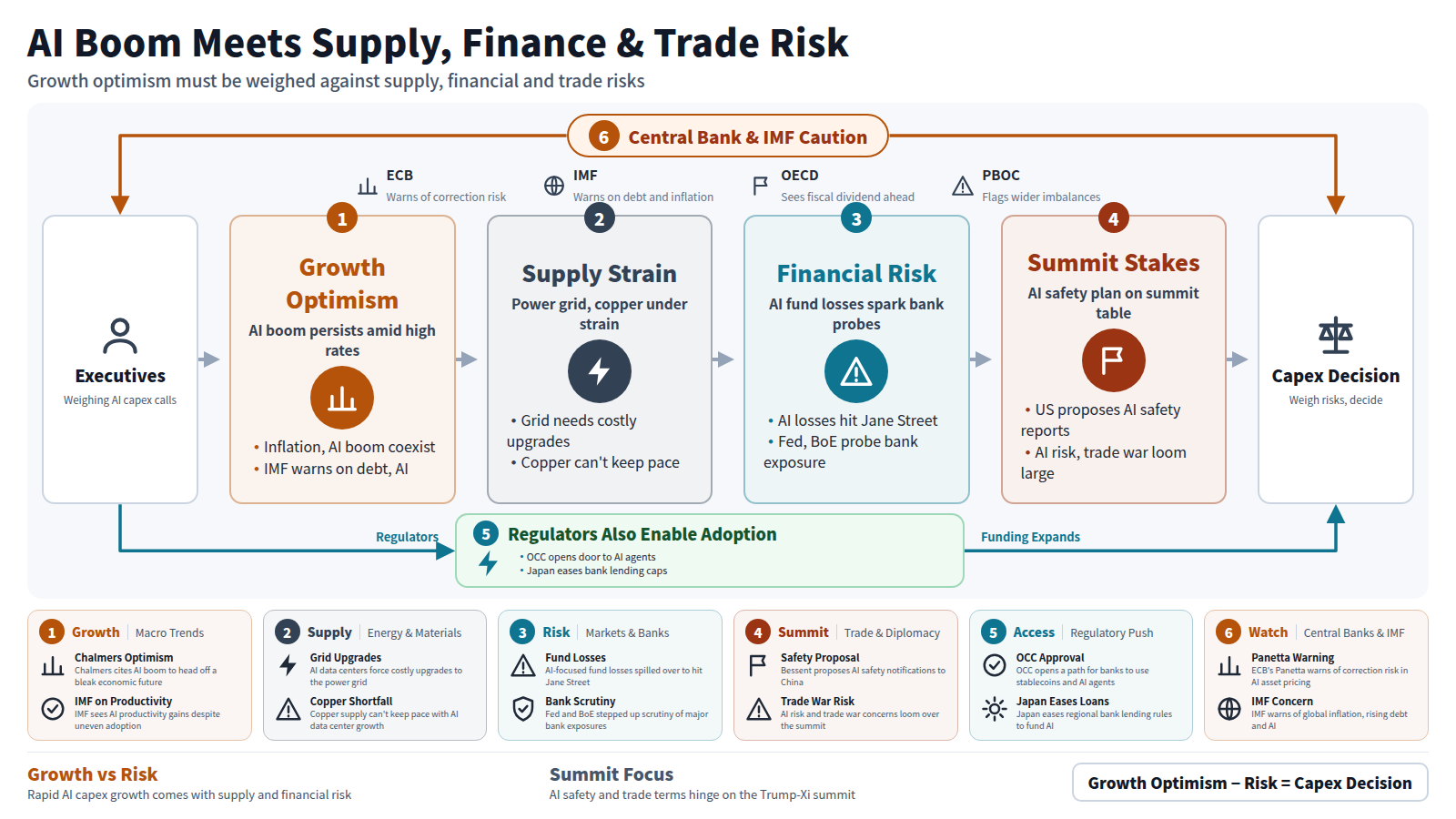
Ahead of the Trump-Xi summit, the main focus is on trade talks between the United States and China, including an AI safety reporting system (Bloomberg Television, Al Jazeera, Yahoo Finance). At the same time, central banks and international organizations are becoming increasingly cautious, with ECB Director Panetta warning of the risk of adjustments to optimism in AI-related asset prices (Bloomberg), and the IMF expressing concerns about the relationship between global inflation, debt, and AI (businesstoday.com.my).
Macroeconomic/growth trends
ECB Director Panetta pointed out that the way AI profits are distributed will determine future inflation trends (The Lufkin Daily News). The head of the IMF warns of the link between global inflation and rising debt and AI (businesstoday.com.my). In the United States, even as interest rates continue to rise, it has been pointed out that we are entering a ``high interest rate era'' where inflation and an AI boom coexist (The Economic Times), and in Australia, Finance Minister Chalmers has cited the AI boom as a source of hope in response to concerns about the economic future (AFR).
Productivity trends
Citing the IBM CHRO study, the IMF points out the potential for AI to improve productivity in Europe, but notes that uneven implementation poses a risk (Business Review). An IBM study reports that with the spread of AI, "critical thinking skills" are becoming central to human resources strategies (PR Newswire). On the research front, a paper was introduced stating that while AI saves scientists' time, it also creates a "verification tax" on the cost of verifying results (Research Professional News). In Japanese-speaking countries, it has been pointed out that generative AI produces a large amount of "unsatisfactory output" and that improving productivity alone is meaningless (THE21 Online/Yahoo! News).
Trends in employment and labor market
Bloomberg reported that while the introduction of AI is boosting hiring, the benefits are mainly skewed toward senior jobs (Bloomberg.com). On the other hand, Hilton's early-career job openings are said to have received 15,000 applications against the backdrop of increased hiring activity using AI, which some have described as a ``double-edged sword'' (Benzinga). It has been reported that UMaine in the US is planning to fully implement AI while refraining from future personnel cuts (Bangor Daily News), and that jobs in the cybersecurity field are also being reorganized by AI (csoonline.com). A conference on the changing workforce is scheduled for Hawaii (Hawaii News Now).
Trends in energy/power demand
The expansion of AI data centers is reportedly necessitating expensive upgrades to the power grid (Park Hills Daily Journal). An editorial in New England argued that new data centers should not be allowed until the rules are in place (CT Mirror). On the supply side, it has been pointed out that copper supply may not be able to keep up with the expansion of the AI boom (The Business Journals). On the capital investment side, ABB announced DC power infrastructure for AI data centers, and LG Electronics announced cooling systems (manilatimes.net, UPI).
Remarks by central banks, international organizations, and VIPs
- ECB Director Fabio Panetta warns of "correction risk" in optimism for AI-related asset prices (Bloomberg.com). Furthermore, it has been pointed out that future inflation will be determined by how profits from AI are distributed (The Lufkin Daily News). - IMF (mentioned as a subordinate organization of Managing Director Kristalina Georgieva): Warns about the link between global inflation and rising debt and AI (businesstoday.com.my). Points out the potential for productivity improvements through AI in Europe and the risks of uneven implementation (Business Review). - OECD (Secretary General Mathias Cormann): Europe cannot afford to miss out on AI transformation and says fiscal dividends are in sight (Euronews.com). - Daron Acemoglu (MIT economist and Nobel Prize winner): Warns that AI could destroy democracy (Novara Media, conversation with Aaron Bastani). - People's Bank of China: Points out that AI may widen China's economic imbalances (IDNFinancials). - US Treasury Secretary Scott Bessent: Proposes framework for AI safety reporting in consultation with Chinese Vice Premier He Lifeng (Yahoo Finance, Al Jazeera, Technology Org, Soifang Keizai Shimbun). - Regarding Kazuo Ueda (Governor of the Bank of Japan), Christine Lagarde (Governor of the ECB), Andrew Bailey (President of the BOE), Ajay Banga (President of the World Bank), and Erik Brynjolfsson (Stanford), there are no reports of statements or movements that fall under the headings in this list.
Trends in corporate capital investment
Google's financial results take the lead in the earnings season for major tech companies, and the scale of capital investment (capex) is expected to determine future AI-related prices more than the cloud growth rate (Stocktwits). Michael Burry warns that hyperscalers are hiding $3 trillion in AI-related debt (Yahoo Finance). China's Xunce Technology has launched a new service "TokenCloud" and announced a capital investment plan of up to RMB12B (TradingView). In the United States, it is reported that corporate AI-related investment exceeds housing investment for the first time, and data center spending is reshaping the economic structure (finance.biggo.com/BigGo Finance). AI-related investors in Asia are reportedly shifting their attention to financial results ahead of the Xi-Trump summit (scmp.com).
Trade and industrial policy
Ahead of the Trump-Xi summit, US Treasury Secretary Bessent and Chinese Vice Premier He Lifeng held talks on the topics of AI, tariffs, and mineral resources (IndexBox). During these discussions, the United States proposed an AI safety reporting system (AI incident warning system) to the Chinese side (Al Jazeera, Technology Org, Yahoo Finance, Sotobo Keizai Shimbun). Some analysts say that AI risks and trade wars are looming large as concerns ahead of the summit (The Daily Upside, Bloomberg Television).
Integrated analysis: What is happening now
On the macro level, the AI boom is starting to be talked about from both growth expectations and inflation/debt risks, and the warnings from ECB Director Panetta and the IMF appear to be two sides of the same coin with the rapid expansion of AI-related investment (corporate capital investment exceeds housing investment). The rapid increase in capital investment is directly linked to the physical bottleneck of supply constraints such as electricity, power grids, and copper (Park Hills Daily Journal, Business Journals), and this may determine the pace at which future productivity improvements (as pointed out by the IMF and IBM) will be realized. In terms of employment, a report (Bloomberg) that the boosting effect of hiring is unevenly distributed among seniors, when read in conjunction with discussions on productivity (``verification tax'' and ``unsatisfactory output''), suggests that the benefits of AI introduction are not being spread evenly across the labor market. Furthermore, in the form of a proposal for an AI safety notification system, the US and China are converging issues of industrial policy and security, as well as issues of capital investment and trade, into a single event called a summit meeting.
Future points of interest
- Whether or not there was an agreement regarding the AI safety notification system, tariffs, and mineral resources at the Trump-Xi summit meeting - The scale of capital investment (capex) of major tech companies, starting with Google's financial results, and the consistency with the debt risk pointed out by Michael Burry - Whether the ECB, IMF, OECD, etc. will issue further official positions on adjustment risks and fiscal implications of AI-related asset prices.
AI and finance latest news
Overview
Over the past 12 hours, the main focus has been on the US and UK central banks' investigations into major bank exposures over huge losses in AI-related hedge funds (Reuters, FT). A parallel movement is underway for the OCC to pave the way for both stablecoins and AI agents (PYMNTS.com, forkast.news). Citigroup CEO Jane Fraser has warned that advanced AI will make it difficult to respond to cyberattacks (NewsBytes).
Bank trends
Goldman Sachs maintains its position that AI infrastructure investment has an advantage over the 5% government bond yield, and analyzes that AI capital investment shows no signs of slowing down, including in Asia (Business Insider, CNBC). OCC opens regulatory path for banks to leverage stablecoins and AI agents (PYMNTS.com). Spanish banks are redesigning their models after panic surrounding the introduction of AI (El Mundo America). There is analysis that AI is bringing about changes that go beyond cost reduction at the practical level of daily work (FF News).
Insurance trends
Attorney liability insurance companies offer AI risk mitigation strategies to law firms (Virginia Lawyers Weekly). A case was reported in which a major European insurance company moved an AI agent into production (FinTech Magazine). PolicyX.com is rolling out new services including AI chatbots for Gen Z (EIN Presswire). A survey by LIIBA found that younger generations have lower trust in autonomous AI (theinsurer.com).
Trends in asset management and market transactions
The central banks of the United States and the United Kingdom have stepped up their scrutiny of major banks' exposures in light of the turmoil at the AI-focused hedge fund Situational Awareness and the large losses at Jane Street (FT, Newsquawk, Reuters). BlackRock's Vavrek points out that AI hardware will drive emerging markets (Bloomberg). Baillie Gifford has partnered with Essentia Analytics on AI (Scottish Financial News). “Sovereign AI” is attracting attention as the next big AI investment theme on Wall Street (Yahoo Finance). In China, stamp duty on stock transactions has increased by more than 80% due to a surge in transactions due to the AI craze (SCMP).
Fintech/payment trends
Analyzes have shown that explainable AI will separate the winners in fintech (finextra.com). XRP rose 4% due to automatic AI trading support from Ripple and Stripe (MarketForces Africa). Catena Trust Bank receives preliminary approval from OCC for AI agent-based financial infrastructure (forkast.news). Sibos 2026 will discuss customer ownership in an AI-driven economy (FinTech Futures).
Remarks from key figures and authorities in the financial world
- Jane Fraser, Citigroup CEO: Warned that advanced AI will make responding to cyberattacks more difficult (NewsBytes). Direct statements regarding the other key figures being tracked (Jamie Dimon, Larry Fink, David Solomon, Brian Moynihan, Ted Pick, Ken Griffin, and Paul Atkins) are not found in today's headlines. No notable movement.
Trends in AI-related stocks and funding
In response to concerns about an AI bubble, some analysis suggests that although it is not a bubble, some tech companies are showing signs of it (Technology Org). It is reported that AI stocks rebounded after the Fed rate hike, led by semiconductor stocks such as NVDA, MU, and AMD (TradingKey). Amazon's earnings boost AI stocks, while Apple sells, Nasdaq futures rise slightly (Stocktwits). British AI infrastructure startup Nscale has filed for an initial public offering (IPO) in the United States (Silicon Republic). It was reported that Anthropic is considering a new model to compete with OpenAI's GPT-6 Astra (analyticsindiamag.com).
Trends in financial regulation and supervision
The Financial Times argues that AI in finance should be regulated differently than in other sectors (FT). The co-leaders of the United Nations' safe AI dialogue have recommended future actions in Fortune magazine (Fortune). In Japan, the Financial Services Agency plans to ease regulations on large-scale lending by regional banks and expand the supply of funds for AI and renewable energy (Nihon Keizai Shimbun, Minkabu FX/Forex). The central banks of the United States and the United Kingdom have launched an investigation into the exposure of major banks following huge losses from AI funds (Reuters).
Integrated analysis: What is happening now
At the center of this is the case in which the losses of the AI-specialized hedge fund Situational Awareness spilled over to Jane Street, and the central bank of the United States and the United Kingdom moved to investigate the exposure of major banks (FT, Reuters, Newsquawk), indicating that the overheating of AI investment has begun to be seen by regulators as a systemic risk. Meanwhile, the OCC is moving toward approving banks' use of stablecoins and AI agents (PYMNTS.com, forkast.news), and regulations are progressing simultaneously in two directions: strengthening risk oversight and allowing the use of technology. In Japan, the Financial Services Agency has eased regulations on large-scale lending by regional banks to support the supply of funds to AI and renewable energy (Nihon Keizai Shimbun), and it seems likely that the authorities in each country will strengthen risk management while supporting the expansion of AI-related investments. On the market side, the flow of AI-related funds and transactions continues to expand, with Goldman Sachs continuing to prioritize AI infrastructure investment over government bond yields (Business Insider), and in China, stamp tax revenue is rapidly increasing due to a rapid increase in transactions (SCMP). Citigroup CEO Fraser's warning (NewsBytes) suggests that the proliferation of AI is creating new cybersecurity vulnerabilities.
Future points of interest
- Results of the U.S. and U.K. central banks' survey of major bank exposures related to AI funds and whether there will be any additional regulatory action (Reuters, FT) - Specific implementation timing and scope of the deregulation of large regional bank loans by the Japanese Financial Services Agency (Nihon Keizai Shimbun) - Future of OCC's approval of AI agent-type financial infrastructure (Catena Trust Bank, etc.) (forkast.news)
- AI gains' distribution will shape inflation, ECB's Panetta says — The Lufkin Daily News09/21 08:01 UTC
- VIDEO: Australia in 2066: AI, slower economic growth and an ageing population — ABC News & Headlines – Australian Broadcasting Corporation09/21 08:50 UTC
- IMF Chief Warns Of Global Inflation, Higher Debt And AI — businesstoday.com.my09/21 01:53 UTC
- Chalmers bets on AI boom to head off bleak economic future — AFR09/21 02:30 UTC
- US economy enters higher-rate era as inflation, AI boom persist — The Economic Times09/21 05:05 UTC
- New IBM CHRO Study: AI Puts Critical Thinking at the Center of Workforce Priorities — PR Newswire09/21 04:01 UTC
- Europe could see productivity boost from AI, but uneven adoption poses risks, IMF says — Business Review09/21 08:09 UTC
- AI saves scientists time but adds ‘verification tax’, paper finds — Research Professional News09/21 06:37 UTC
- AI set to make or break the nation’s finances — AFR09/21 07:39 UTC
- Ontario needs lower taxes and new industrial jobs. AI provides an answer for both — thehub.ca09/21 07:00 UTC
- AI Adoption Is Driving Hiring, But Mostly for Senior Roles — Bloomberg.com09/21 08:00 UTC
- UMaine goes all in on AI amid upcoming layoffs and tech fears — Bangor Daily News09/21 05:00 UTC
- 5 ways AI is reshaping the cybersecurity job market — csoonline.com09/21 08:27 UTC
- Hawaii leaders to discuss AI, workforce shifts in Future of Work conference — Hawaii News Now09/20 22:40 UTC
- Hilton Gets 15,000 Applications for Early-Career Jobs as AI Fuels Hiring Frenzy: ‘Double-Edged Sword’ — Benzinga09/21 07:51 UTC
- Power Grid Faces Costly Upgrades Due To AI Data Centers — Park Hills Daily Journal09/21 05:06 UTC
- Opinion: No new data centers in New England until we write the rules on AI — CT Mirror09/21 04:01 UTC
- AI boom faces new constraint: Copper supply can't keep pace with data center expansion — The Business Journals09/21 08:00 UTC
- ABB’s new direct current portfolio aims to rewire AI data center energy infrastructure — manilatimes.net09/21 08:21 UTC
- LG Electronics launches cooling system for AI data centers — upi.com09/20 23:26 UTC
- US-China Trade Talks: Bessent, He Lifeng Meet on AI, Tariffs, Minerals - News and Statistics — IndexBox09/21 04:21 UTC
- US proposes AI safety notification mechanism in talks with China — Al Jazeera09/21 04:37 UTC
- US Proposes AI Incident Alert System With China Before Trump-Xi Summit — Technology Org09/21 07:41 UTC
- Bessent proposes US-China AI safety notifications in talks with Chinese vice premier — Yahoo Finance09/21 02:47 UTC
- AI Risks, Trade War Loom Over Trump-Xi Summit — The Daily Upside09/21 04:01 UTC
- ECB’s Panetta Warns of Correction Risk on Optimistic AI Pricing — Bloomberg.com09/21 08:12 UTC
- Europe cannot afford to miss AI transformation, with fiscal dividend within reach, OECD chief says — Euronews.com09/21 08:09 UTC
- Watch BofA's Oberoi on Markets, AI Trade, Central Bank Policy — Bloomberg.com09/21 00:00 UTC
- Federal Reserve's hiking cycle raises concerns for AI financing as sector carries $320 billion in debt — Crypto Briefing09/21 04:19 UTC
- Xunce Technology Launches TokenCloud, Plans Up To RMB12B AI Capex — TradingView09/21 08:29 UTC
- AI investors in Asia seen shifting focus to earnings ahead of Xi-Trump summit — scmp.com09/21 09:00 UTC
- Google Kicks Off Big Tech Earnings: Why Capex, Not Cloud Growth, Could Decide Market’s Next AI Trade — Stocktwits09/20 21:41 UTC
- Michael Burry Warns Hyperscalers Are Hiding $3 Trillion In AI Liabilities — And Wall Street Isn’t Looking: ‘When The Music’s Over…’ — Yahoo Finance09/21 02:46 UTC
- US Corporate AI Investment Surpasses Housing for First Time as Data Center Spending Reshapes Economic Structure — finance.biggo.com09/21 07:35 UTC
- U.S. companies' AI investment exceeds housing investment for the first time; data center spending is reshaping the economic structure — BigGo ファイナンス09/21 07:35 UTC
- Mass production of “unsatisfactory output” with generative AI: Why there is no point in increasing productivity alone (THE21 Online) — Yahoo!ニュース09/21 02:51 UTC
- People's Bank of China: The possibility that AI will widen China's economic imbalances and what causes it — IDNFinancials09/21 03:20 UTC
- US proposes AI reporting system to China — 外房経済新聞09/21 05:27 UTC
- Unemployment insurance will create more job opportunities in the AI era. — vietnam.vn09/21 08:38 UTC
- Nobel Economist Warns: AI Will Destroy Democracy | Aaron Bastani meets Daron Acemoglu — Novara Media09/21 08:46 UTCDaron Acemoglu / MIT economist / Nobel laureate

- Why Goldman Sachs Still Prefers AI Infrastructure to 5% Treasuries — Business Insider09/21 05:28 UTC
- AI buildout shows no signs of slowing so far, with Asia set to gain: Goldman Sachs — cnbc.com09/21 03:55 UTC
- Beyond Cost Savings: Where AI Actually Changes Day-to-Day Banking — FF News09/21 09:00 UTC
- Panic over AI puts Spanish banking plans in check after redesigning their models to adapt to the new technology — El Mundo America09/21 08:15 UTC
- OCC Opens Three Bank Doors to Stablecoins and AI Agents — PYMNTS.com09/21 00:22 UTC
- 5+ways+malpractice+insurers+say+law+firms+can+reduce+AI+risk — Virginia Lawyers Weekly09/21 09:05 UTC
- AI Feelings — Insurance Journal09/21 05:15 UTC
- How a Top European Insurer Got AI Agents to Production — FinTech Magazine09/21 08:29 UTC
- PolicyX.com Launches Gen Z-Focused Insurance Push, Including New AI Chatbot and Campus Mentorship Program — EIN Presswire09/21 05:21 UTC
- LIIBA: Early careers less trusting of autonomous AI as learning, relationships on the line — theinsurer.com09/21 06:22 UTC
- Watch BlackRock's Vavrek: AI Hardware to Drive EM — Bloomberg.com09/21 00:00 UTC
- Banesh Prabhu on IntellectAI and Artificial Intelligence in Wealth Management — Hubbis09/21 08:18 UTC
- Fed and BoE stepped up scrutiny of bank exposures to large trading firms after turmoil at AI-focused hedge fund Situational Awareness caused large losses at Jane Street, according to FT — Newsquawk09/21 04:26 UTC
- Baillie Gifford in AI partnership with Essentia Analytics — Scottish Financial News09/21 06:36 UTC
- Libertarians at the Gate: A Review of a Remarkable 72 Hours in the AI Trade — The Dark Side Of The Boom09/21 05:30 UTC
- What Is Sovereign AI? Inside Wall Street's Next Big AI Trade — Yahoo Finance09/21 06:40 UTC
- Wall Street Journal Hires Max Zeff to Cover Artificial Intelligence — citybiz09/21 07:24 UTC
- China’s stamp duty on stock sales jumps over 80% as AI frenzy drives trading — scmp.com09/21 04:00 UTC
- Toronto Stock Exchange Today: TSX Edges to a Marginal Gain as Energy Strength Fully Offsets US-Led AI Selloff — BBN Times09/21 07:56 UTC
- Crexendo, Inc. (NASDAQ:CXDO) Adds Meetric AI to Boost Omnichannel Conversation Intelligence — TradingView09/21 05:50 UTC
- The trust dividend: Why explainable AI will separate the fintech winners — finextra.com09/21 09:01 UTC
- Sibos 2026: Digital finance in an AI-driven economy - when the agent does the buying, who owns the customer? — FinTech Futures09/21 04:48 UTC
- Snappi Fintech & AI Lab Summit: Bringing Academia and Industry Together to Shape the Future of Digital Financial Services — Snappi09/21 06:41 UTC
- XRP Rises 4% As Ripple, Stripe Enable Automated AI Transactions — MarketForces Africa09/21 08:04 UTC
- Catena Trust Bank Secures Preliminary OCC Approval for AI-Agent Financial Infrastructure — forkast.news09/21 07:31 UTC
- Is there an AI bubble? No, but some tech companies show signs — Technology Org09/21 06:30 UTC
- Why Did AI Stocks Rally After Fed Rate Hike? NVDA, MU, and AMD Lead Chip Sector — TradingKey09/21 07:11 UTC
- Nasdaq Futures Tick Higher As Amazon Earnings Lift AI Stocks Despite Apple Selloff: Why TSLA, SPCX, RDDT, SMCI, BE, RKLB Are In Focus — Stocktwits09/20 21:53 UTC
- AI stocks — deVere Group09/21 00:50 UTC
- Anthropic Weighs New AI Model as OpenAI’s GPT-6 Astra Gains Ground — analyticsindiamag.com09/21 06:26 UTC
- AI in finance must be policed differently — Financial Times09/21 04:00 UTC
- We co-led the UN’s dialogue on safe and secure AI. Here’s what needs to happen now — Fortune09/21 01:01 UTC
- UK AI infrastructure start-up Nscale files for US IPO — Silicon Republic09/21 08:25 UTC
- KT Group Unveils AI Transformation Gains in Finance and Media; Content Production Efficiency Up 50% — finance.biggo.com09/21 07:55 UTC
- KT Group is expanding its application of artificial intelligence (AI) transformation beyond infrastr.. — 매일경제09/21 08:33 UTC
- Financial Services Agency eases regulations on large-scale loans for regional banks to expand funding for AI and renewable energy — 日本経済新聞09/21 08:00 UTC
- U.S. and British central banks investigate major banks' exposure to AI fund huge losses = FT — Reuters09/21 06:44 UTC
- Financial Services Agency eases regulations on large-scale regional bank loans, expands AI and renewable energy funding = Nikkei — みんかぶ FX/為替09/21 08:12 UTC
- South Korea's KOSA begins discovering agentic AI services targeting payments, shopping, and transportation — BigGo ファイナンス09/21 05:35 UTC
- Citigroup CEO Jane Fraser warns advanced AI makes cyberattacks tougher — NewsBytes09/21 02:36 UTCJane Fraser / Citigroup CEO