AI in Medicine News — 2026-09-23 (Wed) Daily News
Source links point to the original outlet. The AI Integrated Analysis is auto-generated from the headlines below only and is not intended to add facts beyond them. Not investment advice.
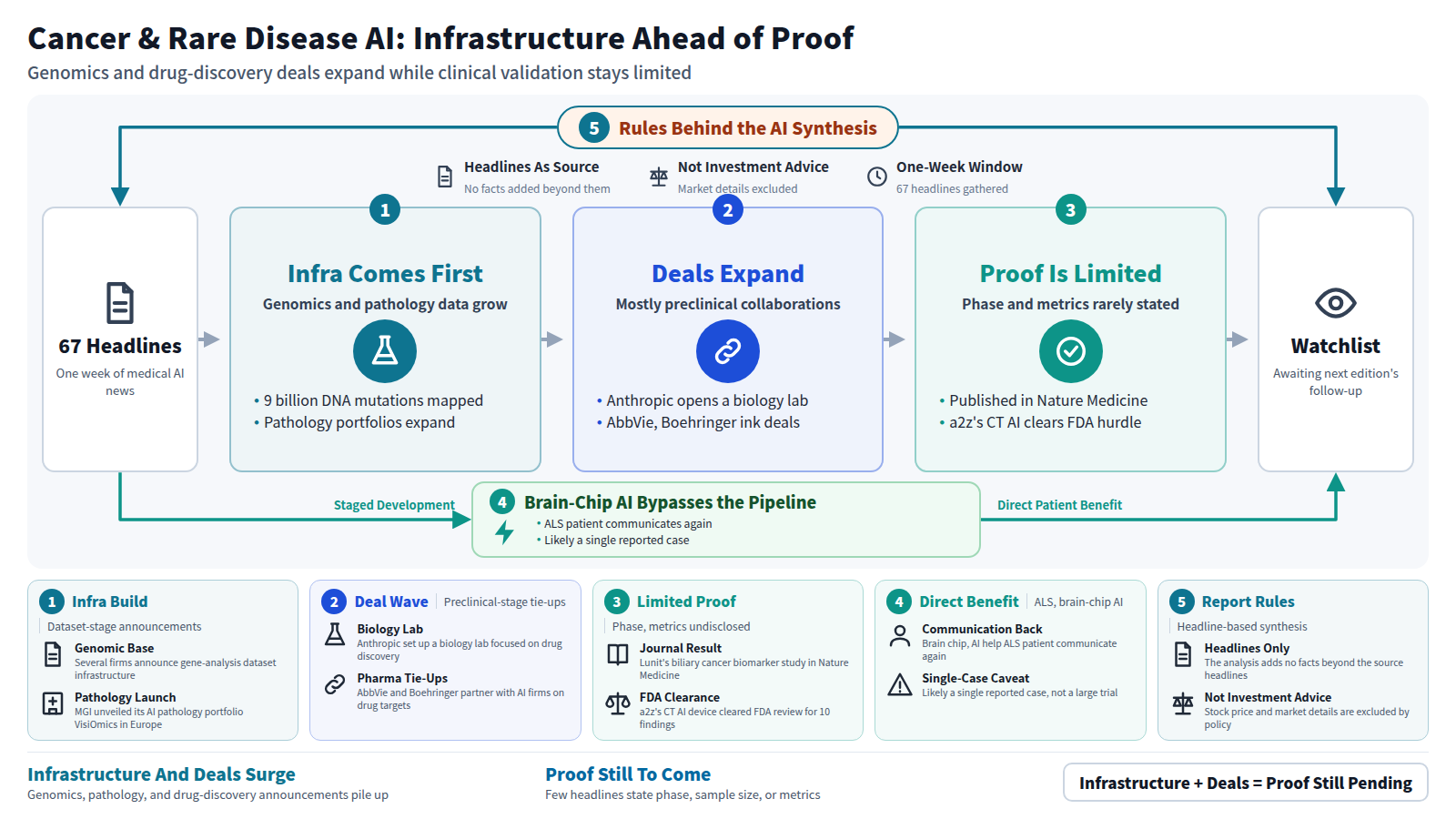
Latest news on AI and rare and incurable diseases
Latest news on AI and rare and incurable diseases
Latest news on AI and rare and incurable diseases
Overview
In the diagnostic field, there are mainly presentations on AI pathology and genome mapping, and there are no headlines indicating specific progress in therapeutic drugs or systems. Several companies announced the construction of genetic analysis infrastructure (dataset preparation). There are no headings showing individual trends in the 348 designated intractable diseases.
Diagnosis of rare diseases
MGI announced its AI-enabled pathology portfolio “VisiOmics” in Europe at ECP 2026
News-Medical
. Numerical values showing diagnostic accuracy and shortened time to diagnosis are not listed in the headline and are unknown. Google DeepMind maps 9 billion DNA mutations and shows its potential for use in elucidating rare diseases
WION
. This is the construction of a mutation map, and does not indicate clinical application to cases or improvement in diagnostic rate.
Gene analysis/genome
Precure selects Helix to provide multi-omics testing and AI tools [Genetic Engineering and Biotechnology News]. Pure Genetic Medical and Breakthrough Genomics launch AI-powered “Virtual Geneticist”
Select Science
, There are no specific numerical values such as mutation determination accuracy in the heading. Tempus AI is also building a large-scale whole-genome multimodal dataset
Bitget
Yahoo Finance
. All of these are at the stage of developing research infrastructure and datasets, and are not reports that demonstrate clinical ability to interpret mutations. The Mainichi Keizai article reports that DeepMind used AI to pre-analyze and map the approximately 9 billion single-letter changes (single nucleotide mutations) in human DNA, and appears to be referring to the same initiative as WION's report.
Development of therapeutic drugs
No applicable information.
Nerve/muscular diseases
No applicable information.
Immunology/Collagen disease
No applicable information.
Rare metabolic/endocrine diseases
No applicable information.
System/Patient Support
No applicable information.
Japanese movements
It was reported that Anthropic will establish a biology research institute and begin full-scale AI drug discovery efforts.
Infoseek News
. The target disease/stage (pre-clinical or not, etc.) is not stated in the heading and is unknown. Mainichi Keizai (Korean media) has reported on DeepMind's mapping of DNA mutations, but it does not indicate the movements of systems and institutions in Japan.
Remarks from VIPs
No applicable information.
Latest news on AI and cancer treatment
Overview
Mainly company trends in the diagnostic/imaging field (CT/radiation AI) and FDA-related permission information. In the drug discovery field, multiple collaborations between major pharmaceutical companies (AbbVie) and AI startups have been reported. Specific primary information indicating the progress of the clinical trial (registration status, phase, endpoint) cannot be confirmed from the headline.
Breast cancer
- In the field of medical examinations, it was reported that Lord's Mark's AI-powered breast cancer screening technology will proceed to the "final clinical trial" stage in the US, UK, and Europe, with a rollout target of April 2027. However, details of the study design, target size, and endpoints are not listed in the heading. - There are reports related to medical examinations using AI wearable technology, but no specific indicators (sensitivity, specificity, etc.) of "final test success" are mentioned in the headline. - The OncLive article discusses the advantages and limitations of AI tools in breast oncology (it appears to be a review, but details are unknown). - In both cases, the stage and evidence level are not clearly stated in the headings, so a definitive evaluation is avoided.
lung cancer
- No relevant information (items classified under the heading "Lung cancer" are mainly related to biliary tract cancer, CT image AI, and drug discovery, and content specific to lung cancer cannot be confirmed).
Malignant brain tumor
- No relevant information (there is information on the FDA's approval of the CT image AI triage tool, but no specific indication for brain tumors is specified in the heading).
Leukemia/lymphoma
- No applicable information.
Colon cancer/digestive organ
- No relevant information (only general articles on ``Children's use of AI'', no specific reports on colon cancer/endoscopy detection).
Rare cancer
- No direct reporting on adenoid cystic carcinoma in the headlines. Anthropic's additional funding for Australian scientific research (total of A$13 million) is listed in the related category, but the details of the cancer type and research content are not listed in the headline.
Diagnosis/Pathology/Image
- It was reported that Lunit's AI biomarker research has shown the possibility of predicting treatment response in HER2-positive biliary tract cancer (cholangiocarcinoma) and was published in Nature Medicine. The size of the study and whether it was retrospective/prospective are not stated in the heading. - Multiple media reported that a2z Radiology's CT imaging AI device has received FDA approval and has expanded its acute care suite to accommodate 10 new findings (Radiology Business, Enidnews, etc.). The specific names of the findings targeted for expanded indications are not listed in the heading. - Altis Labs has raised $25 million in Series A funding for its CT imaging AI tool, with the aim of expanding its use in cancer clinical trial support. - Merge announces AI layer for enterprise imaging platforms (product announcement, not clinical report). - The article on diagnosticimaging.com discusses the multi-party issues of value evaluation and cost evaluation in the introduction of AI (overview).
Treatment selection/drug discovery
- AbbVie and Iambic announced a partnership in AI drug discovery to accelerate small molecule drug discovery. The stage appears to be preclinical (exploratory), but the heading only mentions "collaboration" and "partner" without mentioning a specific phase (Phase I, etc.). - Boehringer Ingelheim has entered into a partnership with Envisagenics to analyze RNA splicing and search for cancer targets using AI technology (apparently in the preclinical/target discovery stage, but details are not listed in the headline). - The Tech Explorist article reports on the possibility that building "virtual cells" using AI could help speed up the drug discovery process (apparently at the basic research/proof-of-concept stage). - Oncodaily (Mr. Fabio Ynoe de Moraes) publishes a weekly evidence brief on the use of AI in the field of radiation oncology (details of content are not listed in the heading).
Regulations/Approval
- FDA: a2z Radiology's CT image AI triage tool received clearance (510(k), etc. permission, type not listed in heading) for detection function for 10 additional findings on CT images. - Other than the above, no other approval/designation information regarding EMA/PMDA is applicable.
Clinical trial implementation status
As primary information from ClinicalTrials.gov, descriptions that specifically link the trial name, target cancer type, phase, and registration status cannot be found in the headings. There is mention of "final clinical trials" regarding Lord's Mark's breast cancer screening technology, but the NCT number, phase, and registration status are unknown, so we cannot speculate on the number or status of cases.
Japanese movements
- It was reported that Alibaba's AI image diagnosis system "Damo Radar" has expanded its ability to detect stomach cancer and approximately 150 medical conditions (reported by Japanese media VOI.ID, the company itself is Chinese). There is no entry in the heading regarding recruitment and clinical evaluation at domestic medical institutions. - An article with the headline ``Corporate value has doubled, but there are no ``real drugs''...The inconvenient truth about new AI drugs'' was found that discusses the discrepancy between the corporate value evaluation of AI drug discovery companies and actual drug development results. Target company names and specific data are not listed in the headings. - There have been multiple reports of the announcement of the opening of a corporate website by DataMEDS AI (the company after the acquisition was completed), but this is corporate information for the stock market, and due to regulations, descriptions of stock prices and market prices will not be covered in this report. Clinical and research content is not listed in the heading.
Remarks from VIPs
- The list of important people being tracked is blank, so there is no relevant information. The publication of a weekly evidence brief by Fabio Ynoe de Moraes (radiation oncology, Oncodaily contributor) has been confirmed, but the content of the statement itself is not listed in the headline.
Latest news on AI and rare and incurable diseases
Overview
This period has no headlines that show direct progress in the diagnosis and treatment of designated intractable diseases, but focuses on genome analysis platforms, trends in AI drug discovery companies, and announcements by Anthropic to establish a biological research institute. In terms of systems, primary reporting within Japan was limited.
Diagnosis of rare diseases
No applicable information
Gene analysis/genome
There is a headline stating that Tempus AI (TEM) has announced the "100,000 Genome Platform," but the target disease, diagnostic accuracy, and verification stage (preclinical/case report, etc.) are not mentioned in the headline and are unclear. There are multiple articles regarding the company's stock price and investor trends, but these are market information and do not indicate medical effects or verification results. There is also a report (Earth.com) that an AI model has been trained to detect "dangerous DNA," but the target disease, specific detection accuracy, and verification stage are unclear from the headline.
Development of therapeutic drugs
There are reports (CHOSUNBIZ, Business + IT) that Anthropic will establish a biological research laboratory in the United States and focus its search for new drugs on the preclinical stage and rare disease areas. Both are at the stage of establishment and policy announcement, and the specific compound name, target disease name, and clinical trial stage are not listed in the heading.
Nerve/muscular diseases
There is a report (CBS News) that an ALS (Amyotrophic Lateral Sclerosis) patient is now able to communicate again using a brain chip and an AI program. ALS is a disease that is included in the group of designated intractable neurological and muscular diseases, but the notification number is not listed in the headline and cannot be confirmed. The number of cases, number of subjects, and verification stage (case report or clinical trial) are unclear from the headline, and it should be noted that there is a possibility of a single case.
Immunology/Collagen disease
No applicable information
Rare metabolic/endocrine diseases
No applicable information
System/Patient Support
No relevant information (there are no specific headings regarding medical expense subsidies, intractable disease laws, research groups, and patient associations)
Japanese movements
Japanese-speaking coverage includes an article introducing Anthropic's establishment of a biological research institute (Business + IT) and an article predicting the future of the digital pathology market (Niconico News, expected to reach USD 8.5 billion in 2035, CAGR 18.9%). The latter is a market forecast regarding the use of AI to improve the efficiency of pathological image analysis and diagnostic workflows, and there is no mention of specific designated intractable diseases or specific diagnostic accuracy in the headline.
Remarks from VIPs
No relevant information (headings do not include statements by important people or comments with titles)
- AI framework improves rare disease diagnosis support in pediatric cases — AADC News09/09 19:07 UTC
- Hong Kong teen with rare disease creates AI avatar to ensure his story lives on — South China Morning Post09/13 07:00 UTC
- JAZZ: Record growth, new launches, and AI-driven strategies fuel rare disease expansion and raised outlook — TradingView09/10 16:47 UTC
- EXCLUSIVE: Anthropic quietly sets up biology lab as it ramps AI drug program — Reuters09/18 10:02 UTC
- “Anthropic” created a laboratory for biological experiments to use AI to find cures for rare diseases — Бабель09/18 12:30 UTC
- MGI launches VisiOmics in Europe and unveils AI-enabled pathology portfolio at ECP 2026 — News-Medical09/16 10:32 UTC
- Google DeepMind maps 9 billion DNA mutations: How AI could help solve rare diseases — WION09/09 07:00 UTC
- Tempus AI (TEM) Unveils Whole Genome Platform With Plans For 1 Million Genomes — finance.yahoo.com09/19 11:14 UTC
- 3billion Accelerates Global Expansion of AI Variant Interpretation Platform — 3billion09/09 05:55 UTC
- Precure, LLC selects Helix as multi-omics lab and AI tools provider — Mayo Clinic News Network09/21 13:15 UTC
- Is Tempus AI (TEM) A Bargain After Its Whole Genome Research Platform Push? — simplywall.st09/15 00:24 UTC
- Tempus AI plans 100,000 whole genome sequencing dataset — Investing.com09/11 07:00 UTC
- Precure Selects Helix as Multiomics Lab and AI Tools Provider — Genetic Engineering and Biotechnology News09/21 15:09 UTC
- Pure Genetic Medical and Breakthrough Genomics introduces AI-powered Virtual Geneticist — Select Science09/17 04:56 UTC
- Ultima Genomics Selected to Generate One Million-Sample, World-Leading Multi-omic Biomedical Dataset for AI/ML Precure, LLC Initiative — PR Newswire09/22 12:00 UTC
- Tempus AI Building Multimodal Whole-Genome Dataset for AI Research — Bitget09/11 07:00 UTC
- Tempus Launches Effort to Build the Largest Multimodal Whole-Genome Dataset to Advance AI-Driven Healthcare Innovation — Yahoo Finance09/11 07:00 UTC
- Should Whole Genome Platform Require Action From Tempus AI (TEM) Investors? — simplywall.st09/21 10:24 UTC
- Tempus AI (TEM), What Is Behind The Latest Buzz? — Yahoo! Finance Canada09/20 05:12 UTC
- Tempus AI (TEM) Unveils 100,000 Genome Platform Built For AI Healthcare — simplywall.st09/20 03:47 UTC
- Tempus AI, Inc. (TEM) Stock Price, News, Quote & History — Yahoo! Finance Canada09/22 04:16 UTC
- Millions of years of evolution taught an AI model to flag dangerous DNA — Earth.com09/20 13:00 UTC
- ACT Brief: Patient-Site Trust and AI Role, Platform Approach to Scale, Gene Therapy for Pediatric Disease — Applied Clinical Trials09/21 10:21 UTC
- Yan Leyfman։ AI-Enabled Standardization for Scalable Cell and Gene Therapy Trial Matching — Oncodaily09/22 20:10 UTC
- NIH backs AlphaRose's AI-designed therapy for ultra-rare Bain syndrome — Dealroom09/22 20:38 UTC
- AI is changing the talent biotech companies compete to hire — BioSpace09/16 07:01 UTC
- Brain chip, AI program help ALS patient communicate again — CBS News09/22 23:25 UTC
- Anthropic establishes biology laboratory to focus on preclinical research on rare diseases - CHOSUNBIZ — Chosunbiz09/20 04:34 UTC
- Anthropic establishes biological research institute as AI drug development begins in earnest — Japanese media09/18 10:02 UTC
- [Karada/Kokoro Navi] 7% of patients use generated AI — Japanese media09/11 07:00 UTC
- Anthropic establishes biological research institute as AI drug development ramps up in earnest | Infoseek News — Infoseek09/18 10:02 UTC
- What would happen to our bodies if one letter in our DNA changed? Google DeepMind used artificial intelligence (AI) to analyze the approximately 9 billion ``single-letter changes'' that can occur in human DNA and created a huge map. — 매일경제09/09 07:00 UTC
- Anthropic establishes biology research lab in US to focus new drug discovery on preclinical and rare diseases - CHOSUNBIZ — biz.chosun.com09/20 01:47 UTC
- Anthropic uses AI in biology laboratory for drug discovery — Japanese media09/18 20:38 UTC
- US Anthropic establishes biology research institute to accelerate AI drug discovery (Business + IT) — Japanese media09/18 13:30 UTC
- Anthropic secretly establishes wet laboratory, AI drug discovery ambitions shift from simulation to actual experiment — Japanese media09/18 13:25 UTC
- Introducing a list of drug discovery and biotech stocks! Explanation of noteworthy investment points in AI drug discovery and regenerative medicine — Japanese media09/11 07:00 UTC
- Novo and Anthropic partner in drug discovery to shorten development time using AI — Japanese media09/18 08:06 UTC
- Anthropic establishes biology research institute to accelerate AI drug discovery — Japanese media09/18 10:00 UTC
- Digital pathology market predicted to grow to USD 8.5 billion and CAGR 18.9% in 2035 | AI-based pathological image analysis and diagnostic workflow design — Japanese media09/17 03:03 UTC
- Weighing the Benefits and Limitations of AI Tools in Breast Oncology — OncLive09/23 03:37 UTC
- Lord’s Mark Advances AI-Powered Breast Cancer Screening Technology Towards Final Clinical Trials Across USA, Great Britain and Europe — ANI News09/23 08:13 UTC
- National Cyber Summit puts AI’s impact on the workforce in focus — WAFF09/23 00:38 UTC
- Lords Mark targets April 2027 launch for AI breast cancer screening — scanx.trade09/23 03:16 UTC
- Cancer Screening Breakthrough: AI Wearable Technology Reaches Final Trial Success — Dalal Street Investment Journal09/23 06:01 UTC
- Lunit AI shows potential to predict response in HER2-positive biliary tract cancer — koreabiomed.com09/23 03:24 UTC
- Boehringer taps Envisagenics' AI to mine RNA splicing for cancer targets — FirstWord09/22 14:41 UTC
- Altis Labs raises $25M for CT AI tool — AuntMinnie09/21 21:27 UTC
- a2z Radiology secures FDA clearance for CT AI device — AuntMinnie09/21 17:29 UTC
- Altis Labs raises $25 million USD Series A to expand AI for cancer trials — BetaKit09/21 13:33 UTC
- FDA clears radiology AI triage tool to check for 10 additional findings on CT scans — Radiology Business09/23 06:37 UTC
- My kid is already using AI, and yours probably is, too. What parents can do — KRDO09/21 13:33 UTC
- Anthropic pours A$10M more into Australian science, lifting total to A$13M — app.dealroom.co09/22 03:57 UTC
- Lunit AI Biomarker Study on Bile Duct Cancer Published in Nature Medicine — Seoul Economic Daily09/22 23:39 UTC
- MA-A2Z-RADIOLOGY-AI — thefacts.com09/21 12:49 UTC
- The Multi-Stakeholder Dilemma with Assessing Value and Costs of AI Integration — diagnosticimaging.com09/22 20:44 UTC
- a2z Radiology AI Expands Acute Care Suite with 10 Newly Cleared Findings | Associated Press | syndication news — Enidnews.com09/21 12:49 UTC
- Merge Launches New AI Layer Powering Intelligence Across Enterprise Imaging Platform — Imaging Technology News09/21 17:27 UTC
- Iambic, AbbVie partner on AI drug discovery — mobihealthnews.com09/21 17:35 UTC
- AI-built "Virtual Cells" could speed up drug discovery — Tech Explorist09/22 13:34 UTC
- Fabio Ynoe de Moraes: AI in Radiotherapy and Oncology — Weekly Evidence Brief — Oncodaily09/22 17:12 UTC
- AbbVie partners with Iambic to apply AI to small molecule drug discovery — thepharmaletter.com09/21 16:45 UTC
- AbbVie and Iambic Announce Collaboration to Accelerate AI-driven Drug Discovery — Yahoo Finance09/21 12:00 UTC
- Alibaba opens access to Damo Radar, an AI that can detect stomach cancer and almost 150 medical conditions — VOI.ID09/22 01:00 UTC
- Corporate value has doubled, but there are no "real drugs"...The inconvenient truth about new AI drugs — news.infoseek.co.jp09/22 00:03 UTC
- DataMeds AI shares rise as new website launches after acquisition of Heromics — Japanese media09/21 12:38 UTC
- DataMEDS AI launches new corporate website following completion of acquisition Written by — Japanese media09/21 10:05 UTC