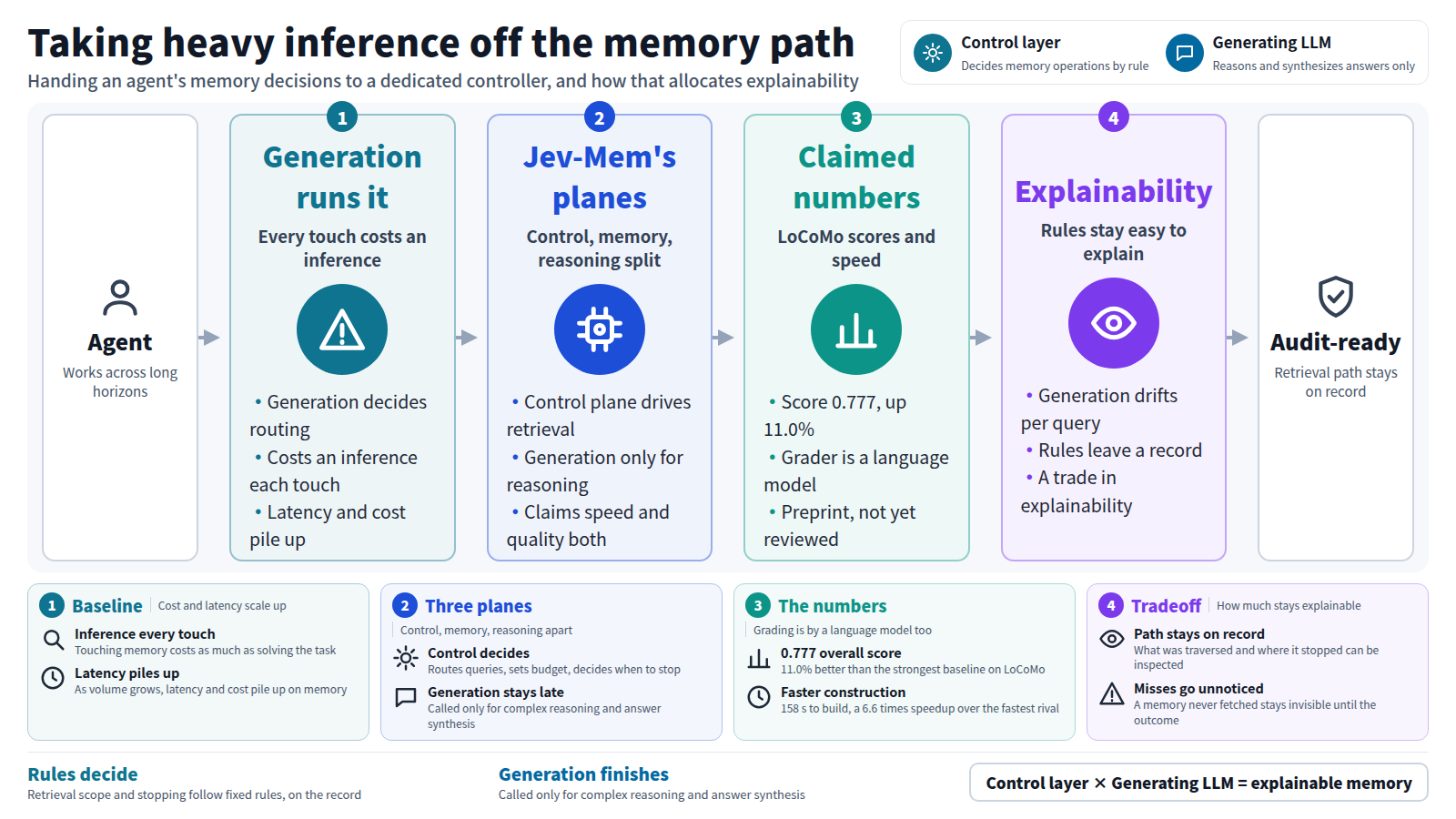
Every touch of memory runs an inference
An agent that works across long horizons needs memory: what to retain, what to link it to, what to surface when asked. Little of that is contested. The contested part is how the machinery is driven. Most current implementations hand the organising, the routing and the sizing of retrieval to a language model's generation.
The consequence is that touching memory costs an inference. Memory is supposed to be support work for the real task, yet the support work consumes the same compute as the task. As volume grows, latency and cost accumulate on the memory side. This paper puts a different control layer there[1]. The primary source for this article is an arXiv preprint that has not been peer reviewed.
Splitting fast and slow decisions inside memory itself
The core of the proposal is one move: let a light, dedicated control layer — not the generating language model — decide the memory operations. Borrowing the view that human cognition divides into a fast side and a deliberate side, the architecture separates into a control plane for the fast side, a structured multi-relational memory plane, and a reasoning plane for the deliberate side. The authors call the system Jev-Mem.
The fast control plane handles memory typing and relational organisation during construction, and then a chain of decisions during retrieval: where to route a query, how much retrieval budget to allocate, how far to traverse the graph, how to score candidates, when to stop. None of these calls go through generation.
The deliberate side — the generating model — is invoked only for complex reasoning and answer synthesis. Put plainly, the design lifts the heavy computation off the path that memory operations travel. Memory quality and system speed are usually treated as a trade; the authors claim both improve at once.
What the abstract claims
The abstract reports the following. On LoCoMo, a benchmark for long-horizon dialogue, the overall LLM-as-a-Judge score reaches 0.777, an 11.0% relative improvement over the strongest baseline. Memory construction time falls to 158 s, described as a 6.6 times speedup over the fastest competing memory system. Average query latency is given as 0.93 s, a 36.7% reduction[1].
One thing deserves care here: the grader is itself a language model. A statement that the score rose is a statement that another model judged it so — not that a human read the answers and found them right. Speed numbers settle when measured; quality numbers depend on the grader's properties. The abstract states no conditions for the grading. This is the authors' claim, not an established result.
What it looks like in operation
Taking memory control out of generation shows up operationally as this difference.
Generation drives memory
What to retrieve is reasoned out in prose each time. Behaviour is supple, but the same question can be handled differently twice. Latency and cost scale with the number of queries, and it is hard to explain afterwards where the budget went.
A dedicated controller drives memory
Retrieval scope and stopping conditions follow fixed rules. Behaviour is stiffer, but the same question takes the same path. What was traversed and where it stopped is on the record and can be inspected from outside.
The point is not speed. It is confining the places where judgement is allowed to vary. What is delegated to generation is hard to explain; what is delegated to rules is easy to explain. The question is not which is better but how much of the system stays explainable.
What is not new, and what cannot be read
Layering memory and separating cheap decisions from expensive ones is not a new idea; giving language models a memory hierarchy has been built on for a while[5], and the fast-versus-deliberate framing is an old borrowing from cognitive science. What this paper adds is applying that split to the control of memory itself, and taking generation off the critical path.
Much cannot be read from the abstract. How the control layer was built, what it was trained on, which set the rules were fitted to. What happens when the stopping condition misfires — that is, when a memory that mattered was never fetched. The abstract states no conditions for any of these, and says nothing about whether the speed gains hold as the volume of stored memory grows. Because this is a preprint, judgement belongs after the full text and review.
Votes and code stood up; press did not
The paper drew 27 upvotes and 2 comments, and the implementation has reached 100 stars[2][3]. Both the readers' vote and the implementers' vote are standing. Alongside it, in the same window, sits another paper on curating task-adaptive memory for agents[4]. The cluster size is 2.
No press coverage was found within the range of this collection, so there is no sign yet of the topic leaving the research community. Worth restating: votes and stars measure attention, not correctness or importance. Stars mean that many people wanted to run it, not that running it met expectations. Memory machinery is also the kind of component where differences show up readily on a benchmark and narrow in production.
Where this touches promotional material review
If a system that reviews promotional material is going to have memory, what it must retain is fairly clear. Package insert versions and the history of their revision; past findings and the basis for each; the boundary between wording that was cleared and wording that was not; the interpretations that have accumulated in review meetings. All of it builds up over long periods, and old entries keep acting on present decisions.
What connects this design to regulated work is not its speed but the fact that the retrieval path stays on the record. Which memories were consulted, how far the traversal went, why it stopped there. Written down as rules, that can be explained to an auditor. Delegated to generation, there is no guarantee the same question returns the same answer, and the explanation falls back on reconstructing events after the fact.
The converse holds too. Any design that stops by rule necessarily has memories it did not fetch. When a past finding that should have applied goes untraversed, the omission is invisible until the outcome arrives. Speed gains can be measured; the cost of an omission can only be measured afterwards. So the order of adoption is fixed: first enumerate the memories that must always be consulted, and place stopping rules only outside that list. Do not adopt it because it is fast; decide what has to stay explainable, then take the speed.