AI Highlights — the whole picture — 2026-10-06 (Tue) Evening News
Source links point to the original outlet. The AI Integrated Analysis is auto-generated from the headlines below only and is not intended to add facts beyond them. Not investment advice.
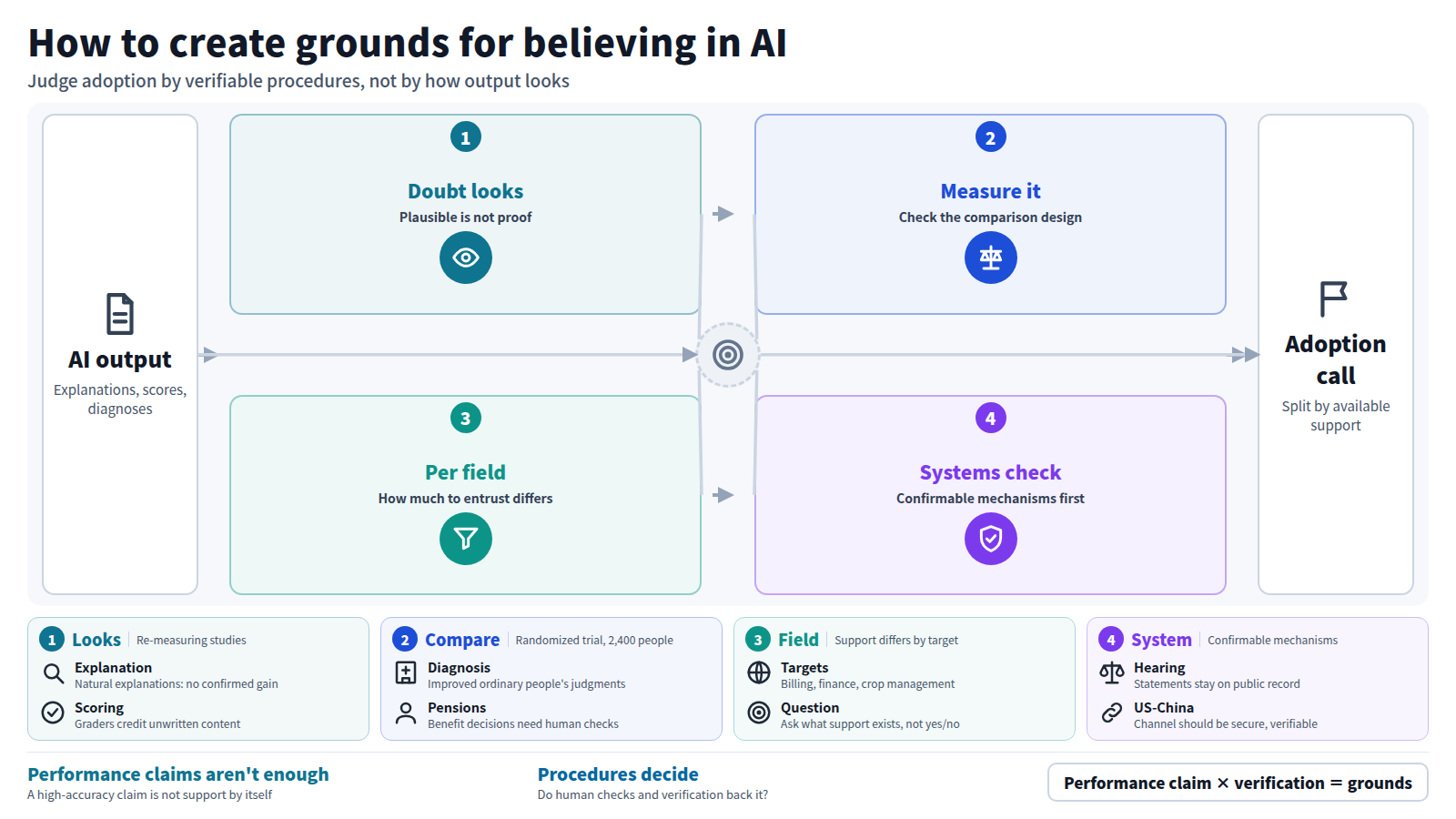
The explanations, scores, and diagnoses provided by AI appear plausible to the reader. However, its accuracy cannot be determined just by looking at it. The explanations provided by research agents about ``why this result should occur'' are usually not measured to see whether they improve predictions. One study reported that it could not confirm the contribution of natural explanations. On the other hand, a randomized trial of a respiratory diagnostic chatbot with 2,400 people showed that it improved the accuracy of judgments made by ordinary people. What we will look at in this half-day is the difference between claims that AI output is correct and results that are backed up by human confirmation and verification procedures. It is becoming clear that the decision to introduce AI is determined not by its performance itself, but by whether the support is available.
Research to re-measure the accuracy of explanations and scoring
When an AI research agent plans an experiment, it includes an explanation of why the result should be this way. Readers use these as clues to estimate the outcome, but whether the explanation improves the prediction is usually not measured. One preprint (on its own website) calls the amount that an explanation adds to a prediction the ``predictive contribution,'' and sets up a procedure to measure it by pairing predictions with only the explanation swapped. They reported that they could not confirm the contribution of natural explanations, as measured by toxicity tests and machine learning tasks. Whether an explanation can be read plausibly and whether it is useful for prediction are two different questions.
There is the same type of review on the scoring side. When performing LLM reinforcement learning on tasks where there is no single correct answer, it is becoming increasingly common to award partial points based on scoring criteria (rubrics) that list the requirements for the answer. Another preprint (on their own site) points out that the scorer may give points for information not included in the answer, calling this Vacuous Credit. As a countermeasure, we are proposing MetaRubric, which alternates between a learning process in which points are awarded only when there is evidence, and a process in which standards are revised while looking at the answers. A high score does not prove that the written content is good. This is because the habits of the grader directly determine the direction of learning.
The handling of success records is also being questioned. To help students learn difficult tasks, records of actual successful tasks are useful. However, if success relies on the assistance of a special harness, that assistance cannot be used in a real environment. The third preprint (own site) proposed Recursive Self-Rewrite (RSR), which extracts successes found under a variety of harnesses into a procedure manual, checks for leaks, and redoes them with a common harness. This is a procedure to rewrite the successful trajectory of terminal work into learning data with the same conditions as the actual one. A record of success can only be used if it is confirmed that it can be reproduced without assistance.
The same composition can be seen outside of research. ChinaTalk reports that a lack of funding and a state-led approach to AI security research in China are determining the future of the field. Also, according to OfficeChai, Microsoft AI CEO Suleiman expressed concern that Anthropic is teaching Claude to be conscious. Both cases overlap with the previous three in that they both call into question whether the foundation of the research and the basis for the claims are sufficient.
All three preprints question the procedures used to measure AI output, rather than the output itself. The decision to introduce the system is likely to be influenced not only by the performance numbers, but also by whether the verification procedures that support those numbers are clearly prepared.
Introduction that requires confirmation by a person on site
In the pension field, even if AI becomes widespread, "person verification" is considered essential for member procedures (Pensions Expert). This is because mistakes in decisions related to benefit amounts and qualifications have a direct impact on participants' lives, so the design of implementation will focus on where people will look, rather than the scope of automation.
Research on chatbots for respiratory diagnosis provides one clue as to whether there are situations in which it is possible to omit human confirmation. In a randomized trial of 2,400 people, the chatbot improved the accuracy of people's decisions (nature.com). What is important here is not that the correctness of the AI output itself was demonstrated by self-report, but that the comparison was made by randomly dividing people who use AI and those who do not. We use verifiable procedures to measure how well a person's judgment has improved. When readers are looking to assess the effectiveness of an AI tool, it makes sense to first look at whether it is designed to make such comparisons, rather than claiming that it is "highly accurate."
Practical implementation is spread between the two. Lottie acquires CareMaster to bring AI to care billing (konsulteer.com). In the pharmaceutical industry, there are reports of moves to accelerate the transition from evidence to action by introducing practical AI (Emerj Artificial Intelligence Research). How investment banks are using AI is also organized (Oracle NetSuite). In agriculture, micronutrients are being combined with AI and nanotechnology to transform the nutritional management of rice crops (AgroLatam). Billing, evidence, financial operations, and crop management are very different targets and the consequences of failure.
Therefore, even with the same concept of ``AI implementation,'' the answer to what extent it can be entrusted differs from field to field, and depends on what has been verified in that field. Some areas, such as pensions, rely on human verification, while others have shown effectiveness through randomized trials. We are now at the stage where we are no longer asking the question of whether or not it can be introduced across the board, but rather what kind of support it has in each field. The next question is who will continue to substantiate this and what procedures will be used.
Spread on work and learning and employee anxiety
An article (eFinancialCareers) about job openings at investment managers in Asia asks who will be most affected by AI. The same question exists in the United States. Wall Street financial institutions are beginning to address employee concerns around AI (Global Finance Magazine). AI not only comes in as a tool to support work, but it also brings with it the question of whose work will change and how. Those deciding to introduce the technology are asked not only about the accuracy of the technology used, but also about whether they have prepared explanations for the workers.
In the hiring scene, a lawsuit against Sirius XM was dismissed over allegations of racial discrimination caused by AI (HR Dive). This result alone does not mean that hiring using AI is safe. However, this case clearly shows that disputes can arise over decisions made using AI. In the same way as dealing with employee concerns, when it comes to recruiting, being able to explain the decision-making process will prepare the adopter.
Changes are also progressing on the learning side. Tanaka Study Group has launched a new brand of individualized instruction using AI teaching materials and has introduced it to 50 schools (Hiroshima Corporate Illustrated Guide). This is a move to extend instruction tailored to each student to many classrooms using AI teaching materials. In the field of viewing experiences, the AI museum DATALAND is holding immersive exhibits using Epson projectors (Digital Signage Today). The number of places where AI can be used is expanding, including workplaces, classrooms, and exhibition spaces, and the opportunities for people to interact with AI are increasing.
When these examples are lined up, it becomes clear that the introduction of AI is not determined by technology selection alone. To what extent can the person using the AI and the person receiving the judgment be able to confirm the judgment? In the next section, we will look at how systems and designs are beginning to put in place the means to confirm this.
Verification mechanism that supports trust and dialogue
Voices complaining about the dangers of AI are moving from the research field to the public arena. "We are building and nurturing our own enemies," one AI researcher warned at a hearing in New York, according to CNBC. A public hearing is a place where statements made remain as a public record and are used to consider policy. The warnings issued here are handled differently than internal discussions within individual companies or research laboratories. For those considering introduction, the deciding factor is not only the ability of AI, but also whether society has the means to control and inspect it.
AI is also a topic of discussion on the monetary policy side. The Darden Report reports that Fed Vice Chairman Jefferson spoke about AI, inflation, and confidence. A person in the position of vice chairperson deals with AI in discussions about prices and confidence. What can be gleaned from this article is that AI is no longer just a concern for the technology sector, but has begun to be treated as a subject that is related to the foundations of the system of trust in currency and prices. Confidence is established when the market and the public believe that there is a verifiable explanation. If AI were to enter into economic decisions, the system would also be asked whether it could be put in a state where its output could be checked.
This point becomes even clearer in dialogue between countries. bastillepost.com reports that experts believe that the channels for U.S.-China AI dialogue should be secure and verifiable. When two competing countries, the United States and China, engage in dialogue, they cannot simply accept what the other party has to say. As a result, there are calls for safety and verifiability in the route itself. This idea is not based on goodwill or promises, but rather on procedures that allow for mutual confirmation.
Warnings from researchers, statements from central bank executives, and recommendations from experts regarding U.S.-China dialogue all come from different places and positions. However, what they have in common is that trust is based on a mechanism that allows confirmation. Decisions on the introduction of this technology by companies and operations in educational settings are also based on this premise. The next question is who will design such a system and who will pay for it.
What these half-day talks had in common was that you can't decide whether an AI's output is trustworthy based on its appearance or self-report. Only after re-measuring could we find out whether the explanations were useful for making predictions or whether the scorers were giving points for information that was not written. In pension procedures, human verification was left in place, and in diagnostic support, randomized comparisons showed effectiveness. Hiring complaints, employee concerns, warnings at public hearings, and debates over prices and confidence also question whether there is a way to explain and check the decision-making process. When deciding to introduce a system, the deciding factor is not the claim of high accuracy, but whether the claim is supported by procedures that can be checked and verified by humans.
Q1: Of the output of the AI you are currently using, how do you check the accuracy of the parts that are left to humans without looking at them? Q2: Can you provide a procedure that can be reproduced and verified by a third party as a basis for saying that AI's explanations, scoring, and diagnosis are correct? Q3: When deciding to introduce AI, do you consider performance claims and the verification and human verification system to support them as separate criteria?
Finally, three questions
- Of the output of the AI you are currently using, how do you check the accuracy of the parts that are left unchecked by humans? Q2: Can you provide a procedure that can be reproduced and verified by a third party as a basis for saying that AI's explanations, scoring, and diagnosis are correct? Q3: When deciding to introduce AI, do you consider performance claims and the verification and human verification system to support them as separate criteria? - Can you provide a procedure that can be reproduced and verified by a third party as a basis for saying that AI's explanations, scoring, and diagnosis are correct? Q3: When deciding to introduce AI, do you consider performance claims and the verification and human verification system to support them as separate criteria? - When deciding to introduce AI, do you consider performance claims and the verification and human verification system to support them as separate criteria?
📚 Sources (all material)
Every item this issue drew on. External links open in a new tab. 19 items.
AI Industry
AI and the Economy
AI and Finance
Living and Working with AI
AI and Healthcare
AI, Welfare and Long-term Care
AI and International Politics
AI Around the World
AI & Education
AI, Philosophy & Thought
AI, Arts & Creativity
AI in Medicine (Cancer Care, Rare Diseases)
AI and Agriculture
AI Regulation, Safety and Geopolitics
AI and the Pharma Industry
- Accelerating Evidence to Action in Pharma with Practical AI Adoption — Emerj Artificial Intelligence Research
AI and Frontier Research (Papers)
- Do a Research Agent's Explanations Make Experimental Forecasts Better? ── A preprint that measures "predictive credit" by swapping only the explanation in paired forecasts, and reports that credit for natural explanations was not confirmed — 自サイト
- Keeping Graders That Reward Missing Content Out of Reinforcement Learning ── A preprint that identifies "vacuous credit" in rubric-based reinforcement learning and proposes MetaRubric, which alternates evidence-aware training with rubric revision — 自サイト
- Rewriting Assisted Successes into Training Data That Works Without the Assistance ── A preprint proposing Recursive Self-Rewrite, which turns successful terminal-task trajectories into runbooks, screens them for leakage, and re-executes them under a general harness — 自サイト