AI Highlights — the whole picture — 2026-10-07 (Wed) Morning News
Source links point to the original outlet. The AI Integrated Analysis is auto-generated from the headlines below only and is not intended to add facts beyond them. Not investment advice.
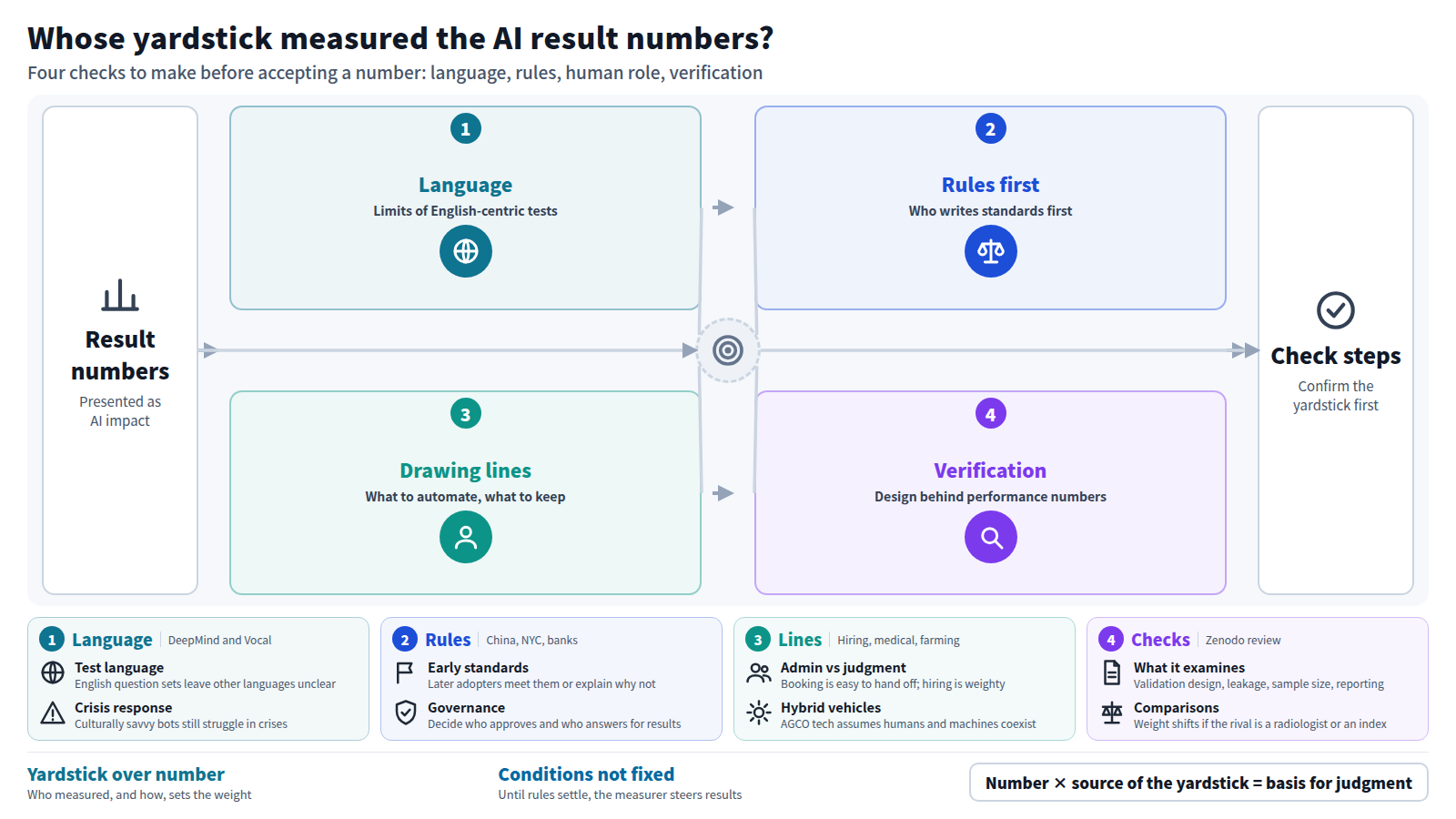
Numbers that convey the effectiveness of AI implementation are often disseminated without mentioning in which language, in which context, and under which rules they were measured. For example, even if a student gets a high score on a question set written in English, it does not necessarily mean that the same standard will be maintained in other languages. Some are beginning to document what they consider safe, such as China's national efforts and the New York City Council's efforts. As long as standards, procedures, and rules for each country are not finalized, the person holding the yardstick that produces the numbers will have more control over the distribution of results and responsibilities than the numbers themselves. In this article, we'll take a look at four things you should check before accepting numbers: language, rules, human involvement, and verification.
Review of measurement methods biased toward culture and language
DeepMind called for a review of AI evaluations that are biased towards English and called for consideration of cultural differences (Chosunbiz). If the assessment question sets and grading standards are written in English, high scores may only indicate performance in English-speaking countries. The score alone does not tell us whether the same standards will be maintained in other languages and cultures. An article (Vocal) about conversational bots for mental health points in the same direction. Even with bots designed to be culturally savvy, challenges remain when it comes to crisis response. Being easy to use in daily consultations and being able to move appropriately in serious situations are two different performances, and evaluation of the former does not guarantee the latter. Those considering the introduction of the system need to check in which language and culture, and in which situation, the scores proposed were measured.
It is not only in terms of language that the standards for what is considered an achievement are wavering. Regarding AI awareness, Anthropic and Microsoft each expressed their views (Yahoo Finance). Development companies do not agree on whether they are conscious or not, and how to handle them. An article about Anthropic's biological experiments (IBM) discusses what the experiments showed. What constitutes success or significance of an experiment can vary depending on the reader's perspective. The two cases mentioned here are both topics that require us to decide from which point of view we should evaluate them before coming to a conclusion.
These questions are not limited to discussions among experts, but are also reaching local decision-making forums. West Lafayette school board candidate spoke about AI and the budget during a student-sponsored panel (Purdue Exponent). How much a school spends on AI is inseparable from how it measures the effectiveness of its implementation. The numbers and expectations presented by candidates also have different weight depending on which criteria they are measured against.
English-based scores, crisis response performance, views on consciousness, significance of experiments, and school budgets. In either case, the conclusion changes depending on who uses which criteria. In the next section, we will turn our attention to the procedures and rules that define these standards.
Struggle for dominance in rule-making
The Diplomat (Asia-Pacific Current Affairs Magazine) reports that China is promoting AI governance and vying for leadership in creating global AI rules. In the United States, the New York City Council is poised to lead the nation in AI safety regulation, PYMNTS.com reported. One is a nation, and the other is a city council, and the scale is very different. However, both of them are the same in that they are taking the lead in documenting the standards for ``what is considered safe and what must be observed to be compliant.'' If the standards are made into a document first, companies and other local governments that introduce them later will be in a position to either meet those standards or explain why they do not. First, we would like to confirm which of these preceding standards were used to measure the numbers that readers see regarding the safety and effectiveness of AI.
Even outside of the rules, efforts are underway to improve operational standards. According to CIO Dive, banks are focusing on responsible operations and governance as the use of AI proliferates. The governance referred to here is not a mechanism for stopping usage. Decide in advance who will give approval, who will be responsible for the results, and how to explain when a problem arises. Banks that established their own operational standards before laws and regulations were finalized will be able to demonstrate their performance even if rules are established later. On the other hand, those who only proceeded with the introduction without establishing standards cannot demonstrate responsibility even if they provide figures for the results. When reading case studies, you should look not only at the magnitude of the results, but also at how the allocation of responsibilities was designed.
Discussions of rules and operations are inseparable from the underlying resources and prices. Reuters (market experts say high diesel oil prices and demand for semiconductors for AI are inflation factors) reported the views of market experts who point to high diesel oil prices and demand for semiconductors for AI as inflation factors. If the demand for AI affects prices through the supply and demand of semiconductors, the introduction of AI will not only improve the efficiency of one company, but will also affect other industries and households in the form of prices. Who bears the cost and how much is likely to be influenced by the judgment of those deciding the rules and operating standards. However, this view is just an expert's opinion, and the magnitude of the impact needs to be confirmed using other numbers.
If it is easier for those who create standards to allocate results and burdens, the next question to ask is how those standards are measured in the actual workplace and how they are incorporated into procedures.
Drawing the line between human involvement and office automation
The lines are being drawn in different ways in different areas such as recruitment, medical administration, corporate information infrastructure, and agricultural work, as to where to leave it to machines and where to leave people behind.
In recruitment, theaccountant-online.com has an article titled ``AI Recruitment: The Value of Human Involvement.'' This title indicates the position that, in the trend of using AI for selection, there is value in human involvement itself. Meanwhile, in the medical field, Pro Kpo AI has started a business with the goal of automating reservation management and reducing administrative costs, knoxnews.com reports. Coordinating reservations is often routine work, so it's easy to leave it to machines. The decision to hire is a highly responsible act of evaluating applicants. Even with the same "introduction of AI," the reasons for keeping people on will differ depending on whether clerical work is eliminated or judgment is replaced. For businesses, an event was held in Tallahassee covering AI and cloud adoption, WCTV reports. Each region has a place to start introducing the system, and it can be seen that each company is gathering information at these places to decide which tasks to be entrusted with.
When it comes to agriculture and creation, the lines that need to be drawn are even broader. AGCO showcased technologies for autonomous driving, AI, and hybrid vehicles at Tech Day 2026, precisionfarmingdealer.com reported. The term ``hybrid vehicle'' suggests the assumption that autonomous machines and human-operated machines will be co-located on the same site. This means that the technology is not intended for complete unmanned operation, but for operation in which humans and machines coexist. In terms of creation, freeyork features ``an AI artist's eerie works of Ruined Throne and Fallen Kingdom.'' When a product is placed alongside human expression, questions arise about whose work it should be treated as and to what extent it is considered expression. Again, lines are drawn separately for each industry.
The materials for this article are mainly the article titles and media names, and it is not possible to confirm the hiring evaluation method, Pro Kpo AI's reduction amount, and the details of AGCO's technology in this article. Therefore, it is necessary to read the figures presented by each company and media based on the premise of what is left to others and what is left to others. Lower costs due to office automation, human involvement valued in recruitment, the level of autonomy in agricultural machinery, and the handling of creative works cannot all be measured using the same yardstick. Those who decide where to draw the line will also decide how to distribute results and responsibilities. The question of who should draw the line and what procedures should be followed is also connected to the development of rules and standards in each country.
Quality of verification of images and cancer prognosis prediction
The use of AI in breast cancer image diagnosis has become a hot topic in the field. The second audio program on diagnosticimaging.com focused on the current status and challenges of using AI in breast imaging diagnosis. Regarding the lungs, there is a report in the Vitamin Jurnal ilmu Kesehatan Umum that examines how the support of artificial intelligence affects diagnosis and management policy decisions for indeterminate lung nodules found by CT. What we need to look at here is the stage in which the AI output enters the final decision. The meaning of the numbers changes depending on whether they measure not only the accuracy of diagnosis but also the policy of how to manage the nodules.
Zenodo's post-mortem transparency archive is a direct test of whether you can trust the performance numbers. This appendix is a systematic review that examined validation designs, data leaks, sample adequacy, and reporting of performance measures of studies using [18F]FDG PET/CT radiomics and AI models to predict pathological complete response after neoadjuvant chemotherapy for breast cancer. Even if the model performs well, if the training data and evaluation data are not separated, or if the number of cases is insufficient, the numbers will not reflect actual performance in the field. It is precisely this premise that the review examines.
The same pattern can be seen in other cancer types. Regarding prostate cancer, Research Square has a report comparing a transfer learning AI model that detects extraprostatic spread using bpMRI/mpMRI with a radiologist. For glioma, a prognostic prediction model that integrates clinical features, multiparametric MRI radiomics, deep learning features, and intratumoral heterogeneity has been published in Frontiers in oncology. A multimodal radiopathomics model for predicting metachronous liver metastasis after surgery for gastric cancer has been published in Nature communications. For hepatocellular carcinoma, a method to evaluate T cell inflammatory gene expression profiles using CT radiomics and see the relationship with the response to immunotherapy is published in Health care science, and for upper tract urothelial cancer, a new machine learning model that predicts recurrence based on nuclear features is published in Scientific Reports. The features used and the targets to be predicted differ from paper to paper.
When we line these up, we can see that comparing the AUC and sensitivity of each paper side-by-side has little meaning. This is because the weight of the same number changes depending on whether the person being compared is a radiologist or an existing clinical index, how the verification is designed, and whether there is a sufficient number of cases. When performance numbers are presented at the time of introduction or procurement, it is better to first check in which verification framework those numbers were obtained. The question of who decides the framework for verification leads to the core of the discussion so far: who holds the measuring stick for evaluation.
At first glance, the four aspects of bias toward language and culture, precedence in rule-making, the line between humans and machines, and the quality of verification appear to be separate issues. However, in each case, the scores and effectiveness numbers presented depend on who measures and under what conditions, and those conditions are not fixed. The scores obtained in English-based evaluations indicate performance in English-speaking countries, the standards that are put into writing first determine the position of those who come later, and the way in which people are retained determines where responsibility lies. The weight of the same number changes depending on whether the verification method is disclosed. Therefore, when looking at the introduction or result numbers, it is necessary to first check the source and conditions of the measuring stick, and then be willing to revise your judgment.
Q1: Can you explain to yourself the numbers of AI results you are seeing in which language, in which situation, and under what conditions they were measured? Q2: To what extent do you understand the disclosure status of the authors, scope of application, and verification methods regarding the evaluation and safety standards of the AI you are using? Q3: Is there a step in place before decision-making to check whose yardstick was used to measure the numbers that determine the success or failure of implementation?
Finally, three questions
- Can you explain to yourself the numbers of AI results you are seeing in which language, in which situation, and under what conditions they were measured? Q2: To what extent do you understand the disclosure status of the authors, scope of application, and verification methods regarding the evaluation and safety standards of the AI you are using? Q3: Is there a step in place before decision-making to check whose yardstick was used to measure the numbers that determine the success or failure of implementation? - To what extent do you understand the disclosure status of the authors, scope of application, and verification methods regarding the evaluation and safety standards of the AI you are using? Q3: Is there a step in place before decision-making to check whose yardstick was used to measure the numbers that determine the success or failure of implementation? - Is there a step in place before decision-making to check whose yardstick is used to determine the success or failure of an implementation?
📚 Sources (all material)
Every item this issue drew on. External links open in a new tab. 22 items.
AI Industry
AI and the Economy
AI and Finance
Living and Working with AI
AI and Healthcare
AI, Welfare and Long-term Care
AI and International Politics
AI Around the World
AI & Education
AI, Philosophy & Thought
AI, Arts & Creativity
AI in Medicine (Cancer Care, Rare Diseases)
AI and Agriculture
AI Regulation, Safety and Geopolitics
AI and Cancer Research
- Impact of Artificial Intelligence Assistance on Clinicians’ Diagnostic and Management Decisions for Indeterminate Pulmonary Nodules on CT — Vitamin Jurnal ilmu Kesehatan Umum
- Transparency archive for: Validation design, data leakage and performance reporting in [18F]FDG PET/CT radiomics and artificial intelligence models for predicting pathological complete response in breast cancer: a systematic review — Zenodo (CERN European Organization for Nuclear Research)
- Detection of extraprostatic extension of prostate cancer by transfer learning AI models versus radiologists on biparametric and multiparametric MRI — Research Square
- An integrated prognostic model incorporating clinical characteristics, multiparametric MRI radiomics, deep learning features, and intratumoral heterogeneity for glioma patients. — Frontiers in oncology
- Multimodal radiopathomics model predicts postoperative metachronous liver metastasis in gastric cancer. — Nature communications
- A Computed Tomography Radiomics Approach for Assessing the T Cell-Inflamed Gene Expression Profile in Hepatocellular Carcinoma and Its Association With Immunotherapy Response. — Health care science
- A novel machine-learning model using nuclear features to predict upper tract urothelial carcinoma recurrence — Scientific Reports