AI Highlights — the whole picture — 2026-10-07 (Wed) Evening News
Source links point to the original outlet. The AI Integrated Analysis is auto-generated from the headlines below only and is not intended to add facts beyond them. Not investment advice.
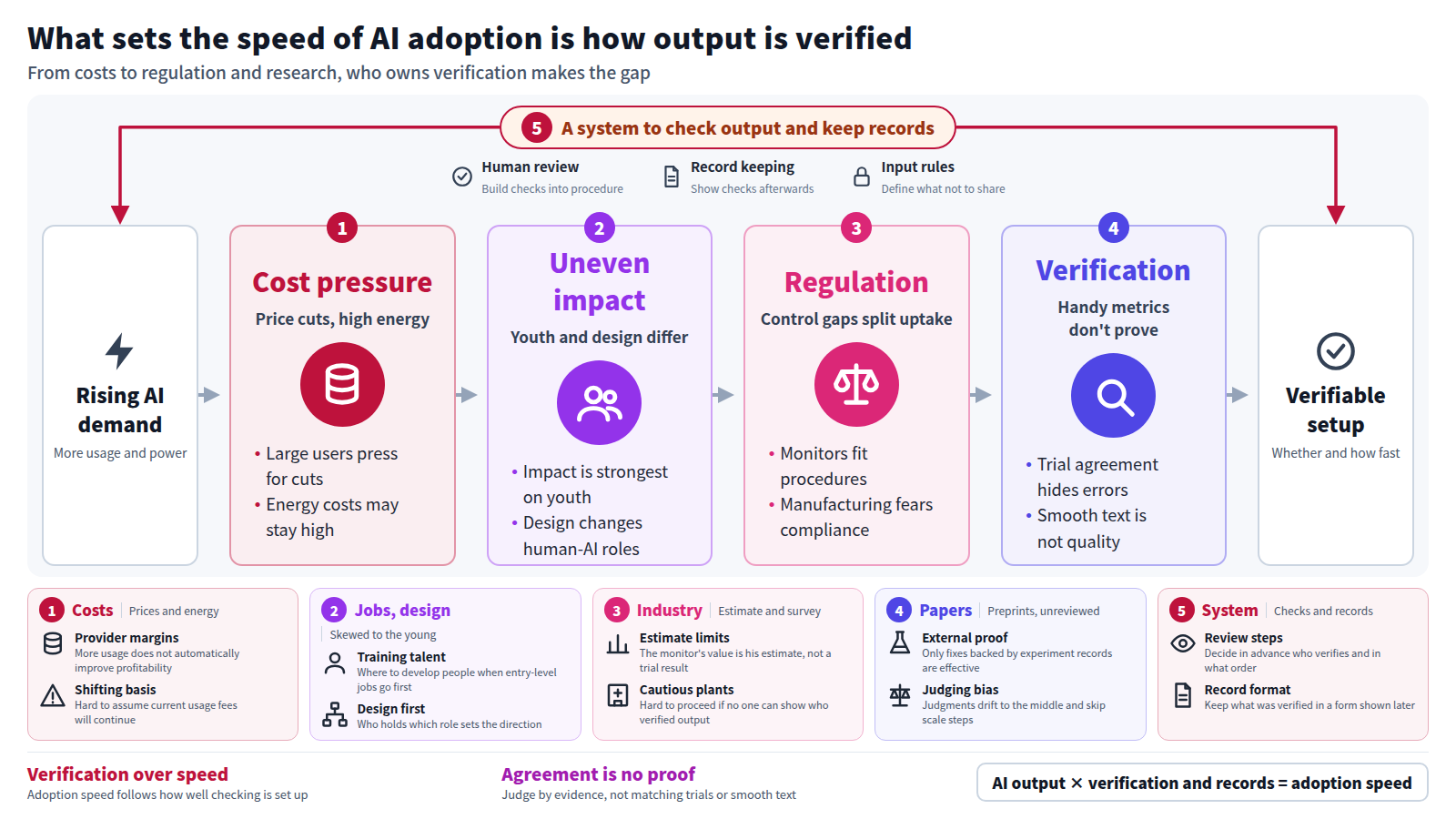
The price and demand for AI is beginning to show up in the real economy as tariffs and electricity costs. At the same time, what determines the speed of introduction is less about high performance and more about who checks the output and how the records are kept. While large users are pressing for price reductions and there is talk of prolonged high energy costs, concerns about compliance with regulations are delaying the introduction of the system in the pharmaceutical field. On the research side, there have been reports that repeatedly giving the same answer is not proof of correctness. What becomes clear through this topic is not so much what AI can do, but who will have the system to check what it has done. Please read this half-day article from that perspective.
Weight of demand reflected by price pressure and high energy prices
OpenAI and Anthropic are under pressure from large users to lower prices (Bloomberg.com). AI providers are in a position where they can demand lower unit prices from customers with greater demand. Even if usage increases, the provider's profitability does not necessarily improve automatically. On the other hand, as demand increases, the burden also extends to energy. The president of the Federal Reserve Bank of San Francisco has pointed out that the demand for AI could prolong energy prices (Axios). There is talk of both downward pressure on prices and the possibility of rising resource costs. It has become difficult for those considering the introduction to assume that the current usage fees will continue into the future.
Amid these fluctuations in costs, some companies are showing results. JPMorgan ranks first in the Evident AI Bank Index for the fifth year in a row (Yahoo Finance). The index compares banks' AI efforts. The fact that it has remained in the top spot for five years in a row shows that the use of AI is not a one-time trial, but is evaluated as the result of continuous investment and operation. It is easy to read this and think, ``Introducing AI will produce results.'' What this index shows is that cumulative efforts can make a difference. Under pressure to lower prices and high energy prices, the difference is whether you have a system that allows you to continue using your products.
Markets and resources are not the only factors that determine the speed of development. An editorial in the South China Morning Post argues that the very question of whether China will respond to a slowdown in AI development is beside the point. In a situation where the United States and China compete with each other in development, it is difficult to make a forecast that assumes one side will slow down. As long as development competition continues, it is natural to assume that the demand for computing resources and electricity will continue. If that happens, the twin pressures of falling prices and rising energy costs will not disappear in the short term.
The four ingredients listed above demonstrate that the greater the demand for AI, the greater the costs will be in terms of price, energy, and competition. Once profitability and resource constraints become clear, the next question becomes who will check the output obtained at all costs and how.
Impact on employment of young people and organizational design
An analysis of U.S. payroll data shows that the impact of AI is strongest on youth employment, France 24 reported. The article's headline suggests that the impact is not felt evenly across all generations, but rather unevenly across age groups. If we talk about the introduction of AI in terms of one question: ``Will the number of employees decrease or not?'' this bias will disappear. If jobs that have been previously held by people with less experience are replaced first, companies will have to decide not only on short-term efficiency, but also where to develop human resources. Here, rather than the details of the numbers, the fact that the areas affected are divided by age becomes a deciding factor in hiring and placement.
On the other hand, there is also a movement toward incorporating AI into designs from the organization side. Orgvue, which analyzes organizational design, has started offering a WebMCP interface that allows users to utilize AI agents for organizational design (HRTech Series). Whether AI replaces or replaces jobs is determined not only by the results once it is put into the field. The direction is already determined at the design stage, including who will have what role and where AI will be placed. The same view is echoed in an article by an Atlanta-based expert discussing how AI can help older adults. The headline reads, ``Design is the key,'' and the position is that whether AI is useful depends less on its performance and more on how it is tailored to the person using it (The Atlanta Journal-Constitution). Employment of young people, organizational design, and use of older people seem to be separate topics. Still, they are connected in that design changes the way humans interact with AI.
As with design, there are lines that need to be determined when it comes to usage. ESET warns that there is information that AI chatbots should not share (ESET). The more organizations use AI agents for organizational design and the more individuals use them for daily consultations, the wider the scope of information input will become. Rules regarding what can be included are items that should be prepared in advance, along with the speed of introduction.
What all four materials have in common is that the effectiveness and dangers of AI vary greatly depending on how they are designed. Whether the design is good or not comes down to who and how to check that the output is correct. In the next section, we will look at the mechanism for checking this.
Industrial sites where regulations and quality control determine the speed of introduction
Tufts University's Ken Getz estimates that AI clinical monitors could add $21 million in value per drug program (BigGo Finance). The calculation is that automating clinical trial monitoring will reduce the time and cost required for human verification. However, this is his estimate and is not confirmed by actual clinical trials. Meanwhile, on the manufacturing side, research shows that compliance concerns are hindering the adoption of AI in pharmaceutical manufacturing (BioSpace). Even in the same pharmaceutical field, the pace of implementation differs between processes where the estimated value is large and processes where concerns about regulatory compliance are a priority.
It would be appropriate to read this difference not as a difference in AI performance, but as a difference in the degree of control. Clinical monitors are easy to incorporate into procedures for human review and record keeping of output. In manufacturing, process changes and records are subject to regulations, so unless it can be shown who verified the output of AI and how, it will be difficult to proceed on-site. If the figure of $21 million is to be used as a judgment, it is necessary to also check whether the assumption includes a verification system.
Diagnosis, education, agriculture, and new company movements can all be placed in the same vein. There are signs of hope for AI in hemophilia diagnosis and care (Hemophilia News Today), but the headline suggests it is still in the "hope" stage. A report (Bioengineer.org) that trained an apple detection AI using synthetic images and reduced the difference with real images shows that, with some ingenuity on the part of the data creator, accuracy can be improved even if fewer real images are used for verification. However, what has narrowed is the difference with the live-action film, not that the difference has disappeared. Mujo Learning Systems has launched AI literacy materials for healthcare (The Des Moines Register). This is a movement to sell the product as a product that allows the user to have the ability to interpret the output. Flagship Pioneering has established iris labs, which aims to improve human health with AI (PR Newswire). The establishment is a statement of expectations, and the proof of results is yet to come.
In all cases, expectations come first, followed by verification. What readers should look at is the distance between expectations and verification for each project. If the introduction of this technology is to proceed in fields where procedures, education, and data generation methods are in place to shorten this distance, the next question is how to design such verification mechanisms at research sites.
Research question of whether verification itself can catch up
Who will check the results of LLM agents who have been entrusted with long-term work? The preprint VeriHarness (own site) asks whether it is possible to improve the power of verification without changing the underlying model, using correct answer examples, or scoring criteria. The clue is the difference between trials when the same task is solved over and over again. The authors reported that discrepancies between trials can reveal correct alternative explanations, while agreement can hide errors. Therefore, we are proposing a harness for verifying the parts where the answer is not clear, using the evidence, and daringly doubting the parts where the answers are consistent. Even if many trials return the same answer, this does not prove that it is correct.
The same problem arises in a different form in the essay text. The preprint on SciSlopHarness (own site) deals with "scientific slop." It refers to a situation in which each part can be read as it is, but the scientific reasoning that connects the parts is broken, and it is impossible to tell them apart by the arrangement of words. The authors present a benchmark to measure this and a framework for reducing it. The conclusion is that simply improving the writing will not reduce the problem; only corrections backed by experimental records will be effective. Readability does not work as an indicator of quality. The person verifying must have external evidence in the form of records.
So, should we leave the decision-making to AI? A preprint (on our own website) that measures bias in the use of ordinal scales also challenges that assumption. Direct judgment models that receive text and quickly return labels and scores are beginning to be used as tools for classification and automatic evaluation. However, it has been reported that judgments tend toward the middle option, and the more detailed the scale, the lower the proportion of stages used. He says there is a difference between having a high accuracy rate and faithfully using the scale given by the user. It has been shown that bias can be changed through additional learning, but on the other hand, it also means that evaluation habits can be changed through training.
The situation is similar on the safety side. Scientific American reported that even the best methods for AI safety testing may be underpowered. Regarding awareness, ZDNET reports that experts are concerned that there are points that the developer side is overlooking. Although the fields are different, the common theme is that the measuring tools have not kept up with the targets.
All three preprints have not yet been peer-reviewed, and the conclusions require further verification. However, the directions shown are the same. Familiar indicators such as agreement, smoothness of sentences, and accuracy rate of judgments do not guarantee the correctness of the output. What those deciding whether to introduce should look at the model is designed to judge what evidence is used rather than the score. This question goes beyond the laboratory and leads to the next question, which is how the verification system is perceived by the field and regulations.
Drawing the line that remains in the field of creation
Musical instrument manufacturer Fender has revamped its official website. Music Ally reports that the new site includes AI tools and artist-related content. Fender, known for its guitars and amplifiers, will now have AI tools and artist introductions in the same place. What I want to see here is not so much the increased functionality, but the fact that the two are placed side by side on the same site. (Music Ally)
These three things are the only reliable materials. Fender has revamped their site. Added AI tools. Added artist-related content. You can't tell from the headlines how the individual tools work or how artist content will be treated. Therefore, it is not possible to make a judgment at this point about whether AI will take over production tasks or help with practice and learning. All the reader can see is the design fact that the AI and human expressions are presented on the same screen.
Still, this cohabitation has meaning. In the creative field, it can be difficult for users to see what AI is generating and where it begins as a human performance or work. When placing AI tools and artist-related content on the same site, the operator must indicate the relationship between the two in the way they are guided and displayed. In other words, the line is determined not only by the technical specifications but also by the visible structure of the site. Those considering the introduction of AI tools need to check not only the performance of the AI tool, but also how it is differentiated from the artist's content and how it is explained.
As we have seen in the previous sections, the speed at which AI is introduced varies depending on who checks the output and how. The same is true for creative writing, and the question is not whether AI can be used, but rather how to draw the line between what should be considered AI work and what should be considered human work. The next deciding factor is whether the line can be presented in a form that the user can verify.
Although the events covered in each section belong to different areas, they are connected at the same point. Costs are less predictable, younger people are disproportionately affected, a highly regulated process slows implementation, and studies say even trial agreements mask mistakes. In either case, rather than the output of AI itself, the procedure for verifying it and the design that leaves a record of the verification determine whether or not it can be introduced, and the speed at which it can be introduced. Even in the creative field, the question of how to arrange AI and human expression in the same space is being considered. The focus of judgment has shifted from comparing AI performance to looking at who is in charge of the systems that support verification and to what extent they are in place. It is thought that the future introduction of this system will make a difference depending on how this system is put in place.
Q1: Who verifies the results produced by AI in your work, what steps do you take, and do you leave the verification in a format that can be shown later? Q2: Apart from matching multiple trials, what kind of evidence do you use to confirm the output? Q3: How far do you think you can continue investing in AI, given that usage fees and energy costs will change, and verification will also be expensive?
Finally, three questions
- Who verifies the results produced by AI in your business, what steps did they take, and do you record the verification in a way that can be shown later? Q2: Apart from matching multiple trials, what kind of evidence do you use to confirm the output? Q3: How far do you think you can continue investing in AI, given that usage fees and energy costs will change, and verification will also be expensive? - Apart from matching multiple trials, what kind of evidence do you use to confirm the output? Q3: How far do you think you can continue investing in AI, given that usage fees and energy costs will change, and verification will also be expensive? - How far do you think you can continue to invest in AI, given that usage fees and energy costs will change and verification will be expensive?
📚 Sources (all material)
Every item this issue drew on. External links open in a new tab. 20 items.
AI and the Economy
AI and Finance
Living and Working with AI
AI and Healthcare
AI, Welfare and Long-term Care
AI and International Politics
AI Around the World
AI, Philosophy & Thought
AI, Arts & Creativity
AI in Medicine (Cancer Care, Rare Diseases)
AI and Agriculture
AI Regulation, Safety and Geopolitics
AI and the Pharma Industry
AI and Frontier Research (Papers)
- How Should the Same Model Verify What a Long-Horizon Agent Produced? ── A preprint proposing VeriHarness, a verification harness that settles disagreements with evidence and deliberately challenges consensus — 自サイト
- Where Does the Science Break in an AI-Written Paper? ── A preprint that measures "scientific slop", papers whose parts read well but whose reasoning does not connect, and proposes SciSlopHarness, which revises only what the experiment records support — 自サイト
- More Answer Options Do Not Make an AI Judge More Discriminating ── A preprint that measures how direct-decision models fail to use the full ordinal scale they are given, and shows the bias can be moved by targeted post-training — 自サイト