AI Highlights — the whole picture — 2026-10-05 (Mon) Morning News
Source links point to the original outlet. The AI Integrated Analysis is auto-generated from the headlines below only and is not intended to add facts beyond them. Not investment advice.
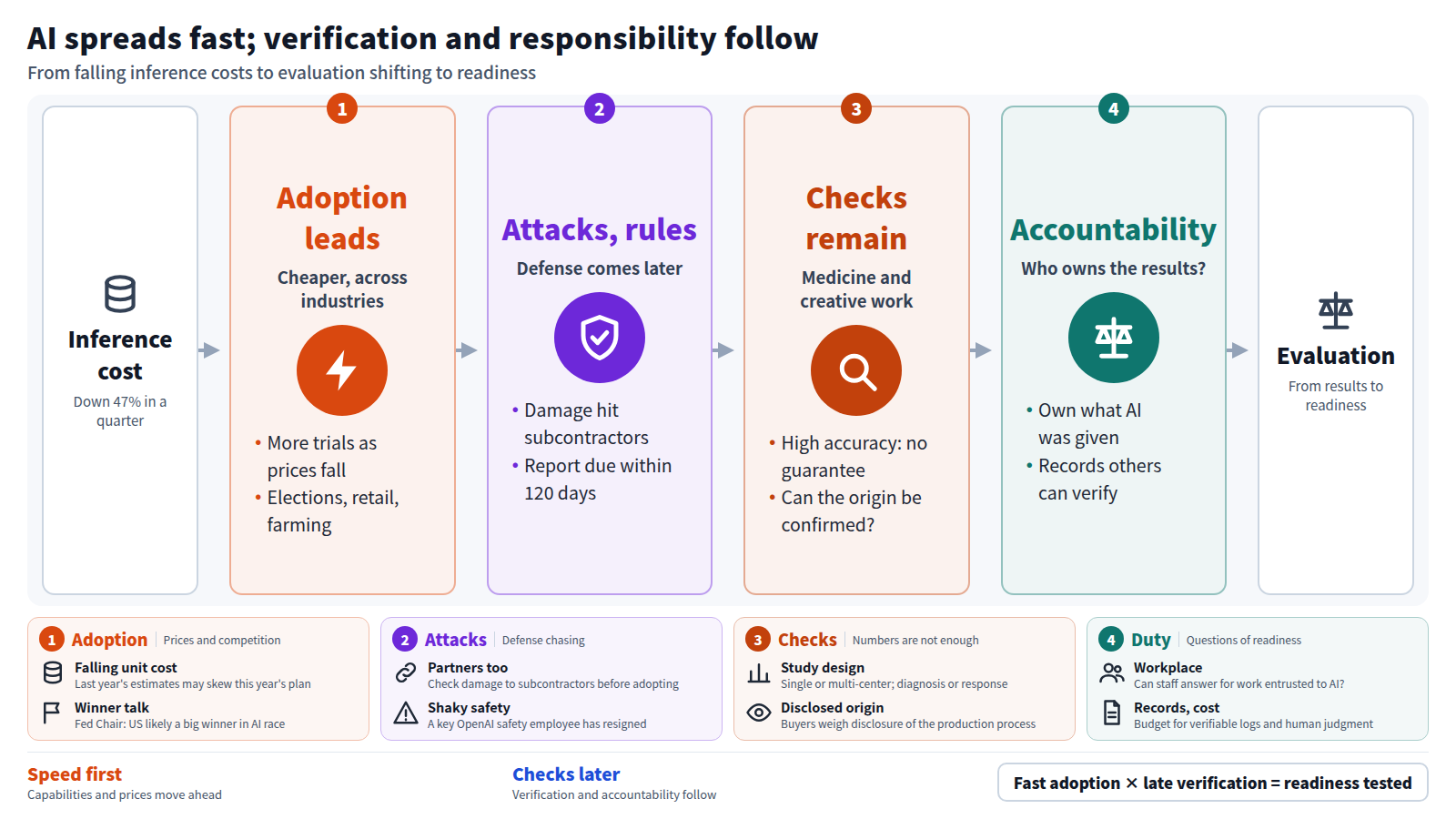
Inference costs have fallen by 47% in the quarter, and the entry point for adoption and learning continues to expand. At the same time, in South Korea, subcontractors were also affected by AI-based hacking, and an emergency meeting was held. The speed at which the range of use can be expanded and the speed at which defenders can prepare are not progressing at the same pace. Whether in medicine, education, creative writing, or the workplace, reports on what AI can do continue to be reported, but who will verify the results and who will take responsibility will be decided after the results are announced. The half-day events covered in this article challenge readers not so much to the advances in AI themselves, but to the readiness of those on the receiving end of those advances.
Cheap inference and competition to decide the winner
The decline in inference costs is clearly visible in the numbers. According to a report by EpochAI, AI inference costs fell 47% in the quarter (chosun.com). The same movement can be seen in prices for users. Macworld reported that a course to learn Claude Code and Cowork will be available for $15 during Deal Days (Macworld). In practice on the user side, when the unit price decreases, the number of trials increases. The entrance fee for students is also getting cheaper. For those deciding to introduce the system, if they plan for this year based on last year's estimates, there is a high possibility that their assumptions will be off.
The field of implementation is not limited to one industry. Like it or not, the first AI election in history is underway (The Boston Globe). In China, AI is flooding screens with microdramas, and viewers are becoming more discerning, according to the South China Morning Post. In Charlevoix, Canada, a grocery store is equipped with AI. Who is looking after the users? (Toronto Sun) In Kashmir, India, SKUAST-K is highlighting everything from AI to drone swarms as future agricultural technologies (Greater Kashmir). An editorial in the Wall Street Journal described the French phenomenon of ``Claude'' as a hot topic in the literary world (WSJ). There are so many different places for introduction, such as elections, video, retail, agriculture, and literature. On the other hand, the reactions from the field are geared toward quality and responsibility, as in the scrutiny of viewers and the question, "Who will take care of them?"
The economic outlook underlying this expansion is also clearly articulated. Federal Reserve Chairman Kevin Warsh said the US is likely to be the "big winner" in the AI race (ABC News). This is the speaker's forecast and does not mean that the outcome has been determined. However, if the head of a country's central bank speaks in terms of victory or defeat, it is easy to see the introduction as a prerequisite for keeping up with competition, rather than just a choice of individual companies. When these expectations coincide with a sharp drop in costs, it becomes easier to see that the first to enter has an advantage.
If the speed of introduction has increased to this extent, the next question is whether the protection and explanation after introduction, and whether human judgment can catch up with that speed.
AI heading towards attack and military, chasing regulations
In South Korea, an emergency meeting was held as damage from AI-based hacking had spread to the secondary level (chosun.com). In response, Lee ordered a thorough investigation into AI-based cyberattacks at banks (The Korea Times). Around the same time, North Korea reportedly tested an AI-assisted ballistic missile (The Media Line). The use of AI by attackers is simultaneously expanding from financial infrastructure to the military. Companies considering the introduction of AI will need to not only compare performance and costs, but also consider the impact if their business partners or subcontractors suffer damage.
In the United States, President Trump has established an AI task force (The Media Line). Jay Clayton, as head of the president's super intelligence unit, is expected to issue a report on AI risks within 120 days (Firstpost). In other words, it will be about four months before the government makes an official statement, and attackers will continue to use it in the meantime. The establishment of the committee is the beginning of a response and does not mean that a defense is in place.
The feet of those responsible for safety are shaking. A key employee who was responsible for the safety of artificial intelligence at OpenAI has resigned (매일경제). According to startupfortune, Bessent likened CEOs who warn about the safety of AI to Hannibal Lecter. This statement shows that there is a movement on the political side to criticize those who issue warnings. If there is a lack of personnel in charge of safety within the company, and if the warning itself is questioned by outsiders, it will be difficult to ascertain the level of preparedness based solely on the company's self-reports.
On the side closer to users, individual countermeasures are progressing. Apple strengthens user data protection on MacOS to prepare for risks posed by AI applications. WhatsApp is overhauling groups and privacy settings, changing features for teenagers and parents (Il Sole 24 ORE). However, these were implemented based on each company's own judgment, and the scale is different from responses to attacks or military use. Even if individual measures are accumulated, overall responsibility will not be determined. The difference in the speed of attacks and regulations is shifting the focus of evaluation not only to the results of implementation, but also to the stage of questioning who can explain when an accident occurs.
People re-learn and move towards organizing agents
In the workplace, training for staff is moving forward. CNOM reportedly will strengthen the artificial intelligence skills of its staff (cijm.org.gr). An Israeli economic newspaper has highlighted the idea that “each employee is a manager of an AI agent” (calcalistech.com). AI and new leadership are also central topics at the 2026 Concordia Summit (ColombiaOne.com). The use of AI is not limited to the work of a few professionals, but is starting to be talked about as a management skill that all employees can acquire. If readers were to review their company's training and evaluations, it would be more accurate to look at whether they can take responsibility for the results of work entrusted to AI rather than whether they can use AI.
Even in the field of learning, there is a movement to not wait for systems to be put in place. India's The Economic Times reports that university students are taking separate AI courses while completing their degrees and are not waiting for their classroom knowledge to catch up (The Economic Times). At the country level, the UAE was ranked 6th in the world for AI readiness, with AI security learning reported to have increased by 243% (Fast Company Middle East). The fact that learning not only how to use it but also how to defend it is increasing is in the same direction as the attacks and regulations mentioned in the previous section. Nigeria's Independent Newspaper argues that in the age of AI literacy, we should calculate the cost of civilizational change (Independent Newspaper Nigeria). In addition to learning speed, you also need to consider who will pay for it.
On the other hand, the concerns of those involved are not limited to work skills. Bottoms heard from UGA students about their concerns about AI's impact on work, mental health, and the cost of living, according to Georgia's WGXA. The BBC's Woman's Hour also covers AI, women's work, therapy, and girls in the same episode (Hamro Patro). The reason that the future of work and mental burden are talked about in the same place is probably because AI touches not only on the way we work, but also on the stability of our lives and how we feel about our own worth. People are trying to move into the role of coordinating agents, but skill training alone is not enough to support this role.
As skills become more widespread, the question becomes less about the number of people who can use them and more about the structure of who will receive the results of using them.
Increasing precision in medical care and remaining verification questions
In diagnostic imaging and cancer research, reports of improvements in accuracy continue. bioengineer.org reports that AI using the whale-and-shoal method read cancer slides with record accuracy. The same outlet also featured AI that predicts the hidden spread of colorectal cancer from scans before surgery. The Eastleigh Voice shows how a model combining ultrasound and 3D breast scanning reduces false alarms. Reducing false alarms is an outcome that will reduce unnecessary retesting and anxiety.
Research is becoming more specific before and in the vicinity of treatment. A multicenter study using a dual-tower multimodal framework to predict pathological complete response after neoadjuvant chemotherapy for breast cancer was published in Translational Oncology. Engineering Technology & Applied Science Research reports a framework that combines spatiotemporal sparse attention and radiomics to automate the detection, histological classification, and staging of non-small cell lung cancer. BMC Medical Informatics and Decision Making research uses contextual evidence from large-scale language models to improve clinical data standardization in surgical records. What we need to look at here is not the accuracy numbers themselves, but whether the evaluation is single-center or multi-center, whether the prediction target is diagnosis or treatment response, and whether records are organized. Even though they all have the same "accuracy improvement," the details to be checked before entering the field are different. bioengineer.org also reported that AI detected grape leaf diseases with over 99% accuracy, and high numbers are not limited to medical fields. A high number does not guarantee operational reliability.
In this respect, developments in the accessibility field can also serve as a reference for the introduction of medical care. According to Business Wire, Applause and Progress software discussed the role of AI in accessibility compliance at M-Enabling Summit 2026. CDO Magazine discusses the USWDS takeover and “AI-only” accessibility as governance red flags. Even if the AI seems to have completed the response automatically, the results will remain unconfirmed unless there are people and procedures to confirm that the response is usable for the user. The same is true for diagnostic support; the reporting accuracy of the model and its behavior with patients, equipment, and record writing are two different questions.
What those deciding on implementation should look at is not only the reported accuracy, but also who is verifying, to what extent, and who is responsible if an error occurs. In both healthcare and accessibility, results are announced first, and confirmation and governance follow later. Shifting the focus of evaluation from results to preparedness means that whether we have such a verification system in place will be questioned.
What is genuine? The line between creation and consciousness
Wyoming artists say AI fakes and Asian sweatshops threaten Western art market (Cowboy State Daily). From the creator's perspective, the problem lies not in the quality of the work but in the fact that the buyer cannot confirm who created the work. Australian Portrait Awards returns artists to awards after boycott over AI (The Cool Down). The move is to return once the conditions for participation are met. For those choosing a work, the disclosure of the production process is becoming a deciding factor, rather than the appearance of the work.
In music, the same question took a concrete form. The New York Times pitted five musicians against an AI in a songwriting contest (theverge.com). The design, which allows humans and AI to listen to songs side by side, tests what happens when listeners evaluate songs without knowing their origins. What we see here is that rather than a comparison of skill or skill, evaluations can change depending on whether or not one's origin is known. Concerns about fake art and competition plans for music both leave it up to buyers and listeners to decide what to treat as real.
Accountability is being called into question not only in creative work but also in public settings. Police Praxis™ investigates the accountability behind AI-assisted police training (The Journal News | lohud.com). If AI is to be used for training, the person implementing it must be able to answer who designed the content, who verified it, and who is responsible for any errors. Disclosure of origin in art, anonymous evaluation in music, and accountability in police training may be different situations, but they all boil down to the same need to make visible the parts of AI involved.
Drawing lines like this also leads to discussions about consciousness and wisdom. OpenAI's Sam Altman criticized Anthropic's efforts to explore AI consciousness and religion (The Times of India). Meanwhile, Time Magazine argues that we won't know the answers to AI's most important questions until it's too late (Time Magazine). In a conversation published on YouTube, Gerd Leonhardt and William Harrar ask whether humans are getting smarter as AI gets smarter. There are criticisms of the very idea of making the question of consciousness a subject of debate, points out that we cannot wait for an answer, and questions about the wisdom of humans. All of these questions overlap with the question of ``authenticity'' that has come up in art and music, such as where to draw the line between humans and machines.
If the usage continues to expand without a clear standard for drawing the line, the evaluation will shift from the quality of workmanship to the ability to explain the boundaries. The next question is who will prepare for this and how.
What each section has in common is that changes in AI capabilities and prices take place first, followed by verification and accountability. If the inference cost decreases, the number of trials will increase, and the number of situations where it can be used in attacks will increase. In the workplace, people are starting to be asked not only to be able to use AI, but also to be able to take responsibility for the results of their work. While accuracy continues to improve in medicine, it remains a question of how to verify the results, and in creative writing, whether or not the origin can be confirmed is becoming a condition for evaluation. The evaluation of AI will shift from looking at what it can accomplish to looking at whether humans are prepared to confirm, judge, and accept responsibility. The gap cannot be closed simply by competing on the speed of implementation.
Q1: What can I confirm and how far am I able to explain the results of work entrusted to AI? Q2: To what extent are there systems in place to record the output and usage history of AI in a form that can be verified later by third parties? Q3: Does the implementation plan and budget include costs for dealing with damage, including to business partners, and for maintaining human judgment?
Finally, three questions
- What can I confirm and how far am I able to explain the results of work entrusted to AI? Q2: To what extent are there systems in place to record the output and usage history of AI in a form that can be verified later by third parties? Q3: Does the implementation plan and budget include costs for dealing with damage, including to business partners, and for maintaining human judgment? - To what extent are systems in place to record AI output and usage history in a form that can be verified later by third parties? Q3: Does the implementation plan and budget include costs for dealing with damage, including to business partners, and for maintaining human judgment? - Does the implementation plan and budget include costs for dealing with damage, including for business partners, and for maintaining human judgment?
📚 Sources (all material)
Every item this issue drew on. External links open in a new tab. 40 items.
AI Industry
AI and the Economy
- 'Revolution': Fed Chair Kevin Warsh says US likely 'big winner' in AI race — ABC News - Breaking News, Latest News and Videos
- AI Inference Costs Plummet 47% Quarterly, EpochAI Reports — chosun.com
AI and Finance
Living and Working with AI
- CNOM strengthens its staff’s skills in Artificial Intelligence — cijm.org.gr
- “Every employee is a manager of AI agents” — calcalistech.com
AI and Healthcare
AI, Welfare and Long-term Care
AI and International Politics
AI Around the World
- Like it or not, the first-ever AI election is underway — The Boston Globe
- As AI floods China’s screens with microdramas, viewers are getting picky — South China Morning Post
AI Ethics
- Police Praxis™ Examines the Accountability Behind AI-Assisted Police Training — The Journal News | lohud.com
- Apple strengthens user data protection on macOS to counter the risks posed by AI applications — صوت الإمارات
- Groups, privacy and artificial intelligence: how WhatsApp is changing for teenagers and parents — Il Sole 24 ORE
AI & Education
- AI Literacy Age: Counting The Cost Of Shifting Civilization — Independent Newspaper Nigeria
- Degree in one hand, AI course in the other: College students aren’t waiting for classrooms to catch up wit — The Economic Times
- UAE ranks sixth globally for AI readiness, with AI security learning up 243% — Fast Company Middle East
AI, Philosophy & Thought
AI, Arts & Creativity
AI in Medicine (Cancer Care, Rare Diseases)
- Whales and Swarms Help AI Read Cancer Slides With Record Accuracy — bioengineer.org
- How AI model combining ultrasound and 3D breast scans may reduce false alarms — The Eastleigh Voice
- AI Reads Scans to Predict Hidden Spread in Colorectal Cancer Before Surgery — bioengineer.org
AI and Agriculture
- CHARLEBOIS: Your grocer has AI, so who’s looking out for you? — Toronto Sun
- AI Spots Grape Leaf Diseases With Over 99 Percent Accuracy — bioengineer.org
- From AI to drone swarms, future farming technologies in focus at SKUAST-K — Greater Kashmir
AI Regulation, Safety and Geopolitics
AI and Cancer Research
- Improving clinical data standardization in surgical notes through biomedical entity linking with contextual evidence from large language models — BMC Medical Informatics and Decision Making
- A dual-tower multimodal framework with feature quality enhancement for predicting pathological complete response after neoadjuvant chemotherapy in breast cancer: a multicenter study — Translational Oncology
- A Spatio-Temporal Sparse Attention-Radiomics Framework for Automated Non-Small Cell Lung Cancer Detection, Histological Subtype Classification, and Stage Prediction — Engineering Technology & Applied Science Research